
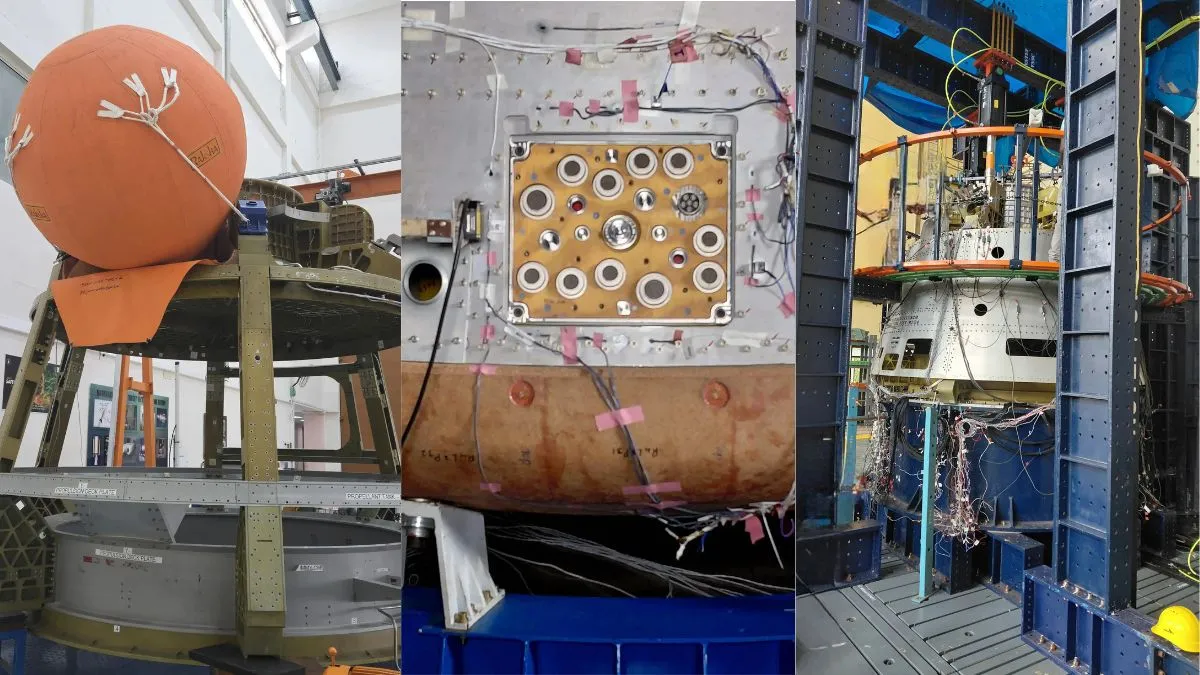
The Indian Space Research Organisation (ISRO) has successfully carried out three important qualification tests for the Gaganyaan mission, marking another step towards India's first human spaceflight programme. The tests focused on critical crew module systems designed to improve astronaut safety during different stages of the mission.
ISRO announced on Sunday that the latest trials assessed the crew module's ability to remain safe after landing in the sea, the separation of key mechanisms during re-entry, and the structural strength of the module during parachute deployment.
ISRO advances crew recovery safety
One of the main tests evaluated the crew module uprighting system, which ensures that the capsule returns to an upright position after splashing down in the ocean. This is considered a vital safety feature for astronauts after landing.
To achieve this, ISRO developed a stored cold gas-based uprighting system. During the qualification test, engineers used a complete system-level setup containing all components of the Crew Module Uprighting System (CMUS). The test successfully demonstrated the inflation of the flotation system by releasing stored gas from a high-pressure bottle through control valves.
Umbilical separation mechanism clears qualification
Another major test examined the crew module's umbilical separation mechanism, which connects the crew module with the service module that supplies power and propulsion during the mission.
The mechanism includes two sections. The first, known as CSU-1, is located on the crew module side, while CSU-2 is positioned on the service module side. During the return journey to Earth, the service module separates from the crew module after CSU-1 disconnects. Shortly before atmospheric re-entry, CSU-2 also separates.
According to ISRO, the separation test of CSU-2 was carried out using a simulated crew module. The trial confirmed that the mechanism separated cleanly while also proving the structural stability of the crew module panel and its connecting interfaces.
Apex cover test boosts mission readiness
The third qualification test focused on the crew module's structural performance during the separation of the apex cover. This protective cover shields the parachutes and related systems throughout the mission and is released just before the parachutes deploy to slow the crew module during its descent.
ISRO said the successful completion of all three tests validates the reliability of these critical systems and represents another milestone in preparations for the Gaganyaan mission.
ALSO READ: ISRO to include civilian astronauts in future Gaganyaan Missions, STEM experts likely to join
