
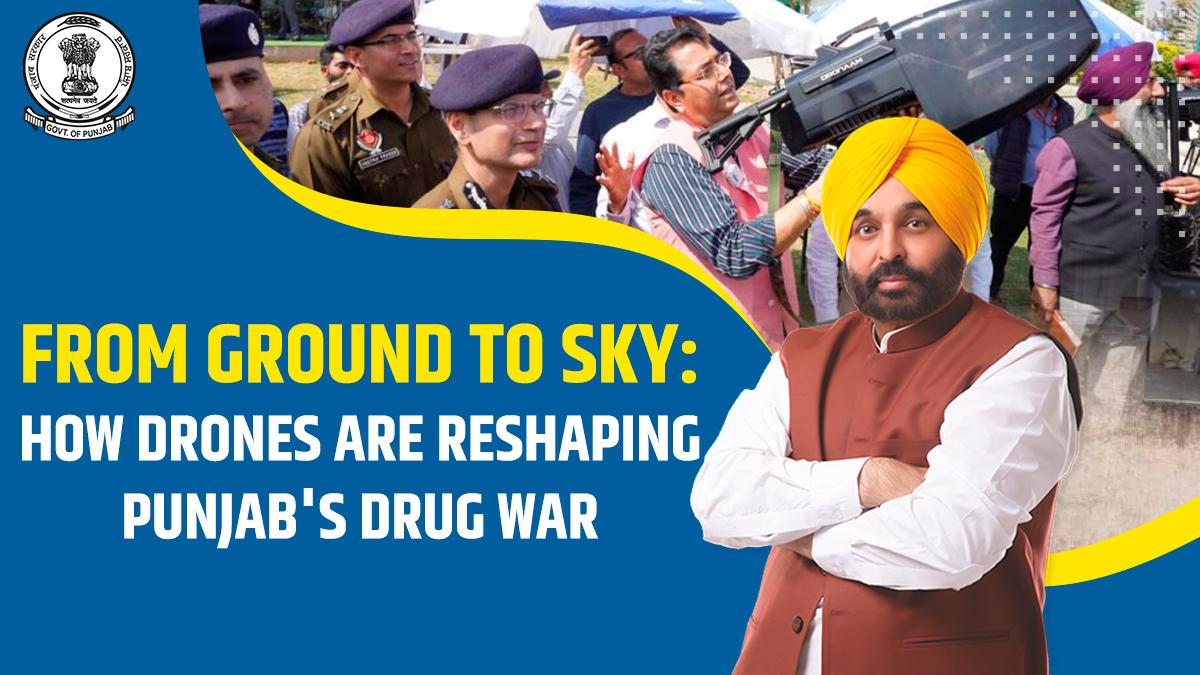
The war on drugs has moved from the ground to the sky. Punjab’s war on drugs has evolved as it faces a new wave of smuggling through drones across the international border. With the rising use of unmanned airborne vehicles for the transport of drugs, guns, and ammunition into the state, anti-drone systems have become an essential component in safeguarding the airspace of Punjab.
Most importantly, such drones fly low, evade radar signals, and sometimes fly at night. Traditional border fencing and patrols simply weren’t designed for threats that come from above.
Border states are facing a new kind of security challenge
Regions with international borders, especially Punjab, have become frontline laboratories for drone-based crime. Officials have repeatedly pointed out that drones are no longer being used sporadically; they are part of organised, repeat supply chains.
Punjab Chief Minister Bhagwant Mann has described drone incursions as one of the most serious internal security threats the state has faced in recent years, particularly due to their role in drug and arms smuggling.
What makes this challenge sharper is that drone operations often originate outside India’s jurisdiction, limiting conventional enforcement responses.
Anti-drone systems close a dangerous blind spot
Anti-drone technology fills a gap that border forces and state police previously had no way to address. Modern systems combine:
• Detection (radar, radio-frequency sensors, acoustic tracking)
• Identification (distinguishing hostile drones from civilian or authorised ones)
• Neutralisation (jamming signals, forcing landings, or disabling drones mid-air)
Punjab’s deployment of the Baaj Akh system reflects this shift, from reactive seizures to real-time interception. The objective is no longer just recovery of contraband, but prevention of entry altogether.
Smugglers are tech-savvy and adapting fast
Criminal networks are using GPS-programmed routes, encrypted signals, and inexpensive commercial drones modified to carry heavier payloads. These are not one-off experiments; they are scalable operations.
Security experts warn that without counter-drone systems, states risk becoming predictable targets. Once smugglers know an area lacks aerial defence, drone traffic inevitably increases. Anti-drone tech, therefore, works as much as a deterrent as it does a defensive tool.
It’s not just about drugs anymore
While narcotics remain the primary concern, drones have also been used globally to transport weapons, ammunition and surveillance equipment. This escalates from public health concerns to an issue of national security.
It has been made abundantly clear by officials that unauthorised drone activity could be used for nefarious purposes by terror groups and organised crime rings, making early detection an absolute necessity.
Technology that enables and supports
When it comes to this particular case, the government does make efforts, along with other countries, to identify the importance of making use of anti-drone technology as part of a broader strategy. In the case of the state of Punjab, it has been seen that the use of the anti-drone strategy takes place together with other rehabilitation initiatives as well as community-run anti-drug campaigns, since, through demand management alone, it has been understood that it would be impossible to repair the damage caused to society. Chief Minister Bhagwant Mann, together with AAP leader Arvind Kejriwal, has termed it “a robust reaction" against smugglers who are making use of technology in an inappropriate manner. CM Mann said, "Armed forces and the BSF have been using such systems. Punjab is the first state in the country to deploy anti-drone technology at the international border. It will give a strong response to drug smugglers from across the border."
Anti-drone technology has therefore gained importance as the threat dynamics have shifted faster than the existing policing strategy. Borders are no longer just land lines, they are airspaces that must be defended with precision, speed and intelligence.
