
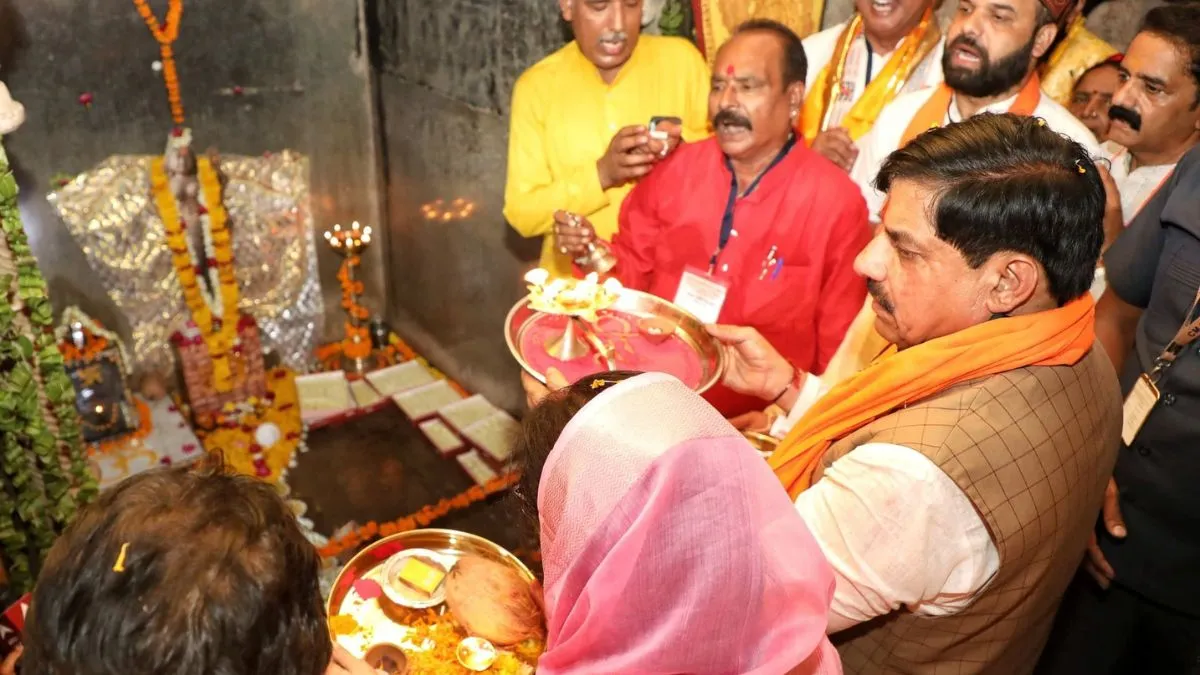
In a moment charged with history and faith, Madhya Pradesh Chief Minister Mohan Yadav visited the revered Bhojshala on Monday, becoming the first Chief Minister in more than seven centuries to offer prayers at the site following its judicial recognition as a temple.
The visit came days after the Indore Bench of the Madhya Pradesh High Court ruled in favour of Hindu petitioners in the decades-old Bhojshala dispute, declaring the historic complex in Dhar district a temple. The verdict was delivered by Justice Vijay Kumar Shukla and Justice Alok Awasthi after extensive hearings on multiple petitions and a writ appeal concerning the Bhojshala–Kamal Maula Mosque complex.
Amid chants of devotion and traditional rituals, CM Yadav offered prayers and recited Saraswati Vandana inside the historic shrine, revered by devotees as the abode of Maa Vagdevi. The atmosphere turned celebratory as members of the Sakal Hindu Samaj offered a grand Chhappan Bhog to the deity — a ritual being performed at the site after an interval of 721 years, according to devotees present at the ceremony.
CM Yadav was also presented with a symbolic emblem of Maa Vagdevi by community representatives.
Dhar to be developed as major tourism hub
Talking exclusively to India TV during his visit, CM Yadav hailed the court verdict recognising Bhojshala as a temple. He said Dhar would be developed as a major tourism hub of Madhya Pradesh, which will also generate employment for the locals. He said efforts will be made to bring back the statue of Maa Vagdevi from the London museum.
Court order after evidence and ASI findings
The long-running dispute over the monument saw Hindu, Muslim and Jain groups approach the court, each claiming exclusive rights to worship at the site. The matter involved extensive hearings, with judges reviewing historical documents, legal records and thousands of pages of evidence connected to the complex.
A key focus during the proceedings was the scientific survey conducted by the Archaeological Survey of India (ASI). The agency submitted a report of more than 2,000 pages, detailing its findings on the structure and its history.
According to the ASI report, a large structure dating back to the Parmar period existed at the location before the construction of the mosque. The survey also stated that several sections of the present building appeared to have been constructed using materials taken from an earlier temple.
ALSO READ: Ayodhya precedent, 2000 page-ASI report: Key takeaways from Madhya Pradesh HC's Bhojshala verdict
