
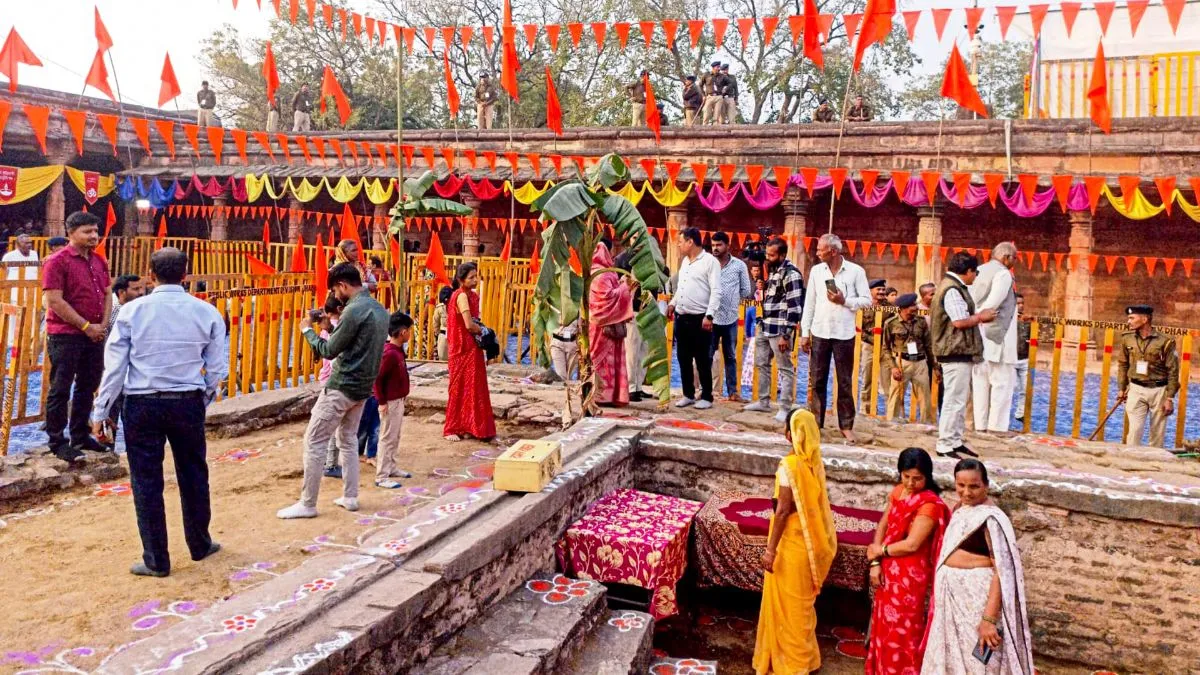
The Indore bench of the Madhya Pradesh High Court on Friday ruled in favour of the Hindu petitioners in the long-running Bhojshala dispute, declaring the site a temple. The judgment was delivered by Justice Vijay Kumar Shukla and Justice Alok Awasthi after weeks of hearings on five petitions and one writ appeal connected to the Bhojshala-Kamal Maula Mosque complex in Dhar district.
The bench had reserved its verdict on May 12 after hearing arguments from all sides.
The case involved competing claims from Hindu, Muslim and Jain groups, each seeking exclusive rights to worship at the disputed monument. During the proceedings, the court examined historical records, legal provisions and thousands of pages of documents linked to the site.
A major part of the case centred on the Archaeological Survey of India’s scientific survey of the complex. In its report, which runs over 2,000 pages, the ASI stated that a large structure from the Parmar era existed at the site before the mosque and that several parts of the present structure were built using materials from an earlier temple.
Key remarks by the court
- The Bench set aside the 2003 order of the Archaeological Survey of India that had earlier allowed Muslims to offer prayers at the Bhojshala premises.
- The Court observed that the religious identity of the disputed structure aligns with that of a temple.
- Based on archaeological material and historical records, the Bench noted signs suggesting the existence of a Sanskrit learning centre and a temple dedicated to Goddess Saraswati at Bhojshala.
- The judgment clarified that members of the Muslim community would be free to approach the State government for allotment of an alternative site for the construction of a mosque.
- The Court stated that its findings were derived from archaeological evidence, historical references, and legal principles emerging from the Ayodhya dispute verdict delivered by the Supreme Court.
- The Union Government and the Archaeological Survey of India were instructed to take appropriate steps regarding the future administration and management of the temple premises.
ALSO READ: Bhojshala declared a temple as MP High Court rules in favour of Hindu side, accepts ASI findings
