
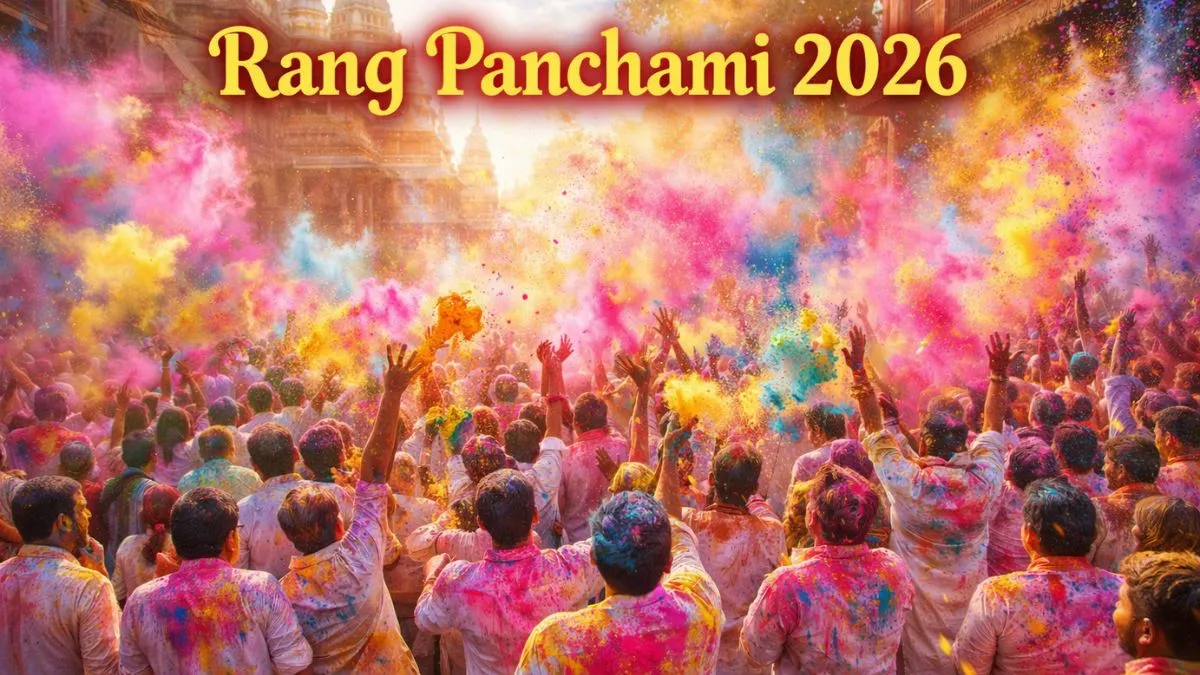
The holy festival of Rang Panchami is celebrated five days after Holi. Every year, Rang Panchami is celebrated on the fifth day of the Krishna Paksha (dark fortnight) of the Chaitra month. According to legend, this festival began in the Dwapar era. Lord Krishna played Holi with Radha Rani, and seeing this, other Gopis also began celebrating Holi with Radha and Krishna.
Seeing Radha and Krishna playing Holi, even the gods and goddesses could not resist and, in the guise of Gopis and cowherds, also joined in playing Holi with Radha and Krishna. Hence, the celebration of Rang Panchami is also called the Holi of the Gods and Goddesses. Now, let us find out the date of the celebration of this festival in 2026 and the significance of the celebration of the festival.
Rang Panchami 2026: Date and Time
As per the Hindu calendar, the Panchami Tithi of the Krishna Paksha of the month of Chaitra begins from 7:20 pm on the 7th of March and ends at 9:14 pm on the 8th of March. Hence, the celebration of the Rang Panchami will take place on the 8th of March, as per the Hindu calendar’s Udayatithi. This year, the celebration of Rang Panchami will take place in conjunction with Dhruva Yoga and Swati Nakshatra.
Why Rang Panchami is celebrated five days after Holi
Rang Panchami is celebrated on the Panchami Tithi, i.e., on the fifth day of the Krishna Paksha in the month of Chaitra, according to the Hindu calendar. Whereas Holi commemorates the triumph of good over evil, along with the advent of spring, Rang Panchami symbolises the injection of happiness, positivity, and colours into our daily lives.
As per the traditional belief, playing with colours on this day is considered auspicious, which helps purify the surroundings. The colors, or gulal, symbolize the removal of negativities, resulting in a festive mood with happiness and harmony.
Rang Panchami is also believed to be the final day of the extended Holi celebrations, which commenced with Holika Dahan, thus ending the festive mood on a happy note.
Rang Panchami traditions and celebrations
The celebrations of Rang Panchami are somewhat similar to Holi, but in a more social way.
Playing with colours
People gather at various places, such as streets, temples, etc., to play with colours. Music, dance, and processions are also seen in some places.
Temple rituals
This day is also celebrated by visiting temples, offering prayers, and performing special rituals. Coloured colours are also offered to the gods at some places.
Community gatherings
Rang Panchami often becomes an occasion for neighbourhood gatherings, cultural programmes and festive meals, strengthening social bonds within communities.
(Disclaimer: The information given here is based on religious beliefs and folk beliefs. There is no scientific evidence for it. India TV does not certify the truth of any of these things.
Also read: Bhalachandra Sankashti Chaturthi 2026: Vrat katha and why devotees worship Lord Ganesha
