
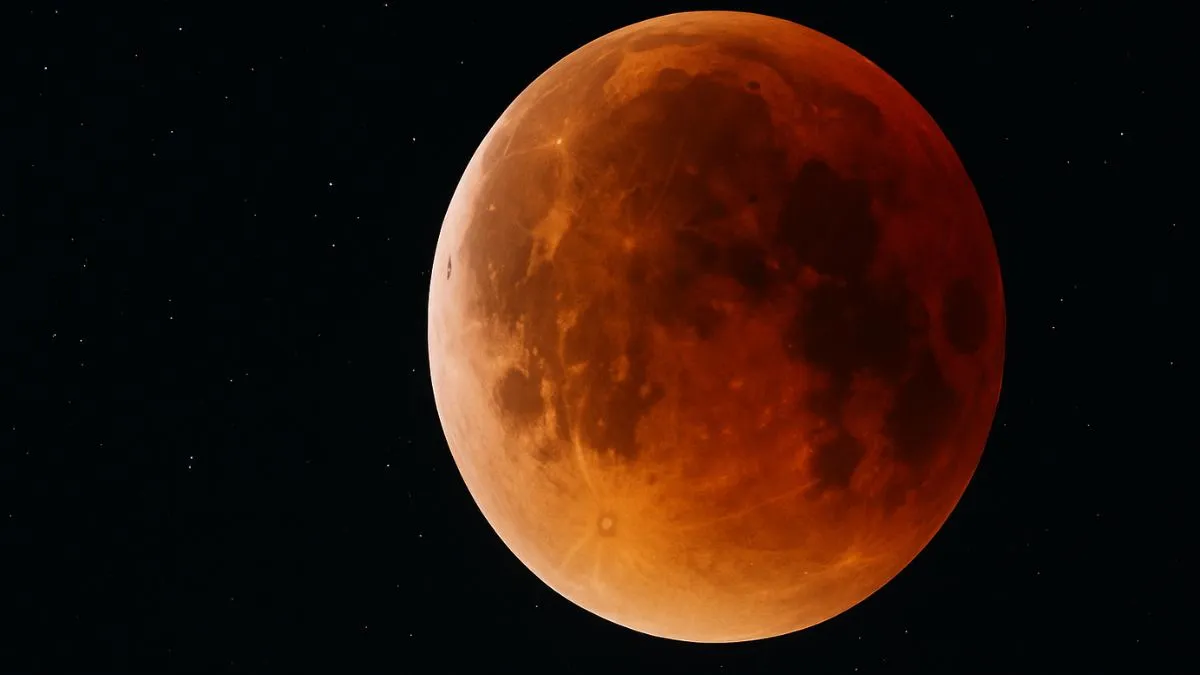
The longest total lunar eclipse since 2022 will be visible across India on the night of September 7–8, 2025. Astronomers say this will also be the first time since July 27, 2018, that the entire eclipse can be seen from every corner of the country.
If you miss this one, you’ll have to wait until December 31, 2028, for the next opportunity.
Also Read: Chandra Grahan on September 7, 2025 LIVE: Eclipse to begin tonight; Sutak already in effect
What time is the lunar eclipse today in India?
According to the Astronomical Society of India:
- Penumbral eclipse begins – 8:58 PM, September 7
- Partial eclipse begins – 9:57 PM
- Total eclipse begins – 11:01 PM
- Maximum eclipse – around 11:42 PM
- Total eclipse ends – 12:23 AM, September 8
- Partial eclipse ends – 1:26 AM
- Penumbral eclipse ends – 2:25 AM
That means the total eclipse phase will last 82 minutes, making it one of the longest in recent years.
Also Read: Grahanam timings today: Full Chandra Grahan 2025 schedule for Hyderabad
Can you see the lunar eclipse without equipment?
Unlike a solar eclipse, you don’t need special glasses or gear. The lunar eclipse is safe to watch with the naked eye, binoculars, or a telescope.
The penumbral phase, when the Moon enters Earth’s faint outer shadow, is hard to notice without binoculars. But the partial and total phases are easily visible.
Why does the moon turn red?
When the Moon is fully inside Earth’s shadow (umbra), it glows a coppery red — often called a Blood Moon.
This happens because Earth’s atmosphere bends sunlight, filtering out blue light and letting red tones pass through to illuminate the Moon. The exact shade depends on the levels of dust, smoke, and pollution in the atmosphere that night.
How people observe the eclipse in India
In many Indian households, people follow traditional rules during the eclipse, such as avoiding cooking or eating during the Sutak period, which starts nine hours before the eclipse.
At the same time, astronomy clubs and institutions across the country are organising public viewing events and live streams, making this a night of both spiritual significance and scientific wonder.
Takeaway: Whether you step outside to watch the coppery Moon or join a live stream, the September 7–8, 2025 lunar eclipse promises to be a spectacular celestial event for everyone in India.
