
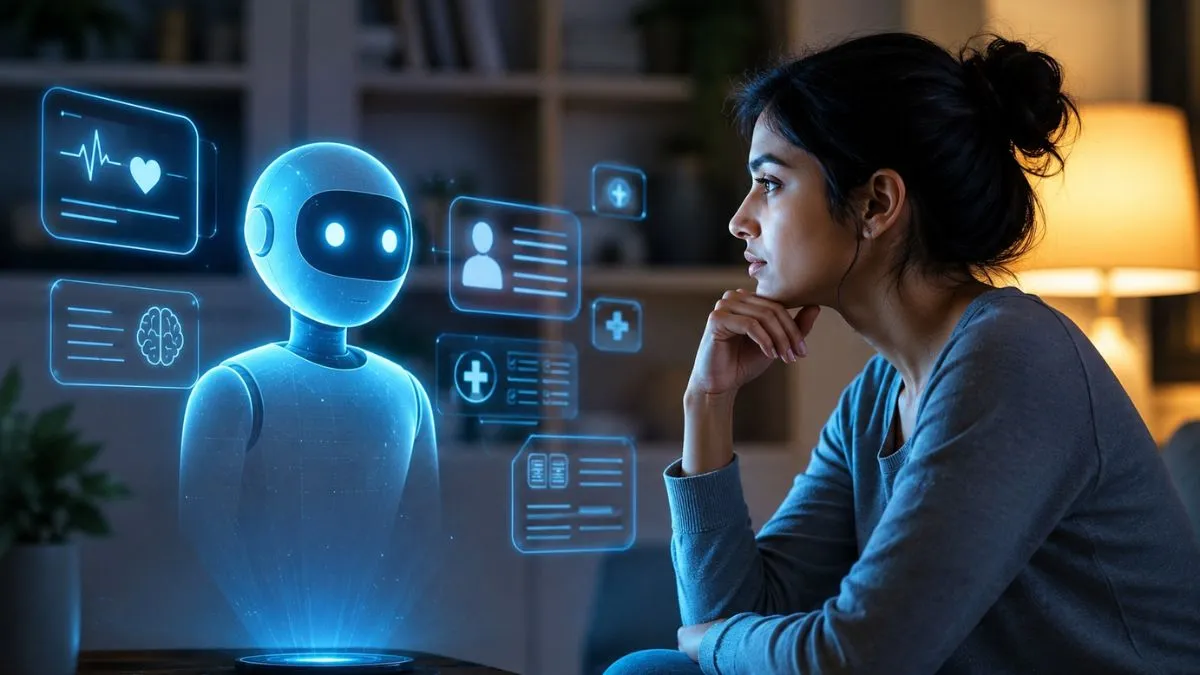
AI chatbots are becoming the new late-night Google search. People are typing in symptoms, uploading reports, and asking serious health questions hoping for quick clarity. And while the technology can sound confident and convincing, doctors say there’s an important difference between information and actual medical care.
That distinction matters more than most people realise.
Why AI can sometimes create more anxiety than answers
“If someone asks me whether they should trust a chatbot for health advice, my honest answer for most people is a big no,” says Dr Akshat Chadha, Lifestyle Medicine specialist. The problem is not that AI always gives wrong information. The problem is that it gives too many possibilities without understanding the person behind the symptoms.
“A headache could be just a headache, or it could be a blood pressure problem, or in rare cases something far more serious,” Dr Chadha explains. A chatbot may list every possible condition, including severe illnesses, without context or clinical judgment.
That can quickly spiral into unnecessary panic. “When a patient reads ‘brain tumour’ or ‘lung cancer’ as a possible explanation for their symptoms, it creates anxiety that did not need to exist,” he adds.
What doctors do differently
A real consultation is not just about symptoms.
Doctors look at:
- Medical history
- Lifestyle factors
- Existing conditions
- Physical examination
- Patterns over time
Instead of offering a menu of possibilities, clinicians work towards a diagnosis based on evidence and context. That human interpretation is still difficult for AI to replicate fully.
Where AI is genuinely helping healthcare
Interestingly, experts are not against AI itself. In fact, many doctors are already using it behind the scenes. “Where I see real value is when AI sits in the hands of a trained clinician,” says Dr Chadha. AI tools are now helping with:
- Reading scans more precisely
- Analysing lab reports faster
- Assisting with complex differential diagnoses
- Supporting communication between specialists
Radiologists and clinicians are increasingly using AI to improve efficiency and accuracy, especially in data-heavy areas of medicine.
So how should ordinary people use AI?
Experts say the smartest approach is to use chatbots as support tools, not replacement for doctors. For example, AI can help people:
- Organise symptoms before appointments
- Understand unfamiliar medical terms
- Prepare better questions for consultations
- Simplify complicated reports
“That is support, not replacement,” Dr Chadha explains.
The risk of self-diagnosis culture
One of the biggest concerns is over-reliance. The easier health information becomes to access, the easier it also becomes to misinterpret.
Without medical training, people may:
- Panic unnecessarily
- Ignore serious warning signs
- Self-medicate incorrectly
- Delay proper treatment
And in health, delays matter.
AI is changing healthcare rapidly. But for now, experts say trust should still sit with trained medical professionals, not chatbots. Technology can assist care. It should not replace it.
