
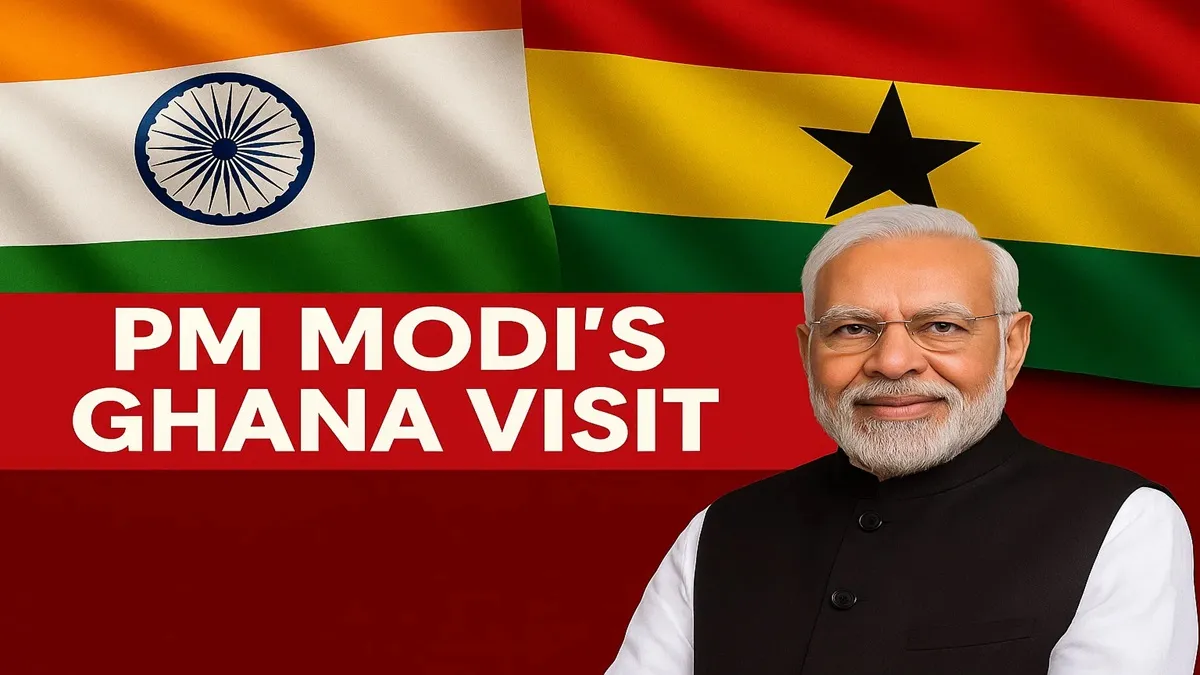
Prime Minister Narendra Modi's visit to Ghana from July 2 to 3 marks the first by an Indian Prime Minister in more than three decades. It comes at a time when India is expanding its outreach across Africa, reaffirming its commitment to South-South cooperation and investing in long-term partnerships on the continent. Ghana, one of West Africa's most stable democracies and fastest-growing economies, has emerged as a key partner for New Delhi – economically, strategically and diplomatically. This visit is not just symbolic. It carries significant weight for India's Africa policy, positioning Ghana as a central player in India's broader engagement with West Africa and the Global South.
Shared history and evolving ties
India's ties with Ghana go back decades, well before Ghana's independence in 1957. New Delhi supported Ghana's freedom struggle at the United Nations, and diplomatic ties were formally established the same year the country gained independence. India opened its representative office in Accra as early as 1953, reflecting its early recognition of Ghana's importance.
Since then, bilateral ties have deepened through trade, development cooperation, education, and cultural exchanges. Ghana was also one of the first African countries to benefit from India's Technical and Economic Cooperation (ITEC) programme. Over the years, what began as post-colonial solidarity has matured into a partnership that spans energy, agriculture, defence, and digital development.
Why Ghana matters for India's economy
Ghana is India's second-largest trading partner in West Africa, after Nigeria. Bilateral trade stands at around USD 3 billion, with India being the largest destination for Ghanaian exports. Gold accounts for over 70 per cent of India's imports from Ghana, underscoring its importance for India's jewellery and industrial sectors.
But the relationship is no longer limited to gold. Ghana is also the eighth-largest oil producer in Africa and holds potential in sectors such as cocoa, agriculture, pharmaceuticals, and digital services. With the Mahama administration undertaking broad economic reforms, India sees a window to increase its investments and commercial presence.
During the visit, Indian companies are expected to explore opportunities in infrastructure, renewable energy, agri-processing and healthcare. Agriculture will be a major focus, with India expected to offer support in the form of mechanisation technology, agri-tech partnerships and rural development models.
A strategic gateway to West Africa
Ghana's democratic stability makes it a natural ally for India. Since 1996, the country has seen eight peaceful transfers of power through democratic elections – unusual in a region struggling with repeated military coups.
Ghana is also a key member of the Economic Community of West African States (ECOWAS), a regional bloc of 15 countries. For India, stronger ties with Ghana mean greater access and influence across West Africa. This is especially relevant as India pushes to amplify the voice of the Global South and expand its trade and development footprint in Africa.
The visit will seek to strengthen cooperation with ECOWAS through Ghana's leadership, particularly in areas of peacekeeping, counterterrorism, and political stability.
Boosting defence and security cooperation
Security in the Sahel region is deteriorating, with violent extremist groups expanding their reach. Ghana’s neighbours – Burkina Faso, Mali, and Cote d'Ivoire have experienced terror attacks and growing instability. Ghana, so far, has remained resilient.
India sees value in supporting Ghana's internal security framework, especially through training, equipment supply, and defence exchanges. Ghana is part of the Accra Initiative, a multilateral effort aimed at addressing terrorism and transnational crime in West Africa. India's expertise in counterterrorism and its growing defence industry offer natural points of collaboration.
While details are still under wraps, defence cooperation is likely to feature prominently in talks between Modi and President John Mahama, who returned to power earlier this year.
Partnership in development and healthcare
India's development assistance to Ghana includes over USD 450 million in concessional Lines of Credit and grants. These have supported infrastructure projects such as rural electrification, sugar plants, and water supply systems.
A key focus of this visit is the establishment of a vaccine production hub in Ghana for West Africa. This aligns with India's ambition to be a leader in affordable healthcare and pharmaceutical production. Given the COVID-19 experience and the limitations Africa faced in vaccine access, this initiative could be a game-changer for the region.
India's strength in producing cost-effective vaccines and generic medicines makes it a valuable partner for Ghana's healthcare expansion goals. Cooperation in medical education, diagnostics, and research is also likely to be discussed.
Digital public infrastructure: A new frontier
Ghana has shown interest in adopting digital public infrastructure similar to India's Aadhaar, UPI and DigiLocker platforms. India's success in digital governance and financial inclusion has attracted global attention, and Ghana is among the countries looking to adapt these solutions.
The upcoming talks are expected to include cooperation on digital ID systems, e-governance, and digital finance. India's experience in delivering large-scale digital solutions can assist Ghana in improving service delivery and boosting financial inclusion, especially in rural areas.
This digital push is in line with India's broader global digital diplomacy, offering scalable, open-source tech to developing nations through multilateral platforms and bilateral partnerships.
People-to-people connections and soft power
Around 15,000 Indians live in Ghana, many from Gujarat and southern India. Several families have lived there for generations and are now into their third or fourth generation. This community plays a vital role in trade, industry, and local business and acts as a cultural bridge between the two nations.
India also offers scholarships to Ghanaian students, facilitates skill development programmes, and supports cultural exchanges. The Indian Council for Cultural Relations (ICCR) has sponsored arts and language programmes, while Indian films and music are popular across urban Ghana.
These people-to-people links underpin the political and economic relationship, making it more resilient and dynamic.
What the visit signals
Prime Minister Modi's visit is both a reaffirmation of India’s long-standing commitment to Ghana and a signal of its intent to be a deeper strategic player in Africa. At a time when other global powers from China to the Gulf states are expanding their presence across the continent, India's approach combines historical goodwill with a pragmatic economic and technological partnership.
