
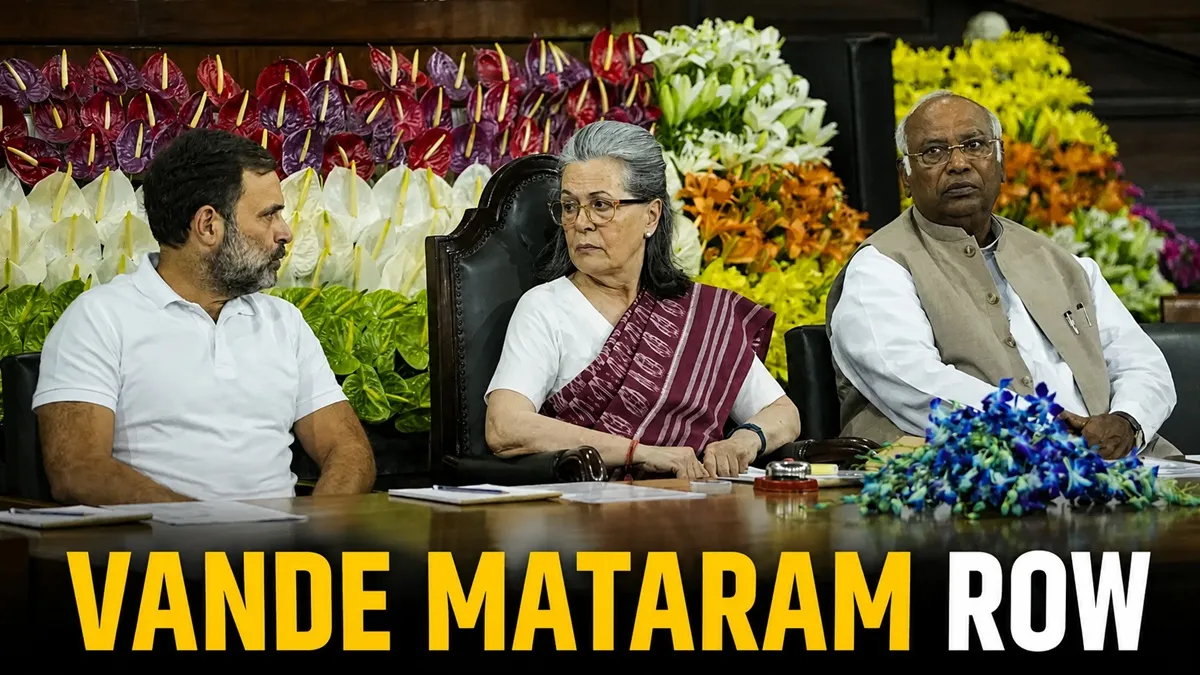
The Vande Mataram debate has once again turned into a major political flashpoint, with the Congress and the Bharatiya Janata Party (BJP) taking sharply different positions over how much of the national song should be sung at public and party events. The Congress Working Committee (CWC) has decided that the party will continue with the first two stanzas of Vande Mataram at its programmes, citing a resolution adopted by the party in 1937.
The decision has come at a particularly sensitive time. Parliament has recently given Vande Mataram statutory protection under the amended Prevention of Insults to National Honour Act, bringing it under the same penal provision that protects the National Anthem from deliberate obstruction. However, the law deals with preventing or disrupting the singing of the National Song. It does not, by itself, prescribe that every organisation must sing all the stanzas of Vande Mataram.
So, why is Congress sticking to only two stanzas? What exactly happened in 1937? And why has the BJP launched such a strong attack on the Opposition party? Here is the complete explainer.
Why is Congress singing only the first two stanzas?
The Congress says its current position is rooted in a decision taken by its top leadership in 1937. At that time, the party decided that only the first two stanzas of Vande Mataram would be used at national gatherings.
The reason was linked to the religious imagery in the later portions of the composition. While the opening two stanzas praise the motherland and describe its natural beauty, the later stanzas contain references to Hindu deities, including Durga, Lakshmi and Saraswati.
The issue had become politically sensitive because the Congress wanted a national song that could be accepted across communities during the freedom movement. The party therefore settled on the first two stanzas for public rendition. The historical decision has now become the foundation of the Congress' present-day position.
What exactly did the Congress Working Committee decide?
At its latest meeting on Wednesday (August 19), the CWC reaffirmed that Congress programmes will follow the two-stanza format. Congress general secretary KC Venugopal said there was no ambiguity in the party's position and that it would abide by the decision taken by the Congress leadership in 1937.
"There is no confusion on that. The Congress president categorically said so yesterday in Goa. Today we also discussed the issue in the meeting of the CWC. Our stand is very clear that the 1937 resolution decided in which Mahatma Gandhi, Pandit Jawaharlal Nehru, Rabindranath Tagore, Subhas Chandra Bose and Sardar Patel - the top-most leadership of the party at that point of time were present," he told the reporters. Venugopal further added, "Whatever the decision they took, we have decided that. We are very clear that our Congress party workers will do that only. This is our decision."
Venugopal also described Vande Mataram and the National Anthem as emotional issues for the Congress, while accusing the BJP of turning the matter into a political controversy. "This is the version of the BJP to distract from national issues of paper leak and 'chanda chori'," he added.
What happened to Vande Mataram in 1937?
The 1937 decision cannot be understood without looking at the political environment of the time. Vande Mataram had already become one of the most powerful symbols of India's freedom struggle. Written by Bankim Chandra Chattopadhyay, the song was first sung at a session of the Indian National Congress by Rabindranath Tagore in 1896. It subsequently became closely associated with the nationalist movement and the Swadeshi movement.
However, concerns were raised over the later portions of the composition because of their religious imagery. The Congress eventually adopted the first two stanzas for use at national gatherings in 1937, while avoiding the portions that had become a source of disagreement. That decision is what the Congress is referring to today when it says it is following its historical position rather than taking a fresh decision against the full song.
What is the difference between the first two stanzas and the later verses?
The first two stanzas primarily portray India as the motherland, describing its greenery, rivers, fertile fields, cool breeze and natural beauty. They do not contain the explicit references to Hindu goddesses that appear later in the composition.
The subsequent verses move into more overtly religious imagery. References to figures such as Durga and Lakshmi became a central part of the debate over whether the entire composition could serve as a unifying national song for people belonging to different faiths.
This distinction is important because the current Congress position is not that Vande Mataram should not be sung at all. The party says it will continue to sing the first two stanzas, as prescribed by its 1937 resolution.
When did Vande Mataram become India's National Song?
Vande Mataram has a long association with India's freedom movement and was accorded the status of the National Song at the time of Independence-era constitutional decision-making. On January 24, 1950, Constituent Assembly President Dr Rajendra Prasad stated that Vande Mataram, which had played a historic role in India's freedom struggle, would be honoured equally with Jana Gana Mana. The distinction is important. Jana Gana Mana is India's National Anthem, while Vande Mataram is the National Song. Both occupy an important place in India's national symbolism, but they are not the same composition or the same designation.
What changed with the 2026 law?
A significant development has taken place this year. Parliament passed the Prevention of Insults to National Honour (Amendment) Bill, 2026, and the President gave assent to the legislation in August. The amendment brought the National Song within the penal protection already available to the National Anthem under Section 3 of the 1971 law.
Under the amended provision, intentionally preventing the singing of the National Anthem or National Song, or causing disturbance to an assembly engaged in such singing, can attract imprisonment of up to three years, a fine, or both.
This is a crucial point in the current controversy. The law protects the singing of Vande Mataram from deliberate obstruction or disruption. It does not state that every private organisation or political party must compulsorily perform every stanza of the composition. Therefore, Congress's decision to sing two stanzas at its own party functions and the legal provision against deliberately obstructing a rendition are separate questions.
Also Read:
