
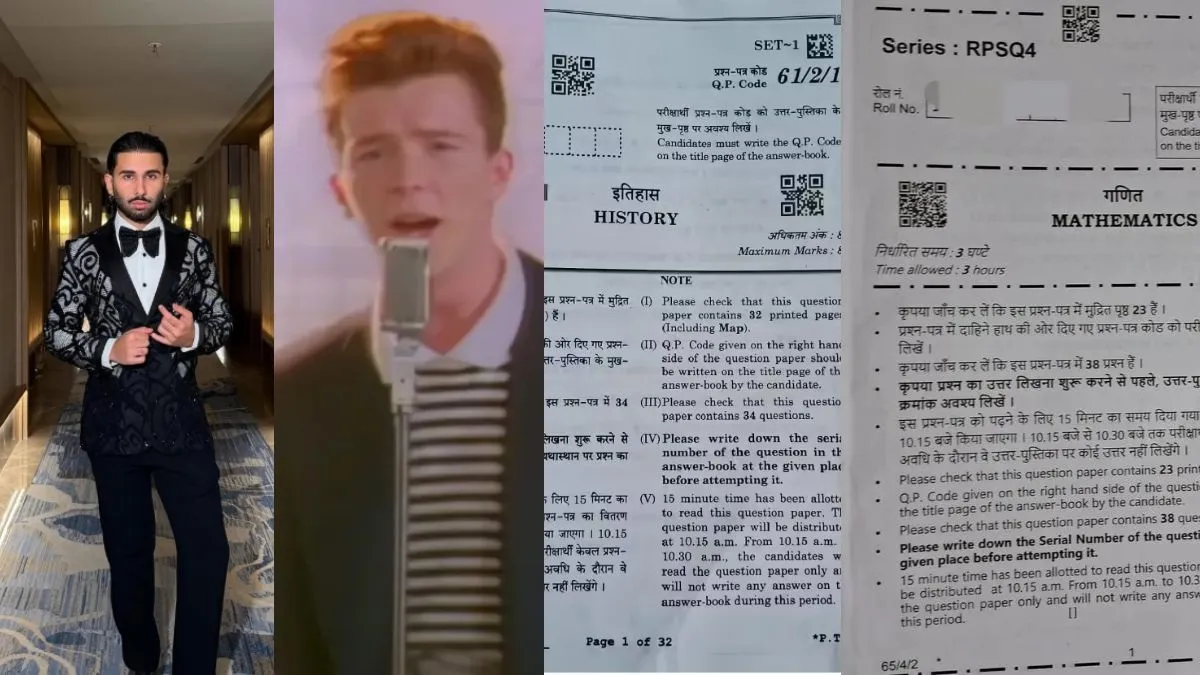
After 'Rickroll' prank in CBSE Class 12 Mathematics paper, another QR code goof up in CBSE 12th History paper has made a social buzz. The QR code is CBSE 12th History paper held on March 30 led to social media influencer Orhan Awatramani, commonly called as "Orry". The CBSE 12th History paper attracted the attention of netizens, with several celebrities joining the conversation.
Earlier the QR code in CBSE 12th Mathematics paper held on March 9 led to the 'Rickroll' prank - a popular music video for Rick Astley’s 1987 hit, "Never Gonna Give You Up".
CBSE's clarification
Meanwhile, CBSE has issued clarification, saying, "the web results are algorithm-driven search outputs and bear no connection to CBSE or its examination process".
CBSE has termed the social media buzz as mischievous propagation. "Certain elements are deliberately misrepresenting these unrelated search results to create false propaganda and malign the image of CBSE," the notification mentioned. The linking of QR codes to unrelated individuals or content is factually incorrect and misleading, it added.
Nature of QR codes
As per CBSE, "the QR codes printed on CBSE question papers are part of internal systems for authentication, tracking and exam integrity and do not open as web links when scanned. Rather, they show the intended text. However, if the user opts to use Google search on the text, Google search suggests certain other words. This does not occur if standard browsers such as Chrome are used."
CBSE's advisory
CBSE has advised students and parents to refrain from sharing speculative interpretations and verify facts through official CBSE communications.
How was CBSE 12th History paper? Check analysis
CBSE Class 12 History paper was analysed as balanced. According to Puja, PGT History, Satya School, Gurugram, "this Grade 12 History paper is well-structured, competency-based, and aligned with NCERT themes, integrating knowledge, comprehension, analysis, and source interpretation. It spans Ancient (Harappan civilisation, Manusmriti), Medieval (Vijayanagara Empire, Bhakti tradition through Karaikkal Ammaiyar), and Modern India (Revolt of 1857, Non-Cooperation Movement, contributions of Mahatma Gandhi). The paper emphasizes key historical concepts such as state formation, agrarian systems, religious practices, social hierarchy, colonial impact, nationalism, and political institutions (Constituent Assembly debates). Question types promote critical thinking, evidence-based reasoning, continuity and change, cause and consequence, and interpretation of primary sources. Overall, the paper is moderate to challenging, requiring conceptual clarity, structured answers, use of relevant examples, and effective time management, making it a strong assessment of higher-order thinking skills."
CBSE Class 12 exam 2026 will conclude on April 10. For details on CBSE 10th, 12th exams, please visit the official website - cbse.gov.in.
Also Read:
| CBSE rolls out new curriculum; three-language formula from Class 6, two-level maths and science in 9th |
| CBSE 10th result 2026 likely by April-end: Sources |
