
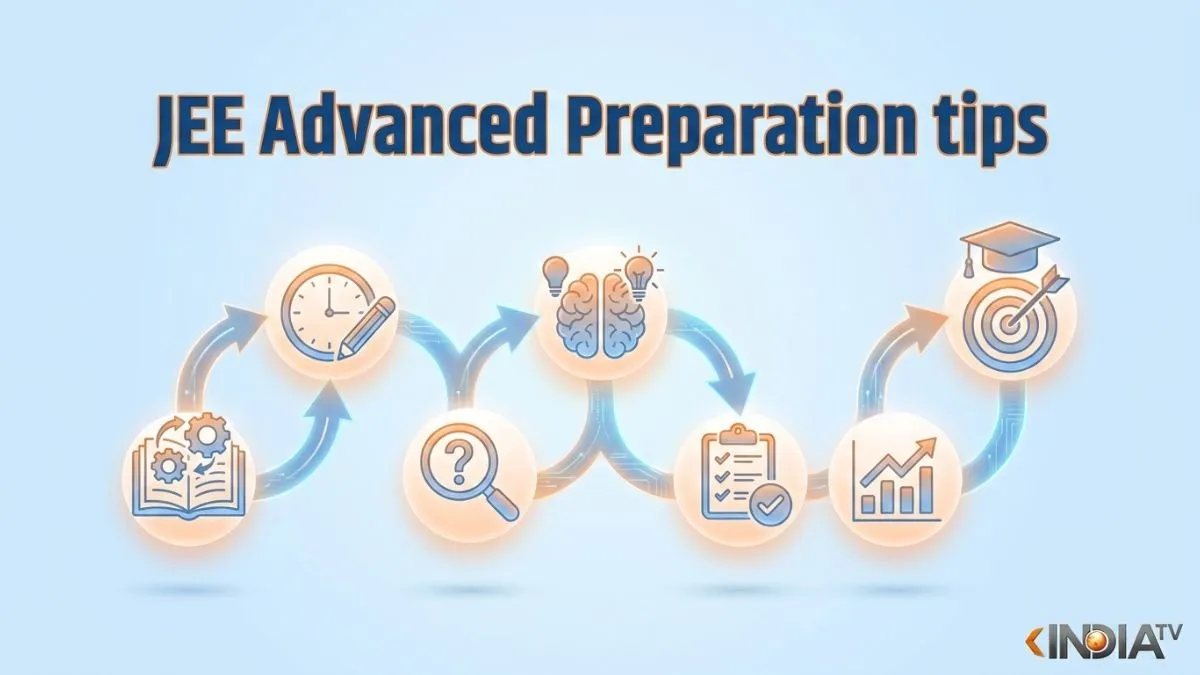
Just days left for Joint Entrance Examination (JEE Advanced) which is scheduled to be held on Sunday, May 17, the IIT-entrance aspirants can follow these revision tips by expert that will help them to excel in the exam.
According to Ramesh Batlish, JEE Expert, "JEE Advanced paper has a mixture of various types of questions. There are questions of multichoice type with either single correct answer or multi correct answers. There could be comprehensions followed by two or more objective type questions with single or multi correct answers.
The matrix match type questions may involve matching two columns or even three columns. The Integer type questions involve a subjective type question with the answer an integer or could be asked correct to two/three decimal places. Students are advised to be careful as the paper has negative marking. The preparation strategy should be built with effective time management and subject-wise planning. Students must also be mentally ready to face some surprises in the paper."
JEE Advanced 2026: Last-minute revision tips
- Make an executable revision plan with all important chapters from the 3 subjects Physics, Chemistry & Mathematics
- Revise important formulae and brush up all important concepts in all three subjects
- Take Mock Tests every alternate day keeping a check on your time taken on each question and devise a strategy for the exam day
- To set your biological clock take the mock tests in the actual timings of the JEE Exam
- Revise from your own handwritten notes, as you will find it easier to grasp
- Avoid studying any new chapters or refer new books in the last one or two weeks before the exam
- Do Test Analysis after every test taken so that you avoid committing the same mistakes
- Most importantly take care of your health. Increase fluid intake to beat the summer heat. You must remain mentally & physical fit for the exam day
- Remain focussed for your exam and avoid chatting or too much discussion about JEE
- Seek guidance from your subject teachers when required as this will boost your confidence
- Practice Meditation and Yoga to ward off any kind of nervousness.
Important last-minute tips
Speed and Accuracy – one of the most important aspects is rigorous practice. Aspirants are advised to practice as many problems, and questions from the previous year’s/ attempt reputed online test series for improving speed and accuracy. Both speed and accuracy matter to enhance your score with competitive edge. As JEE is Computer Based Test, practise of papers from a reputed source is advisable.
Study material and Concept Clarity – To make it to the merit list it is important to practise all problems graded in order of difficulty from single study material to have perfect conceptual understanding and to hone analytical skills. Aspirants are also advised not to use of calculators while solving problems. Being quick in calculations will help you to increase your speed in the JEE Advanced exam.
Cover the complete syllabus – As most of the topics would have been covered by aspirants, it is advised to thoroughly go through the complete syllabus of JEE Advanced. It is advisable to avoid selective study and to cover the entire syllabus but considering the previous year’s trends, students are advised to lay emphasis on the following chapters/topics in the three subjects.
Mathematics: Quadratic Equations & Expressions, Complex Numbers, Probability, Vectors & 3D Geometry, Matrices in Algebra; Circle, Parabola, Ellipse in Coordinate Geometry; Functions, Limits, Continuity and Differentiability, Application of Derivatives, Definite Integral in Calculus.
Physics: Mechanics, Fluids, Heat & Thermodynamics, Waves and Sound, Capacitors & Electrostatics, Magnetics, Electromagnetic Induction, Optics and Modern Physics.
Chemistry: Qualitative Analysis, Coordination Chemistry & Chemical Bonding in Inorganic Chemistry, Electrochemistry, Thermodynamics, Chemical Equilibrium in Physical Chemistry and Oxygen related Compounds, Polymers & Amines in Organic Chemistry.
How to attempt questions
Multiple Choice questions with Single Choice Correct: The best way to attempt these questions is to run through the Question- Option – Question way. Scanning the question again after the options in mind helps strategizing the approach to solve the question. Sometimes the options themselves guide the correct strategy or even the correct answer.
Multiple Choice questions with Multiple Choice Correct: Each question has to be solved and mapped with all options. It may also happen that the options are same values written in different form. Statistically, these are the questions with least percentage of correct responses. One must only answer the correct options in case of partial marking in these questions.
Comprehension Based: Even if you know the concept mentioned in Comprehension, you should still read it thoroughly, there are chances of redefining a concept or providing hypothetical assumptions. In that case your correct approach might lead to incorrect answer.
Matrix Match Type (One to One Matching): If the question is of One to One matching, then your approach should be finding the odd one out (if any). This will help you quickly reach the correct mapping.
Matrix Match Type (One to Many Matching): This type of Matrix Match would be the most challenging and time taking. The suggested way would be to attempt this problem if you are confident on the concepts of all 4 rows, or else keep this question at bay for last.
Numerical Based Answer Type: Generally, these questions are the subjective questions converted to objective, and hence would be time taking. The correct way would be treating them as subjective and solve them only if you have a command on the topic or if you have attempted all other questions of the paper. These questions also have a low scoring statistical record. In previous years, answers correct to two decimal places were also asked. So, students are advised to write answers correct to decimal places as asked.
Reason Assertion Type: These days these types of questions are not asked, but in case there are few questions of this category, be very careful if both the statements are correct. Because, then it’s very tricky to decide between the options A and B or else you can mark the correct response easily.
Aspirants are advised to be ready for surprises in the JEE paper, as it has the history of asking something new. Remain calm in such situations and use the same strategy used to attempt a new question.
JEE Advanced 2026: Exam day tips
- Ensure to have a sound sleep for 6 to 7 hours in the night before the exam day
- Reach the examination venue well in time and follow all the guidelines already released by IIT Roorkee, the Organising body for JEE Advanced 2026
- Don’t forget to carry your admit card, ID Proof and follow instructions as given in the admit card
- Remain focussed and don’t discuss anything with friends outside the exam centre
- Read all the instructions in question paper carefully before starting to answer
- It is advisable to solve the paper in two rounds. In first round, start with the subject as per your comfort level attempting all easier and moderate level questions in the first round
- Solve remaining questions in second attempt and those marked for review
- Do not spend more than a minute on any question if you find that you are not nearing solution. Go to the next question.9. Avoid guessing if you are not sure about the answer to a question with negative marks assigned to it
- Attempt all questions which do not carry negative marks
- Stay Calm and remain focussed. Remember it is the relative performance that counts, so believe in yourself and give your best shot and you will ace JEE Advanced 2026.
For details on JEE Advanced 2026, please visit the official website - jeeadv.ac.in.
