
Advertisement
  1. Home
  2. Education
  3. CBSE 12th Chemistry analysis 2026 Live Updates: Check students and teachers' reactions

CBSE 12th Chemistry analysis 2026 Live Updates: Check students and teachers' reactions

Edited By: Arnab Mitra
Updated:

CBSE 12th Chemistry analysis 2026: CBSE 12th Chemistry paper was held today. Check paper analysis, students and teachers' reactions.

CBSE 12th Chemistry analysis 2026: Check students and teachers' reactions.
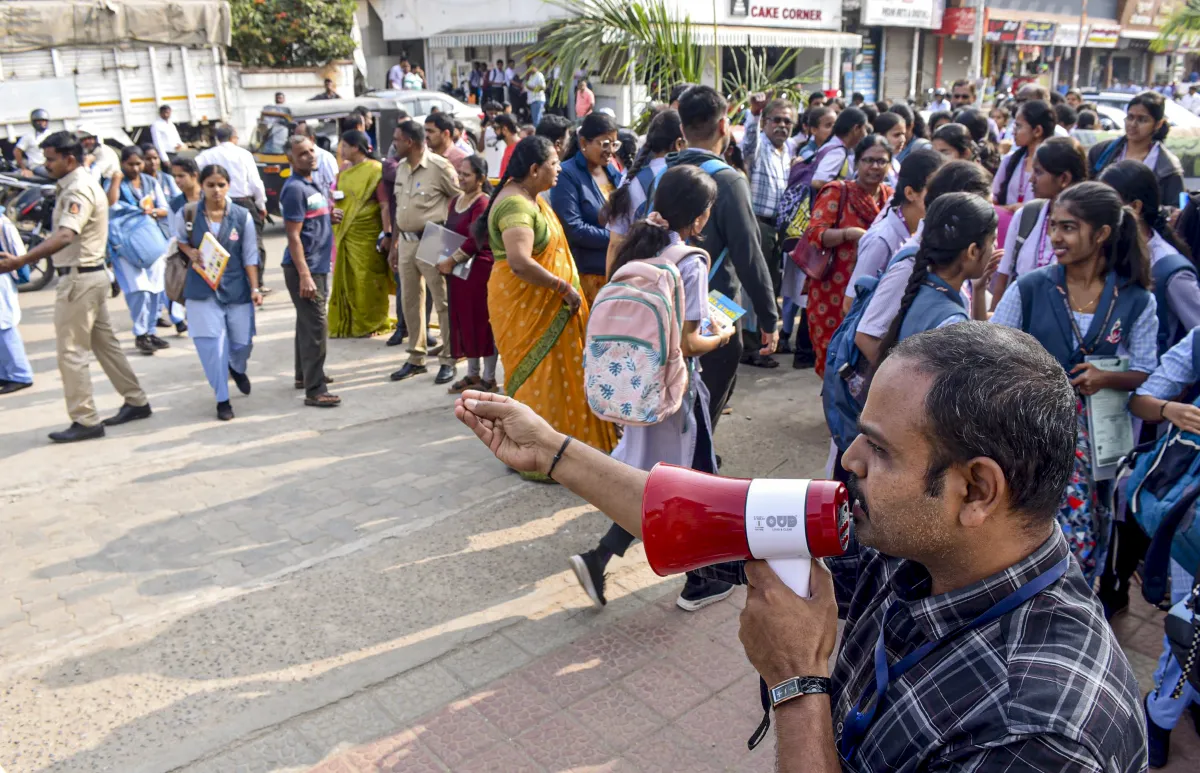
CBSE 12th Chemistry analysis 2026: Check students and teachers' reactions. Image Source : PTI File Photo
New Delhi:

The Central Board of Secondary Education (CBSE) conducted Class 12 Chemistry paper today, while Class 10 exam held on Arabic, Sanskrit, Rai, Gurung, Tamang, Sherpa. The CBSE 10th and 12th exams 2026 were concluded at 1:30 pm.   

The candidates should carry admit card at the exam centre, without it, they will not be allowed to appear for the exam. Along with the admit card, the candidates are advised to bring a government-issued photo ID- PAN, Voter ID card as proof of identity.     

Over 43 lakh students have applied to appear for the CBSE Class 10 and 12 exams 2026 this year. As per CBSE, over 25 lakh (25,08,319) students have applied to appear for Class 10 exam, while 18 lakh (18,59,551) students will appear for Class 12 exam 2026.   

CBSE 12th Chemistry analysis 2026 Highlights: Check students and teachers' reactions

Auto Refresh
Refresh
  • 4:59 PM (IST)
    Posted by Arnab Mitra

    How was CBSE Class 12 Chemistry paper?

    Geeta Dua, Chemistry Faculty at Satya School - " The Chemistry paper was properly divided chapter-wise, balanced, and fully based on the prescribed syllabus. She observed that all the sets were almost equal in difficulty, so students across centres got a fair paper.

    According to her, the question paper was clearly NCERT-focused. Many questions came straight from textbook concepts, examples, and exercise questions. Students who had studied NCERT thoroughly and practised end-of-chapter questions were satisfied after the exam and are expecting good scores.

    In Organic Chemistry, there were several conversion-based questions of moderate difficulty level, along with analytical questions on comparing acidic and basic strengths. Physical Chemistry numerical were direct and mainly formula-based. In Inorganic Chemistry, questions were asked from IUPAC nomenclature, isomerism, and core concepts. The case-based questions from Ethers and Electrochemistry were straightforward and concept-based.

    Overall, students felt the paper had a good mix of conceptual, numerical, and application-based questions. It was rewarding for those who prepared seriously from NCERT and had clear concepts." 

  • 3:35 PM (IST)
    Posted by Arnab Mitra

    CBSE 10th Sanskrit paper analysis 2026

    Shruti Sharma, TGT Sanskrit, Silverline Prestige School - "The CBSE Sanskrit board exam was a well-balanced paper that remained strictly aligned with the NCERT syllabus. The paper effectively balances Applied Grammar and Literature, rewarding students who possess a strong grasp of foundational rules like Sandhi and Samasa. While the reading and translation sections are generally straightforward, success hinges on grammatical precision in the writing tasks. The translation tasks required a solid grasp of grammatical application, whereas the literature section was highly predictable and textbook-based. Notably, the formal/informal letter (Patr) required students to write independently for the first time rather than just filling in blanks, introducing a fresh yet balanced challenge that tested true linguistic competence. Overall, it is a student-friendly exam that serves as an excellent percentage booster for the secondary boards."  

  • 2:54 PM (IST)
    Posted by Arnab Mitra

    'Most of the questions were directly based on NCERT concepts'; check expert's analysis

    Sarita Khokhar, Academic Coordinator, Seth Anandram Jaipuria School, Ghaziabad - "The overall difficulty level of the paper was moderate. Most of the questions were directly based on NCERT concepts, but some required conceptual clarity, especially numericals and organic conversions. A few questions required application of concepts and careful interpretation.

    Students with strong NCERT preparation and practice of numericals and named reactions would have found the paper balanced. Time management was reasonable and students were able to complete the paper within allotted time. The paper followed the expected CBSE blueprint, providing a well-balanced mix of understanding, application, and memory-based questions. Overall, the question paper was well-structured, syllabus-oriented, and competency based." 


  • 2:44 PM (IST)
    Posted by Arnab Mitra

    CBSE Class 12 Chemistry analysis by teacher

    Shikha Nath, Chemistry Teacher, KIIT World School, Gurugram - "The Chemistry question paper was moderate to easy in terms of overall difficulty level. It was well-balanced, student-friendly, and completely based on the NCERT syllabus. The paper was designed to assess conceptual clarity, application skills, and analytical thinking while remaining accessible to well-prepared students.

    The question paper consisted of 33 questions divided into five sections:

    Section A (1 × 16 = 16 Marks)

    This section comprised 16 MCQs of 1 mark each. The questions were direct, conceptual, and completely NCERT-based. Most MCQs were straightforward and scoring. A few required careful reading and conceptual clarity, but overall the section was easy and manageable.

    Section B (2 × 5 = 10 Marks)

    Section B included short-answer questions of 2 marks each. The questions tested fundamental understanding of important topics such as Electrochemistry, Chemical Kinetics, Coordination Compounds, Organic Chemistry, and Biomolecules. The questions were direct and primarily based on NCERT examples and in-text exercises.

    Section C (3 × 7 = 21 Marks)

    This section consisted of 3-mark questions focusing on reasoning, derivations, and numerical. The questions required step-wise explanations and proper presentation. Numerical were formula-based and easy to attempt for students with strong conceptual clarity.

    Section D (Case-Based Questions) (4 × 2 = 8 Marks)

    The case-study questions were application-oriented and based on real-life situations linked to NCERT concepts. The questions were logical and tested analytical thinking skills. Students who had thoroughly prepared from NCERT were able to answer them confidently.

    Section E (5 × 3 = 15 Marks)

    This section contained long-answer questions of 5 marks each. The questions were well-structured and internal choices were provided. They covered important and high-weightage topics. The questions were direct and entirely NCERT-based, allowing students to score well with proper preparation and structured answers.
     
    The entire paper strictly followed the NCERT curriculum, ensuring that students who had prepared thoroughly from the prescribed textbook could perform well. Both theory-based and application-based questions were included, making the paper comprehensive and balanced.
    As per student feedback, the paper was moderate to easy, well-distributed in terms of marks, and manageable within the allotted time. Most students were able to complete the paper comfortably.

    The examination effectively tested conceptual understanding, clarity of expression, numerical accuracy, and analytical reasoning skills." 

  • 2:29 PM (IST)
    Posted by Arnab Mitra

    CBSE 12th Chemistry paper was 'well-balanced'

    Mayank Agnihotri, PGT Chemistry Vidya Gyan School, Sitapur - "A defining feature of the paper was its strong emphasis on the NCERT textbook. Almost all questions were directly based on NCERT concepts, examples, and exercise problems. Students who studied the text thoroughly and practiced end-of-chapter questions found the paper straightforward and highly scoring. Such students have a strong likelihood of securing excellent marks, even full scores.

    In Organic Chemistry, conversion-based questions formed a major component, along with analytical questions requiring the arrangement of organic compounds according to their acidic and basic strengths. Numerical problems from Physical Chemistry were direct and formula-based, allowing students with conceptual clarity to solve them efficiently. In Inorganic Chemistry, questions were largely centered on direct IUPAC nomenclature. Case-based questions were also simple, clear, and easily manageable.

    Overall, the paper effectively assessed conceptual understanding and textbook mastery. It was balanced, student-friendly, and truly rewarding for sincere NCERT-based preparation." 

  • 2:14 PM (IST)
    Posted by Arnab Mitra

    CBSE Class 12 Chemistry analysis by subject expert

    Sonam Chauhan (PGT) Chemistry at JAIN International Residential School (JIRS), Bengaluru - "The CBSE Chemistry Board Examination 2026 proved to be a well-balanced and thoughtfully designed paper that tested students’ conceptual understanding rather than rote memorization. Overall, the difficulty level was moderate, making it accessible to well-prepared students while still encouraging analytical thinking and clarity of concepts.

    Section A (MCQs) was mostly NCERT-based and straightforward, though a few questions required careful reading. Section B, which included short-answer questions, demanded stronger conceptual clarity. Topics such as Electrochemistry, Chemical Kinetics, and Coordination Compounds required logical reasoning and a step-by-step approach. Students who had practiced derivations and understood underlying principles likely found this section fair and scoring.

    The long-answer section was comprehensive yet balanced. Organic chemistry conversions, reaction mechanisms, and named reactions were given importance. Numerical problems were straightforward and formula-based, without being excessively lengthy. The internal choices provided flexibility, allowing students to attempt questions from their stronger areas.

    From a unit-wise perspective, Physical Chemistry featured moderate-level numericals that were largely direct and formula-driven. Organic Chemistry was slightly tricky but entirely NCERT-based, emphasizing mechanisms and conversions. Inorganic Chemistry, especially Coordination Compounds and d and f-Block elements, was largely memory-based but predictable for those who studied the textbook thoroughly. 

    Time management played a key role in this examination. While the paper could comfortably be completed within the three-hour duration, certain numericals and reasoning-based questions required careful calculation and explanation. Students who allocated time wisely would have been able to review their answers before submission.

    Overall, the Chemistry board paper was fair, student-friendly, and aligned with the CBSE examination pattern". 

  • 1:43 PM (IST)
    Posted by Arnab Mitra

    How was CBSE 12th Chemistry paper?

    Afjal Hussain Mazumder, PGT- Chemistry, Modern English School, Kahilipara, Guwahati, Assam - "Question paper of Chemistry (043) is NCERT-based and well balanced between numerical, knowledge, understanding, application, and HOTS. The question is based on critical thinking rather than unintended shortcuts. Variation between the sets is done keeping the concept similar, thus boosting the consistency of measurement. Language of the question paper is simple and ruled out construct-irrelevant variance mostly. For those learners who have thoroughly studied the NCERT textbook, specifically those who followed layered learning, this paper will be a boon. Surface learners may find difficulty in answering many questions; however, scoring the pass mark will not be a big challenge.”  

  • 1:35 PM (IST)
    Posted by Arnab Mitra

    CBSE 12th Chemistry analysis 2026: Initial reactions

    As per the initial reactions received from students, CBSE 12th Chemistry paper was easy, the paper followed the NCERT pattern. The questions were mostly from syllabus, sample papers. 

  • 12:58 PM (IST)
    Posted by Arnab Mitra

    How was CBSE 10th IT paper?

    CBSE 10th Information Technology (IT) paper was held on February 27. As per Asheesh David, TGT – Computer, VidyaGyan School, Bulandshahr, "The question papers for Information Technology (402) and Artificial Intelligence (417) were prepared strictly in accordance with the blueprint and guidelines issued by CBSE. Both papers reflected a balanced structure, comprising a thoughtful mix of competency-based and direct questions, all drawn from the study material prescribed by CBSE. The papers were well designed to assess students’ conceptual understanding, practical skills, and applied aptitude in the respective subjects. Overall, the question papers were fair, comprehensive, and aligned with the learning outcomes envisioned by the Board."  


  • 12:57 PM (IST)
    Posted by Arnab Mitra

    How was CBSE 10th AI paper 2026?

    CBSE 10th Artificial Intelligence (AI) paper was held on February 27. According to the Principal Alka Kapur, Modern Public School, Shalimar Bagh, "The Class 10 Artificial Intelligence examination was well-received by students, who expressed satisfaction with the overall paper. They reported that all questions were strictly based on the prescribed syllabus and were not difficult to attempt. The question paper was thoughtfully designed, well-balanced, and appropriately structured without being lengthy.

    The paper effectively catered to students of varying abilities. The 4-mark questions, particularly those based on Bag of Words and Confusion Matrix, were considered scoring and straightforward. Additionally, most of the multiple-choice questions were application-based, encouraging conceptual understanding rather than rote learning. Overall, the examination was comprehensive, fair, and student-friendly." 

  • 12:55 PM (IST)
    Posted by Arnab Mitra

    CBSE exam 2026 reporting time

    The candidates need to report at the exam centre half an hour to one hour before the exam. For the CBSE Class 10 exam 2026 to commence at 10:30 am, the candidates need to reach the exam centre by 10 am.  

  • 12:54 PM (IST)
    Posted by Arnab Mitra

    CBSE 10th paper today

    CBSE 10th exam 2026 is being held today (February 28) on Arabic, Sanskrit, Rai, Gurung, Tamang, Sherpa. Following the conclusion of Class 10 exam, the paper analysis, students and teachers' reactions will be available. 

  • 12:52 PM (IST)
    Posted by Arnab Mitra

    CBSE 12th paper today

    CBSE 12th exam 2026 is being held on Chemistry today, February 28, the paper will conclude at 1:30 PM. Following the conclusion of Class 12 Chemistry paper, the paper analysis, students and teachers' reactions will be available. 

Read all the Breaking News Live on indiatvnews.com and Get Latest English News & Updates from Education
Advertisement
 
\