
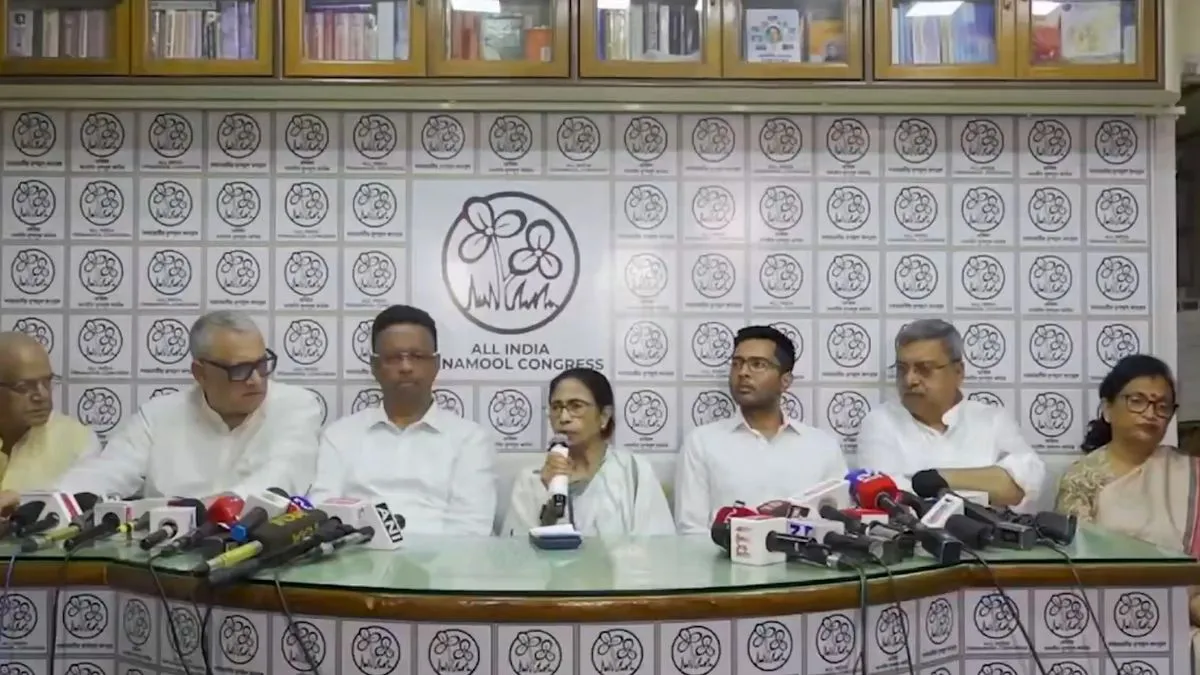
The Mamata Banerjee-led All India Trinamool Congress (TMC) suffered a major setback in the West Bengal Assembly elections, as the Bharatiya Janata Party (BJP) surged ahead with a decisive victory. The BJP secured 207 seats, while the TMC was limited to just 80.
Speaking at a press conference on Tuesday following the poll debacle, Banerjee alleged that the BJP had stolen the mandate. She further claimed that the Election Commission acted at the behest of the BJP to influence the outcome, adding that she would not visit the Raj Bhavan to submit her resignation.
"I will not resign, I did not lose, I will not go to Raj Bhavan...The question doesn't arise. No. Now, I also want to say that we didn't lose the election. It is their attempt to defeat us. Officially, through the Election Commission, they can defeat us, but morally we won the election," she said.
Can a CM refuse to resign after losing an election?
When an incumbent Chief Minister refuses to step down despite losing majority support, the Constitution provides a clear path to ensure continuity of governance.
Speaking on the issue, Senior Advocate Vikas Singh, who currently heads the Supreme Court Bar Association, explained that a Chief Minister technically holds office under the constitutional principle known as the Doctrine of Pleasure. This means the tenure of the Chief Minister is subject to the confidence of the legislative assembly and, formally, to the Governor’s authority.
In practice, however, this “pleasure” is not arbitrary. As long as a Chief Minister enjoys majority support in the House, the Governor cannot intervene. The situation changes dramatically when that majority is lost.
When governor’s role becomes important
According to Singh, precedents across states show that when a government is reduced to a minority, the Governor can step in to test or reconfigure power. The first step is usually to ask the sitting Chief Minister to prove their majority on the floor of the assembly. If the numbers are clearly not in their favor—or if the Chief Minister refuses to comply or resign—the Governor may then explore alternatives.
“In such an extraordinary situation, the Governor is well within constitutional bounds to invite another leader—typically from the largest party or coalition—to form the government,” Singh noted.
This invitation is not contingent on the outgoing Chief Minister’s consent. Once the Governor is satisfied that an alternative leader can command majority support, they may administer the oath of office to the new Chief Minister.
No constitutional deadlock in such situation
The refusal of an incumbent to resign, Singh suggested, does not create a constitutional deadlock. Instead, it triggers the Governor’s discretionary space, allowing a transition of power to proceed in order to maintain democratic functioning. He emphasised that such refusals are often political in nature, aimed at shaping public perception, rather than grounded in constitutional entitlement.
ALSO READ: 'I will not resign, I did not lose election': Mamata Banerjee after TMC's Bengal rout
