
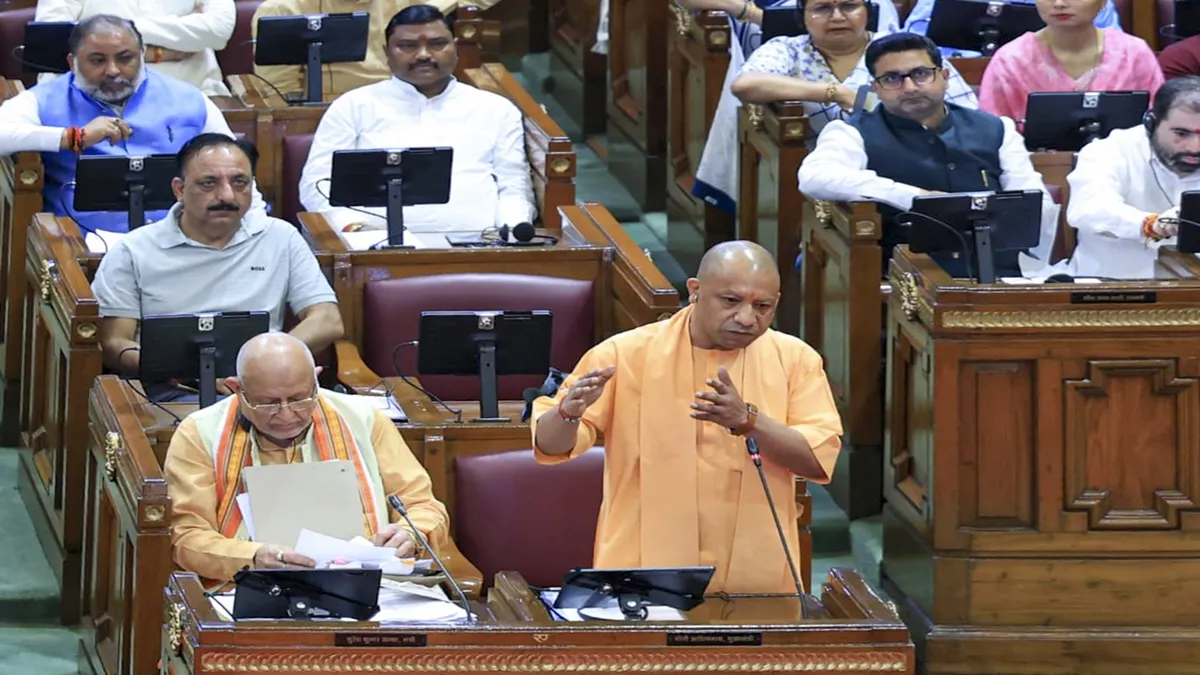
On the third day of the Uttar Pradesh Assembly’s monsoon session, the 'Banke Bihari Temple Trust Bill' was tabled and passed, aiming to institutionalise the management of the historic temple while preserving its centuries-old traditions. The government says the new trust will ensure world-class facilities for devotees while safeguarding the customs established by saint-swami Haridas.
Alongside the Bill, a 24-hour discussion began on August 13 at 11:00 am on the 'Viksit Bharat, Viksit UP' Vision Document 2047, in which the government is presenting departmental achievements and vision plans, while the opposition continues posing questions.
All offerings and properties to come under trust's control
The Bill clearly states that the trust will have authority over all offerings, donations, and movable or immovable properties of the temple.
This includes-
- Idols and property within the temple premises
- Gifts and offerings made to the deities
- Assets given to support any rituals, ceremonies, religious events
- Monetary donations- whether in cash, cheque, demand draft, or sent by post or telegraph
- Jewellery, grants, contributions, and hundis
In essence, all assets of Shri Banke Bihari Ji Temple, movable and immovable, will be considered under the trust’s management.
Traditions of Swami Haridas to continue unchanged
The Bill emphasises that the trust has been formed to carry forward the traditions initiated by Swami Haridas, the revered saint credited with establishing the temple's devotional practices. All customs, festivals, and rituals will continue without any interference or change.
The trust will-
- Decide temple visiting hours (darshan timings)
- Appoint priests and determine their salaries, allowances, or compensation
- Maintain the safety of devotees and visitors
- Ensure smooth administration and effective management of the temple
Modern facilities for devotees
Once formed, the Banke Bihari Temple Trust will develop world-class amenities for pilgrims, such as-
- Organised prasadam distribution
- Separate darshan routes for senior citizens and differently-abled devotees
- Drinking water facilities
- Benches for rest, easy access and queue management kiosks
- Cow shelters (gaushalas), community dining halls (annakshetra), large kitchens
- Hotels, guesthouses, exhibition halls, restaurants, and waiting areas
- Composition of the trust
The trust will have 11 nominated members and 7 ex-officio members.
Nominated members-
- 3 eminent members from Vaishnav traditions/sects/maths (can be saints, monks, gurus, scholars, heads of maths, mahants, acharyas, or swamis)
- 3 from various Sanatan Dharma traditions/sects with similar profiles
- 3 reputed persons from any branch of Sanatan Dharma (scholars, academicians, entrepreneurs, professionals, social workers)
- 2 from the Goswami tradition- specifically descendants of Swami Haridas; one representing Raj-bhog sevadars and another Shayan-bhog sevadars
Ex-officio members-
- District Magistrate of Mathura
- Senior Superintendent of Police
- Municipal Commissioner
- CEO of Uttar Pradesh Braj Teerth Vikas Parishad
- CEO of Banke Bihari Temple Trust
Representative nominated by the state government
All nominated members must be practicing Sanatani Hindus. The term for nominated members will be three years. If any ex-officio member is not Hindu, a junior officer will be appointed in their place.
Meetings, powers, and financial authority
- Trust meetings will be held once every three months, with at least 15 days' advance notice.
- Members will not be held personally liable for actions taken in good faith.
- The trust can independently purchase movable or immovable property up to Rs 20 lakh; larger transactions require government approval.
- The Chief Executive Officer (CEO) of the trust will be an officer of ADM rank.
Balancing heritage with modern administration
The government says this ordinance is designed to protect the temple’s spiritual heritage while introducing an institutional management framework. The plan aims to greatly improve devotees’ experience through advanced facilities without altering the temple’s sacred customs.
