
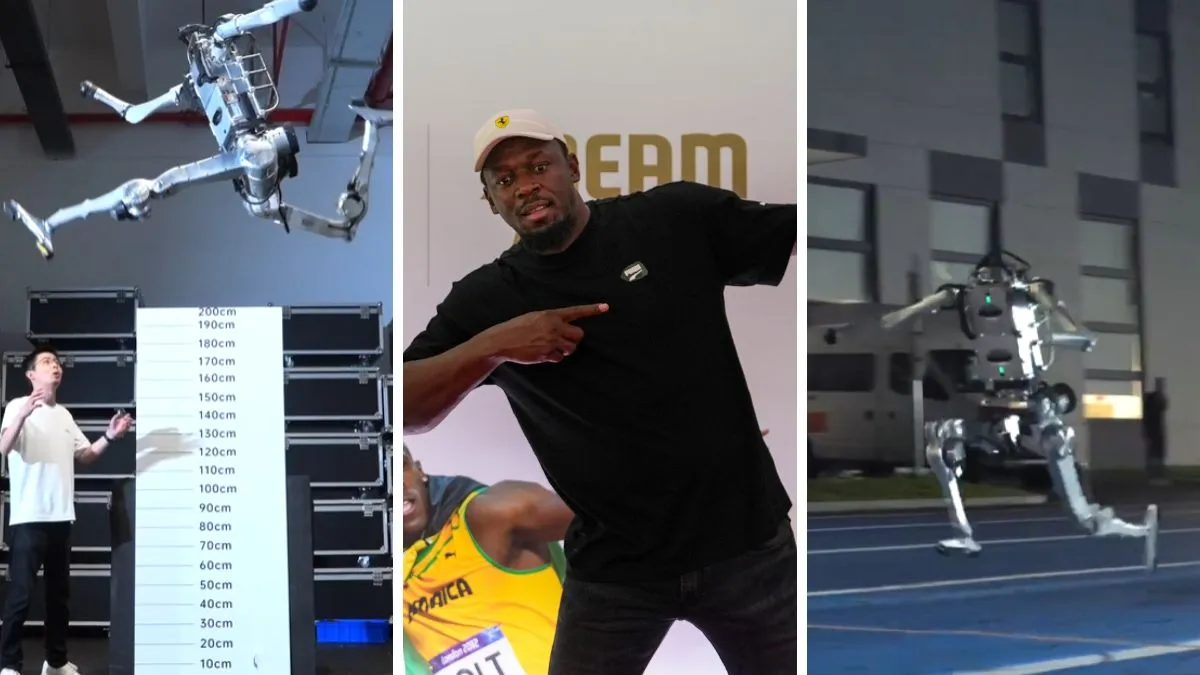
Move over, superheroes. China has unveiled a humanoid robot that has been given the rather ambitious name “Superman”, and its makers say it can run faster than the fastest human sprinter on record. Chinese robotics company Unitree recently showed off the new humanoid prototype, claiming that it can reach a top speed of 12.66 metres per second, or around 45.6 kmph. The robot can also reportedly jump 2 metres from a standing position.
The numbers have understandably caught attention online, particularly because Unitree says the robot's running speed exceeds the peak speed recorded by Usain Bolt during his world-record 100-metre sprint. But there is an important distinction here: these are Unitree's reported test figures, rather than an officially recognised sporting record.
Meet China's ‘Superman’ robot
Unitree's new humanoid robot was unveiled in a short demonstration video. According to the company, the machine was developed in just over three months, with further improvements expected in the coming months. The robot has legs measuring around 0.85 metres, and its headline-grabbing performance comes from its ability to combine speed and jumping power in a human-shaped machine.
Its reported maximum running speed of 12.66 metres per second translates to approximately 45.6 kmph. That is a remarkable figure for a humanoid robot, particularly one that is still being presented as a new prototype.
Is it really faster than Usain Bolt?
This is where things get interesting. Unitree says the robot's maximum speed is higher than the peak speed associated with Usain Bolt's 100-metre world record. Reports comparing the two put Bolt's peak speed at roughly 12.4 metres per second, while the robot is claimed to reach 12.66 metres per second. So, purely as a comparison of the reported numbers, the robot comes out ahead. But calling it a new human-beating world record would be misleading. Bolt's performance was achieved by a human athlete under sporting conditions, while the robot's figure comes from a company demonstration and uses an entirely different mechanical system.
In other words, “faster than Bolt” makes for a great headline, but the comparison needs a little context.
And then it jumps 2 metres
Running is not the only trick Unitree's Superman has up its sleeve. The company says the robot can perform a 2-metre standing jump, which it describes as exceeding human records for standing jumping. That is particularly striking because the robot does not need a running approach to achieve the jump. It is designed to generate enough force through its mechanical legs to launch itself vertically from a stationary position. For a humanoid machine, that kind of movement requires extremely fast coordination between its motors, balance systems and control software. And yes, watching a machine that looks vaguely human suddenly launch itself two metres into the air is every bit as futuristic as it sounds.
Unitree is moving quickly in humanoid robotics
The Superman robot is not an isolated experiment for Unitree. The Hangzhou-based company has been developing humanoid and quadrupedal robots for years and has become one of the major names in China's rapidly expanding robotics industry. Unitree said earlier this month that it had produced around 18,000 bipedal humanoid robots across its models. The company has also been gaining attention for robots capable of dancing, performing martial-arts-style movements and completing increasingly complex physical demonstrations.
The latest Superman prototype appears to be another attempt to push the physical limits of what humanoid robots can do.
Why is China racing ahead with humanoid robots?
Humanoid robotics has become a major technology race, with companies in China and elsewhere attempting to develop machines that can move, work and interact in environments designed for humans.
China has invested heavily in robotics and artificial intelligence, while domestic companies have been competing to improve everything from walking and running to dexterous hand movements.
Unitree's new machine arrives at an especially busy moment for the industry. The company was also preparing for its debut on Shanghai's STAR Market, where its IPO attracted enormous investor interest.
The timing has added another layer of attention to the Superman unveiling.
But can it actually replace humans?
Not quite. A robot being able to run extremely fast or jump high does not automatically mean it can perform useful everyday tasks better than a human. Humanoid robots still face major challenges involving balance, perception, artificial intelligence, battery life, dexterity and safe interaction with people. Even impressive demonstrations usually represent one carefully controlled capability rather than a complete package of human-like intelligence.
That is why the Superman robot is perhaps most interesting as a demonstration of engineering progress, rather than as evidence that robots are suddenly ready to take over the world.
For now, though, one thing is certain: China's latest humanoid has given the phrase “faster than a speeding bullet” a rather unexpected competitor. And unlike the fictional Superman, this one comes with motors, batteries and a very real 12.66-metre-per-second speed claim.
Also read:
‘The warmth was something else’: Foreign woman shares India experience, wins hearts online
