
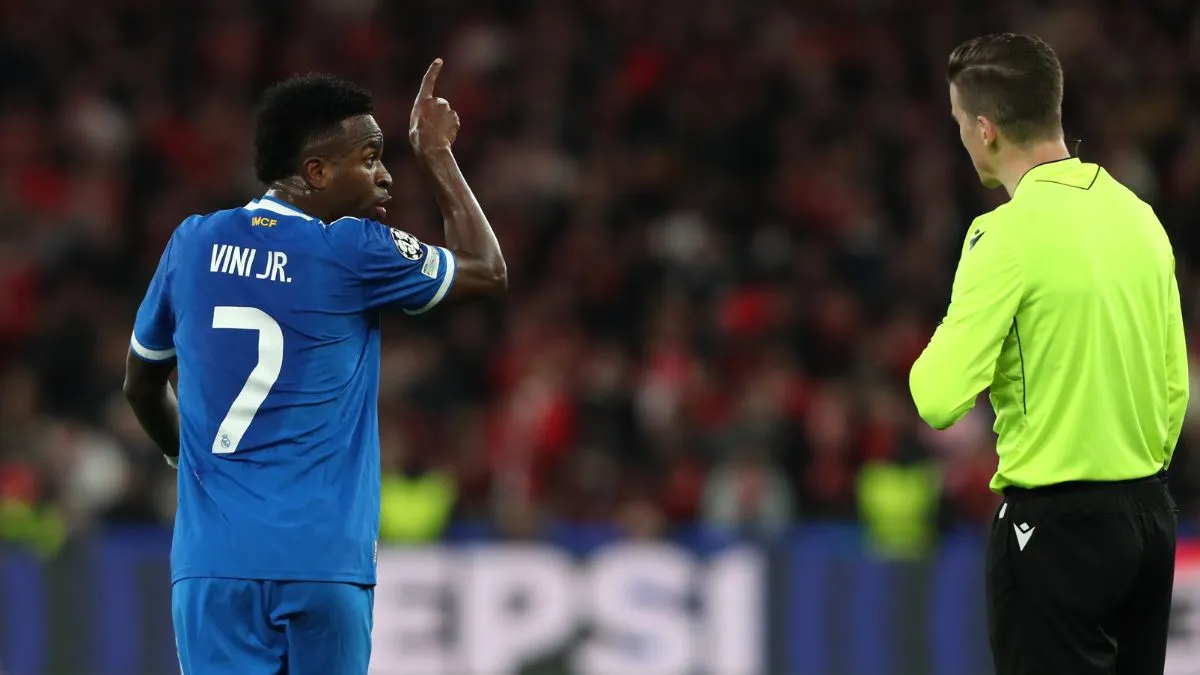
Real Madrid’s Champions League play-off against Benfica was temporarily halted for 10 minutes after Vinicius Jr reported alleged racist abuse during the match. The 25-year-old winger scored a banger of a goal from the edge of the box to hand the 15-time champions a much-deserved 1-0 lead and celebrated it with a dance, something that is very common among Brazilian players.
The goal could have dominated the headlines, especially after Madrid’s defeat to Benfica in the last league game of the campaign but instead, attention turned to the allegations of racism. Benfica’s Argentine midfielder Gianluca Prestianni was accused of directing racial slurs at Vinicius shortly after the goal, a claim Prestianni later denied. However, Kylian Mbappe has witnessed the incident and heard a racist term used five times during the episode.
Now, this is not something new in Vinicius’ life. Since he arrived in Madrid eight years ago, the Brazilian has been subjected to multiple such events. As per the BBC, he has reportedly faced 20 such incidents, but little has been done on UEFA’s part to make things better.
Meanwhile, much to everyone's surprise, Benfica’s coach Jose Mourinho has placed some responsibility on Vinicius for the incident. Mourinho also rejected the notion that Benfica is a racist club, pointing to the club’s legendary player Eusebio as evidence.
“These talents are able to do these beautiful things, but unfortunately was not just happy to score that astonishing goal. When you score a goal like that, you celebrate in a respectful way,” Mourinho said to Amazon Prime Video Sport.
Vini Jr and the subject of systematic racism
Vinicius’s reactions have often been scrutinised. Some see them as excessive or arrogant, while others argue they are a natural response to the repeated abuse he faces. For Vinicius, these moments are part of navigating an environment where discrimination persists. Scholars have long noted the burden of systemic racism. Frantz Fanon wrote in Black Skin, White Masks, “The Black man has to fight twice as hard to be accepted as a man.” Similarly, Eduardo Bonilla-Silva described “racism without racists,” where victims are blamed for their responses rather than addressing the abuse itself.
For Vinicius, what else can he do? He has been extremely vocal about the discrimination he faces in both Spain and across the world. It’s one thing for the fans to be unhappy with his celebrations and the player was shown a yellow card by the referee for the same, which was strange in the first place, but the matter could have been closed there. However, racists never change and they do end up not just hurting the player but the sport.
