
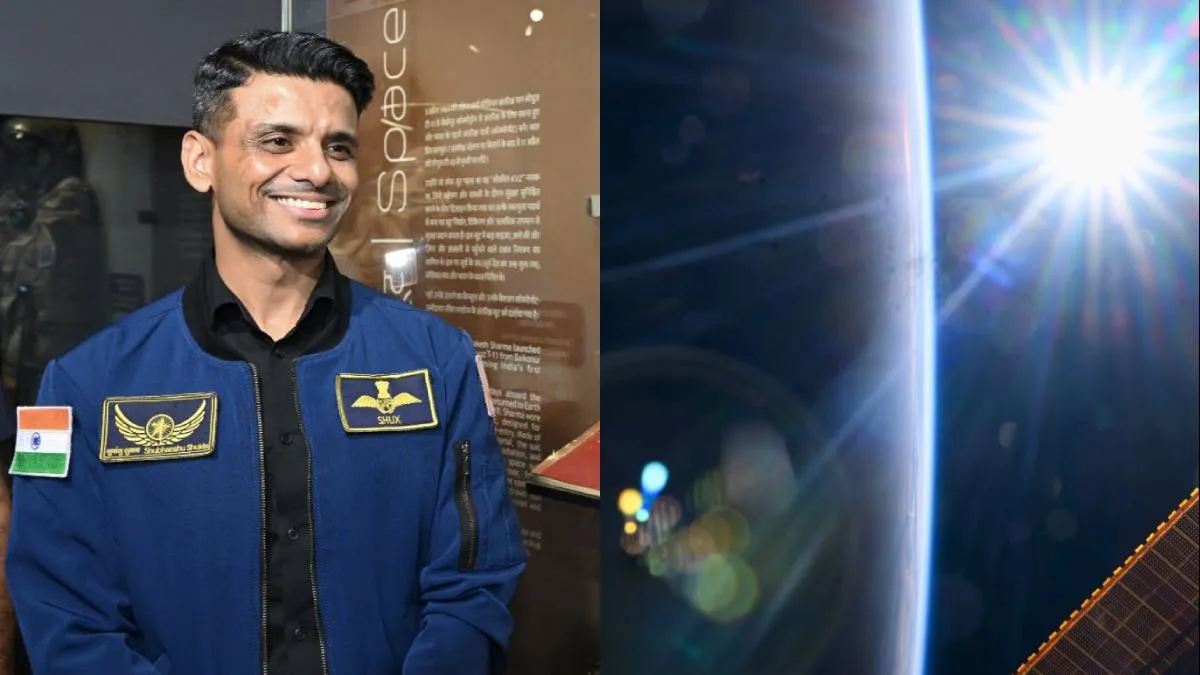
In a landmark achievement for India, astronaut Shubhanshu Shukla became the first Indian to visit the International Space Station (ISS) this past June. Since his return, he has been welcomed with great enthusiasm and has been sharing stories and videos from his time in orbit. Recently, Shukla posted a video showing the "White Night" phenomenon as seen from the ISS. He captured this unique event during his 18-day stay.
What is White night?
For those unfamiliar, a white night is when the sun doesn't set, creating continuous daylight. On Earth, this phenomenon occurs during the summer in high-latitude regions where the sun remains visible due to the angle of the Earth's tilt.
How does it occur in ISS?
Shukla explained that normally, the crew on the ISS experiences about 16 sunrises and sunsets every 24 hours as the station orbits the Earth. However, this isn't always the case. The occurrence of a white night in orbit depends on a key factor called the beta angle, which is the angle between the space station's orbital plane and the sun's position.
When the beta angle is close to zero, roughly half of the orbit is in darkness. Conversely, when the beta angle approaches 90 degrees, the station is continuously bathed in sunlight. As Shukla's video demonstrates, even if the beta angle is less than 90 degrees, the sun might dip low on the horizon but never fully set, leaving the station in perpetual daylight.
Watch video here:
Axiom-4 mission
Alongside three fellow astronauts—Peggy Whitson (US), Sławosz Uznanski-Wiśniewski (Poland), and Tibor Kapu (Hungary)—Shukla completed a 20-day mission aboard the Axiom-4. During this time, the crew conducted over 60 experiments and participated in 20 outreach sessions. Shukla launched from Florida on June 25, docked with the International Space Station the next day, and returned to Earth on July 15.
ALSO READ: NASA Mars rover finds strongest evidence for ancient life on the planet
