
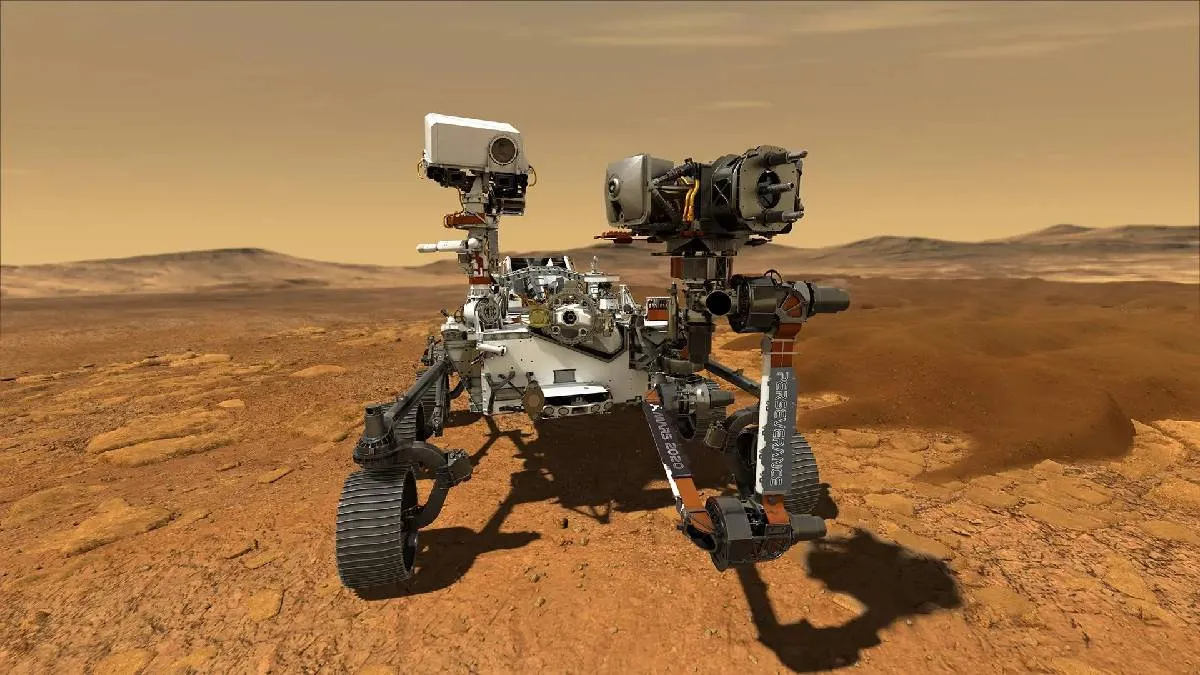
Scientists reported on Wednesday that NASA’s Mars rover Perseverance has uncovered rocks in a dry river channel that may hold potential signs of ancient microscopic life. They stressed, however, that no conclusions can be reached until the sample is analysed in-depth, ideally in labs on Earth.
Although the rover, which has been roaming Mars since 2021, cannot directly detect life, it is equipped with a drill and tubes to collect samples from places believed to have once been habitable. These samples are awaiting retrieval to Earth, a mission that is currently on hold as NASA seeks cheaper, quicker options.
A pair of scientists not involved in the study—Janice Bishop of the SETI Institute and Mario Parente of the University of Massachusetts Amherst—called it an "exciting discovery," but were quick to point out that non-biological processes could also be responsible.
Features could be created in other ways
Lead researcher Joel Hurowitz of Stony Brook University emphasised that while microbial life is one possible explanation, these features could also have been created in other ways. He added that even if the findings do not conclusively prove ancient life, the discovery is still a valuable lesson in how nature can mimic signs of life.
Samples collected last summer
The sample, collected last summer, comes from reddish, clay-rich mudstones in Neretva Vallis, a river channel that once flowed into Jezero Crater. Along with organic carbon, a building block of life, Hurowitz and his team found minuscule specks, dubbed "poppy seeds" and "leopard spots," which were enriched with iron phosphate and iron sulfide. On Earth, these compounds are common byproducts of microorganisms that consume organic matter. The findings were published in the journal Nature.
Samples retrieval effort
Ten of the titanium sample tubes were placed on the Martian surface a few years ago as a backup to the rest aboard the rover, which are the main targets for NASA’s still-developing return mission. When Perseverance launched in 2020, NASA expected the samples back on Earth by the early 2030s, but the date has since slipped into the 2040s as costs have swelled to $11 billion, stalling the retrieval effort.
Until the samples are transported from Mars, scientists will have to rely on Earth-based comparisons and lab experiments to evaluate the feasibility of ancient Martian life. As Bishop and Parente noted in an accompanying editorial, while there is no evidence of microbes on Mars today, ancient ones in a Jezero Crater lake might have reduced sulfate minerals to form sulfides, a process seen on Earth.
ALSO READ: Shubhanshu Shukla inspires students with lessons from space, shares 7 principles of success
