
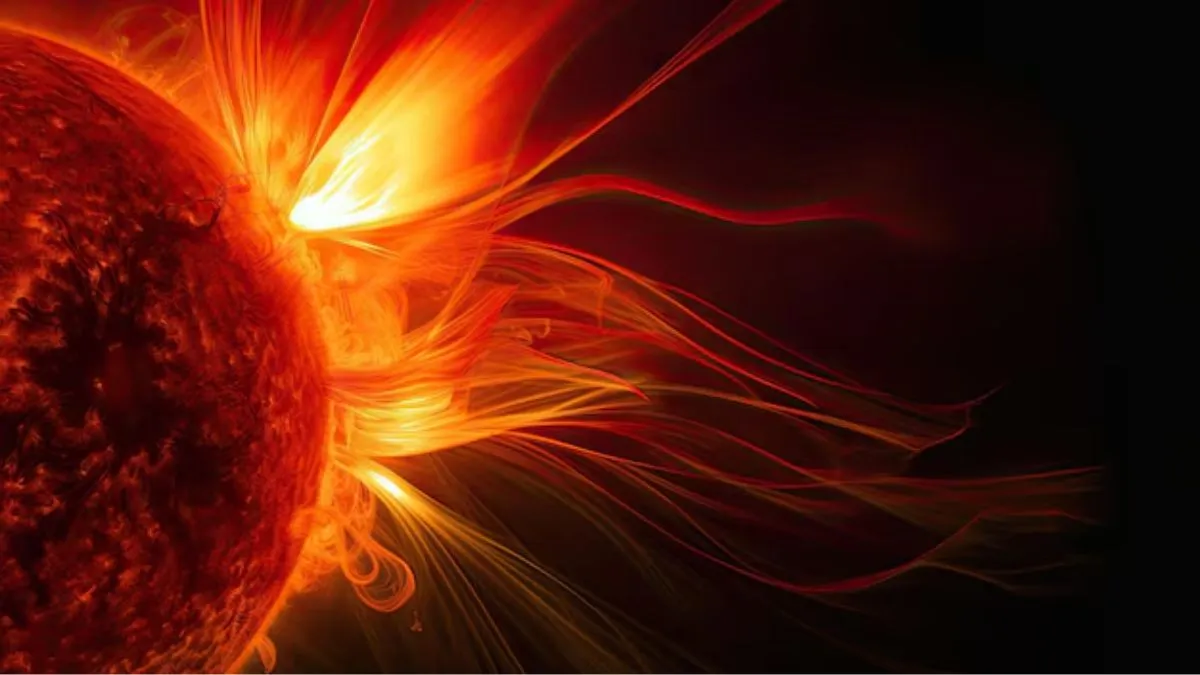
We all have heard that solar flares are the real reason for solar storms. But the scientists have figured out where the powerful solar storms come from. As per the reports, it is a hidden layer deep inside the Sun which causes it. The team has published their findings in Scientific Reports, pointing to the tachocline, a thin strip about 200,000 kilometres below the surface, as the source.
A hidden region inside the Sun has been identified
Solar storms are not just bright flashes or windy, stormy days; they are huge bursts of radiation and charged particles. They show up during periods of peak solar activity and are tied to the Sun’s magnetic field. But for years, nobody actually knew where inside the Sun they started.
What is the Tachocline?
Tachocline is a narrow, tricky zone, wedged between the Sun’s outer convection zone and its inner radiative zone.
The Tachocline is where things are a little different – suddenly it changes in rotating speed and creates a strong shearing motion in the hot plasma. These intense movements in the Sun crank out and amplify the magnetic fields, which sets off the solar storms.
Scientists have been suspecting it for a long time that the tachocline drives the Sun’s 11-year cycle, but now it is clear just how important it really is.
Study based on decades of data
The researchers dug through nearly three decades of data, using info from SOHO and the Global Oscillation Network Group. Those instruments track tiny vibrations on the surface, kind of like listening to the Sun’s heartbeat, which helps reveal what’s going on deep down. The team found that bands of plasma in the tachocline move in a “butterfly pattern", a bit like how sunspots migrate towards the equator. That pattern proves that activity deep inside the Sun directly affects what we see on the surface.
Impact on space weather forecasting
Because solar storms can screw up satellites, GPS, and power grids here on Earth. Most forecasting models have focused on what’s happening on the Sun’s surface, but these new results show we need to pay attention to what’s going on much deeper. Changes in the tachocline show up years before we see anything on the surface—so those early signals could help us spot trouble before it happens.
Better protection for Earth
If scientists can track the Sun’s inner workings more closely, they will predict dangerous storms with better accuracy. That means governments and space agencies could gear up for disruptions to communication and power systems instead of scrambling to fix things afterward.
This discovery about the solar storm is said to be a big level up, which makes it clear on to how the Sun really works – and it could make global space weather monitoring way more reliable.
