
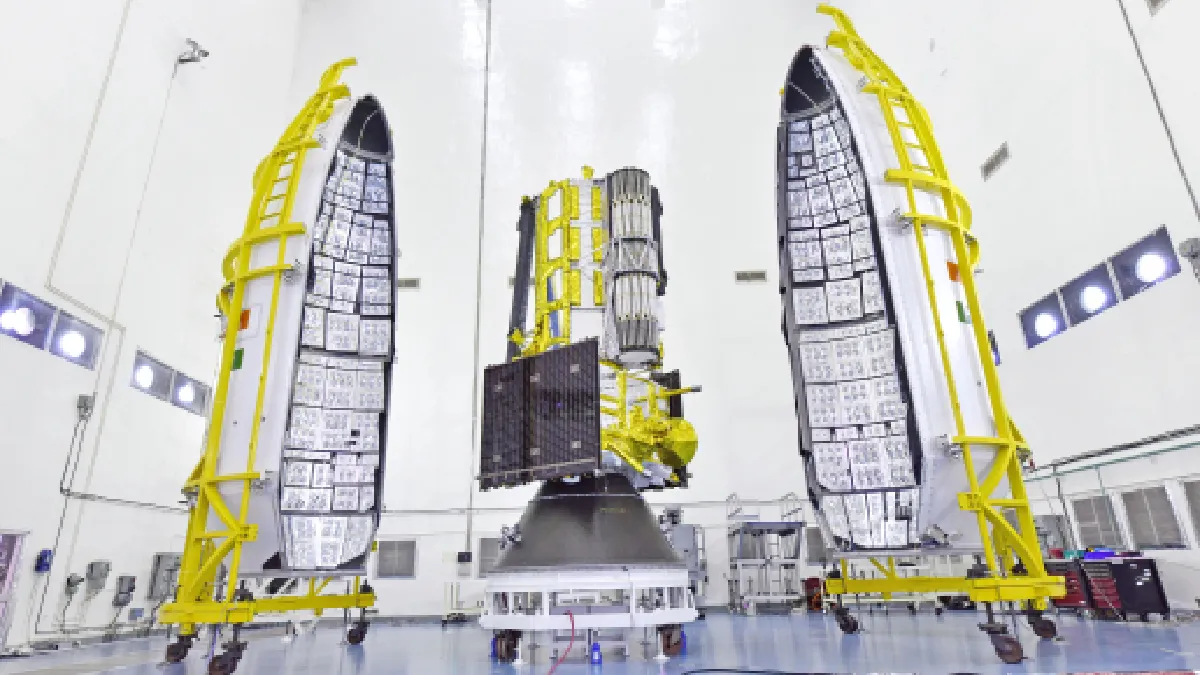
The Indian Space Research Organisation (ISRO) on Saturday said that the NASA-ISRO Synthetic Aperture Radar (NISAR) is systematically imaging the Indian landmass in S- and L-bands to deliver high-resolution, wide-swath data with a repeat cycle of 12 days. ISRO stated that this data has been effectively utilised to demonstrate the generation of soil moisture products at a high resolution of 100 metres.
High-resolution soil moisture data for agriculture and water management
Describing soil moisture as a key indicator of crop health, irrigation needs, and drought risk, ISRO said it plays a vital role in India’s agriculture and water management systems.
According to an ISRO statement, the soil moisture products, demonstrated using both S- and L-band data, provide consistent estimates across India’s diverse agro-climatic regions, including irrigated plains, rainfed farmlands, semi-arid zones, and high-rainfall areas.
The physics-based soil moisture retrieval algorithm, developed at the Space Applications Centre (SAC-ISRO), ensures scientific robustness, reliability, and operational accuracy.
ISRO added that with two observations every 12 days, NISAR enables near-real-time tracking of soil moisture dynamics. This frequent monitoring supports irrigation planning, drought preparedness, agrometeorological advisories, and regional water resource management at district and farming community levels.
National dissemination through NRSC and Bhoonidhi portal
To support national operations, ISRO said 100m Level-4 operational soil moisture products, generated twice every 12 days, will be systematically produced at the National Remote Sensing Centre (IMGEOS/NRSC).
These products will be disseminated through the Bhoonidhi Portal, ensuring seamless access for farmers, planners, researchers, government agencies, and Non-Government Entities (NGEs) across the country.
NSIL-GalaxEye partnership for satellite data resale
Officials said that NewSpace India Limited (NSIL), the commercial arm of the Department of Space, will resell products from Bengaluru-based private space technology company GalaxEye Space under an agreement signed between the two entities.
The products include advanced satellite imagery solutions such as SyncFused OptoSAR data products, designed to deliver insights across sectors including agriculture, disaster management, and natural resource management.
Suyash Singh, co-founder and CEO of GalaxEye Space, said that collaborating with NSIL would help bring advanced Earth observation capabilities to a wider set of users while contributing to India’s strategic and developmental priorities.
Officials added that the agreement makes GalaxEye the first private Indian satellite operator to formally collaborate with NSIL under a data reseller partnership.
GalaxEye’s future plans and mission Drishti
GalaxEye specialises in building payloads such as Synthetic Aperture Radar (SAR), an advanced imaging radar technology deployed in space where large ground-based dish radars cannot be installed. SAR systems use sophisticated technologies and algorithms to replicate the power and resolution of large ground-based radars.
The company is set to launch its Mission Drishti, a multi-sensory Earth observation satellite, and plans to scale it up to a constellation of 10 satellites by 2030.
ALSO READ: New crew to ISS launched after NASA’s first medical evacuation
