
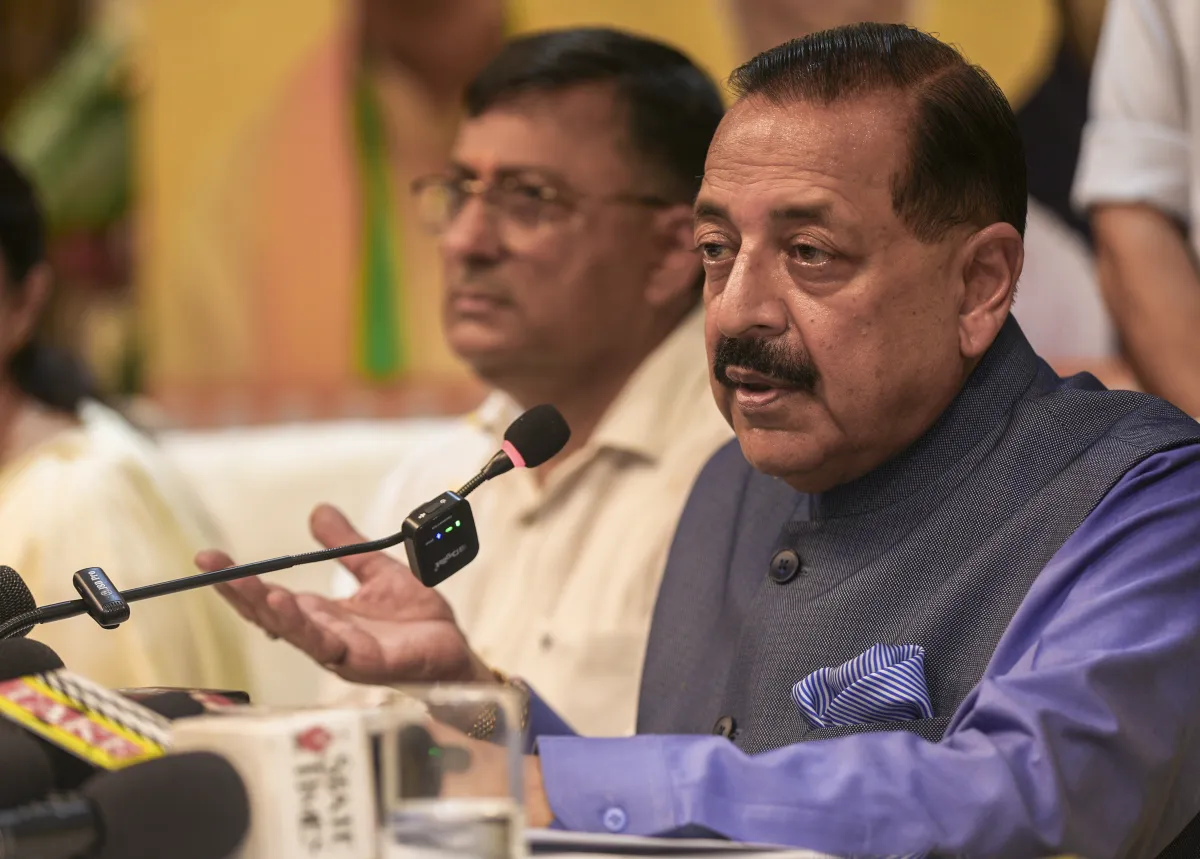
Union Minister Jitendra Singh announced that Shubhanshu Shukla's successful space odyssey had equipped India with valuable expertise for future space missions. He stated that the next Indian astronaut would travel in an indigenously built spacecraft. In an exclusive video interview, Singh explained that Shukla's three-week stay at the International Space Station (ISS) during the Axiom-4 mission had provided significant insights as India prepares for its own Gaganyaan project. Singh shared that the Indian Space Research Organisation (ISRO) is set to launch its human spaceflight mission, Gaganyaan, which aims to send two astronauts to low Earth orbit by 2027.
He emphasised that this upcoming mission would be entirely indigenous, developed within India from the ground up. It will mark a historic moment with Indian astronauts flying in an Indian spacecraft for the first time.
India among an elite group of nations
He highlighted that this achievement would place India among an elite group of nations, which are capable of such feats. It will also pave the way for future endeavors, including plans for establishing its own space station. Singh mentioned that the ISS is a collaborative effort involving five space agencies: NASA, Roscosmos, the European Space Agency, the Japan Aerospace Exploration Agency, and the Canadian Space Agency, while noting that China operates its own space station, Tiangong.
India's own space station
Moreover, Singh indicated that India is working towards creating its own space station, which is projected to be operational by 2035, and has decided to name it the Bharat Space Station. He addressed criticism suggesting that Shukla's mission to the ISS was merely commercial and lacked scientific value, firmly rejecting this notion. According to him, Shukla played a crucial role in the Axiom-4 mission, performing the majority of experiments on board the ISS alongside veteran commander Peggy Whitson.
Substantial investment made by ISRO
Singh described the substantial investment made by ISRO, totaling Rs 550 crore to Axiom Space for Shukla's ISS journey, which included extensive training for Shukla and his backup crew, Prashanth Balakrishnan Nair. He asserted that the outcomes of Shukla's experiments would benefit humanity as a whole.
Furthermore, Singh remarked on the tremendous experience and expertise gained from Shukla’s travel, positioning India favorably for future international collaborations. He expressed that this achievement sends a strong message globally: India has matured significantly in the space sector. He linked the success of Chandrayaan-3, which successfully landed near the moon's southern pole, to India's rising status among leading space-faring nations.
In light of Shukla’s innovative experiments in space, Singh stated that it underscored India’s readiness to tackle challenges in the field. Lastly, Singh noted that the government's decision to invite private players into the space sector has invigorated India’s space economy, projecting growth from the current USD 8.4 billion to USD 44 billion by 2033.
