
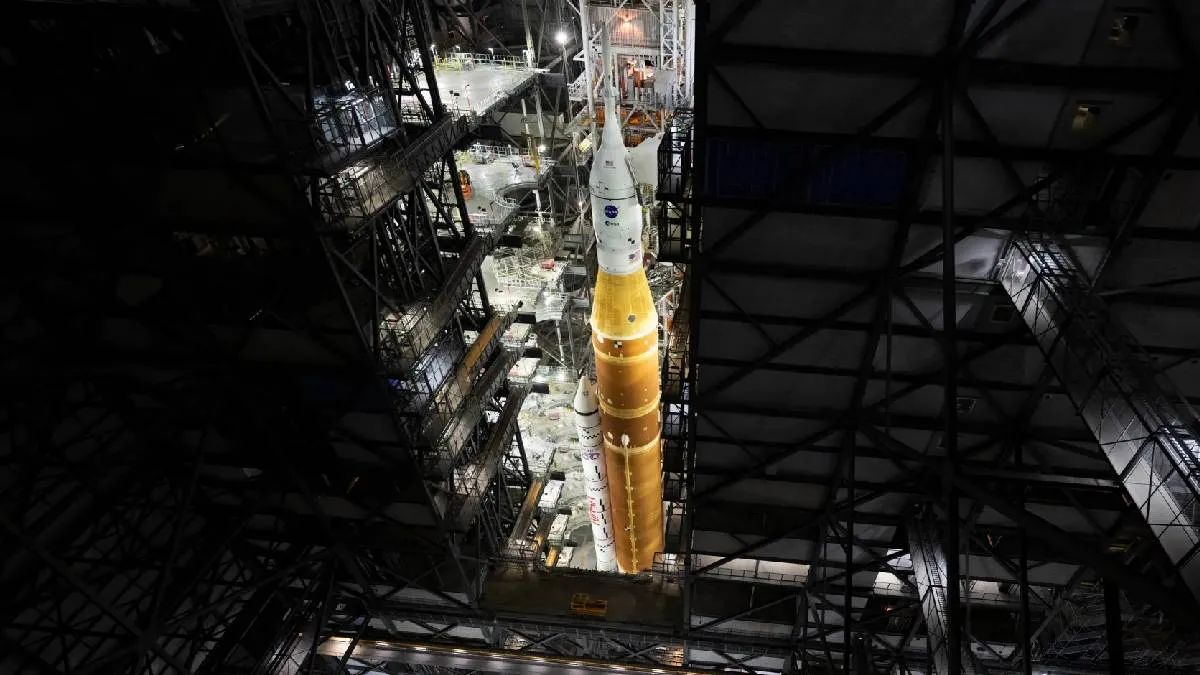
NASA is all set to launch a crewed mission to the Moon, marking humanity’s return to lunar exploration after more than 50 years. As part of the preparations, the American space agency has moved its mega rocket, which will carry astronauts to lunar orbit, to the launch pad at Cape Canaveral, Florida.
The process of transporting the rocket took nearly 12 hours. The rocket, known as the Space Launch System (SLS), will be used for NASA’s upcoming Artemis II mission.
SLS rocket rolled out to launch pad 39B
The SLS rocket began its journey from the Vehicle Assembly Building at 5:34 pm IST on January 17 and reached Launch Pad 39B at the Kennedy Space Center at 5:12 am IST on January 18.
It was moved in a vertical position at a speed of 1.3 km/h. With the rocket now in place, NASA will conduct final checks and testing ahead of the launch.
Wet dress rehearsal before launch
NASA will now carry out a wet dress rehearsal, a crucial pre-launch test that involves rehearsing fuel loading operations and countdown procedures. This step ensures that all systems function correctly before the actual launch of the 10-day Artemis II mission.
Artemis II launch timeline and windows
According to NASA, the earliest possible launch date is February 6, provided all preparations go according to plan. The space agency has also identified additional launch windows in the first few days of March and April.
A total of four astronauts will travel to the Moon as part of this mission.
Artemis II crew details
The Artemis II crew includes NASA astronauts Reid Wiseman, Victor Glover, and Christina Koch, along with Canadian astronaut Jeremy Hansen.
During the 10-day mission, the astronauts will spend the first two days orbiting the Earth. When they fly around the far side of the Moon, they will have a three-hour lunar observation window to observe, photograph, and study the Moon’s geology. These observations will help plan future missions, including a landing near the Moon’s south pole.
First crewed Moon mission since Apollo 17
Artemis II will be the first crewed mission to the Moon since Apollo 17, which landed on the lunar surface in December 1972. NASA has stated that this mission will take astronauts farther into space than any human has traveled before.
Laying the groundwork for Artemis III
The mission will lay the groundwork for Artemis III, which NASA has confirmed will not take place before 2027. Artemis III aims to land astronauts on the Moon and establish a sustained human presence.
Orion spacecraft and European Service Module
A key component of the Orion spacecraft is the European Service Module, built by Airbus in Bremen, Germany. Positioned behind the crew capsule, it provides propulsion to carry Orion to the Moon.
The module is also equipped with large solar arrays to generate electrical power and storage tanks for oxygen and nitrogen, which are mixed to produce air and water for the astronauts.
