
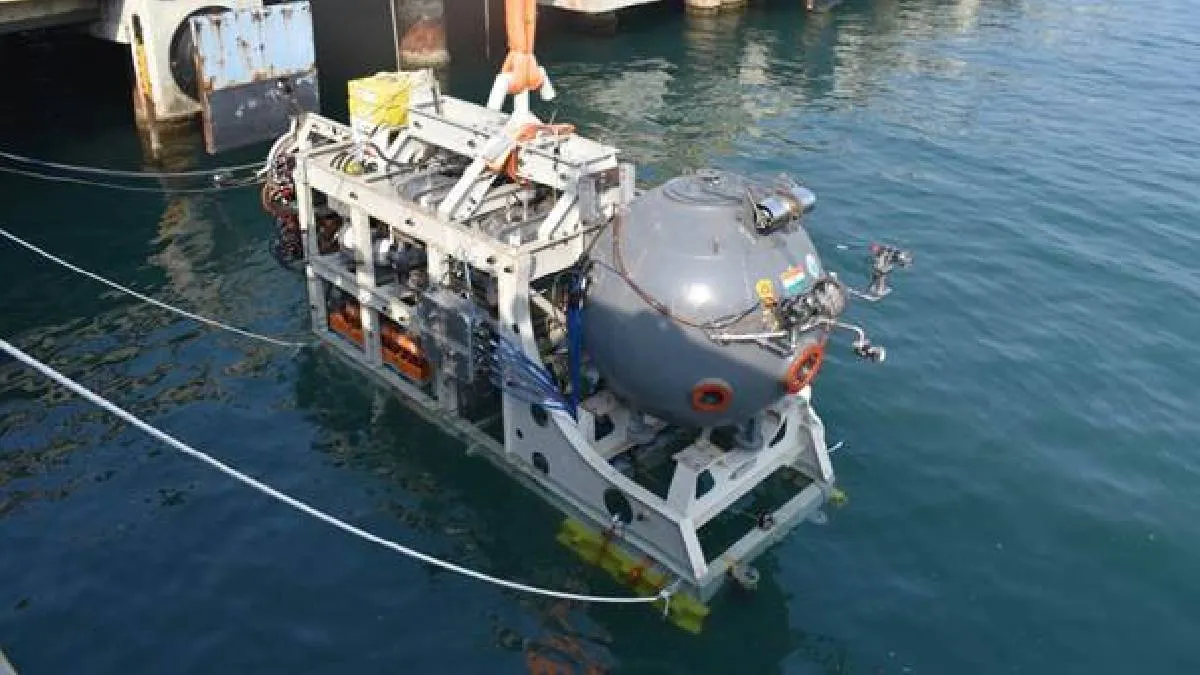
On Wednesday, ISRO's Vikram Sarabhai Space Centre (VSSC) announced that it had signed a Memorandum of Understanding with the National Institute of Ocean Technology (NIOT) to develop MATSYA-6000, a submersible spherical vessel capable of carrying humans into the sea to a depth of 6 kilometers. According to ISRO, this human-occupied vehicle (HOV) is part of 'Samudrayaan,' a project under the Deep Ocean Mission of the Ministry of Earth Sciences (MoES). A release from the space agency on Wednesday detailed that VSSC had carried out the HOV's design, along with the development of the material for its construction.
The release further specified that the sphere, measuring 2,260mm in diameter with an 80mm wall thickness, is constructed from Titanium alloy and is designed to withstand an external pressure of up to 600 bar under low temperatures of -3°C. It was also stated that the vessel has the capability to transport a three-member crew into the deep ocean.
Matsya-6000
Under the Government of India’s Deep Ocean Mission initiatives, the Ministry of Earth Sciences has assigned the National Institute of Ocean Technology the task of designing and developing the 4th Generation deep-ocean human scientific submersible named "Matsya-6000," part of the Samudrayan Project. This submersible is designed to accommodate three individuals within its compact 2.1-meter diameter spherical hull, representing a notable advancement in India's ocean exploration capabilities.
The submersible includes a main ballast system for diving, thrusters for movement in all three directions, a battery bank for power supply, and syntactic foam for buoyancy. It is equipped with a power distribution network, control hardware and software, as well as advanced underwater navigation devices. Communication systems feature an acoustic modem, underwater telephone, and VHF for surface communication, along with underwater acoustic positioning and GPS for precise surface location tracking.
Inside the spherical hull, the integration of human life-support systems is carefully designed, along with displays of various environmental and critical parameters, navigation controls for maneuverability, and a range of oceanographic sensors. Additional features include underwater lighting and external cameras. All subsystems have been designed in India and are presently undergoing integration and qualification testing.
ALSO READ: New NCERT book features Shubhanshu Shukla: 'Earth looks one from space, no border exists'
