
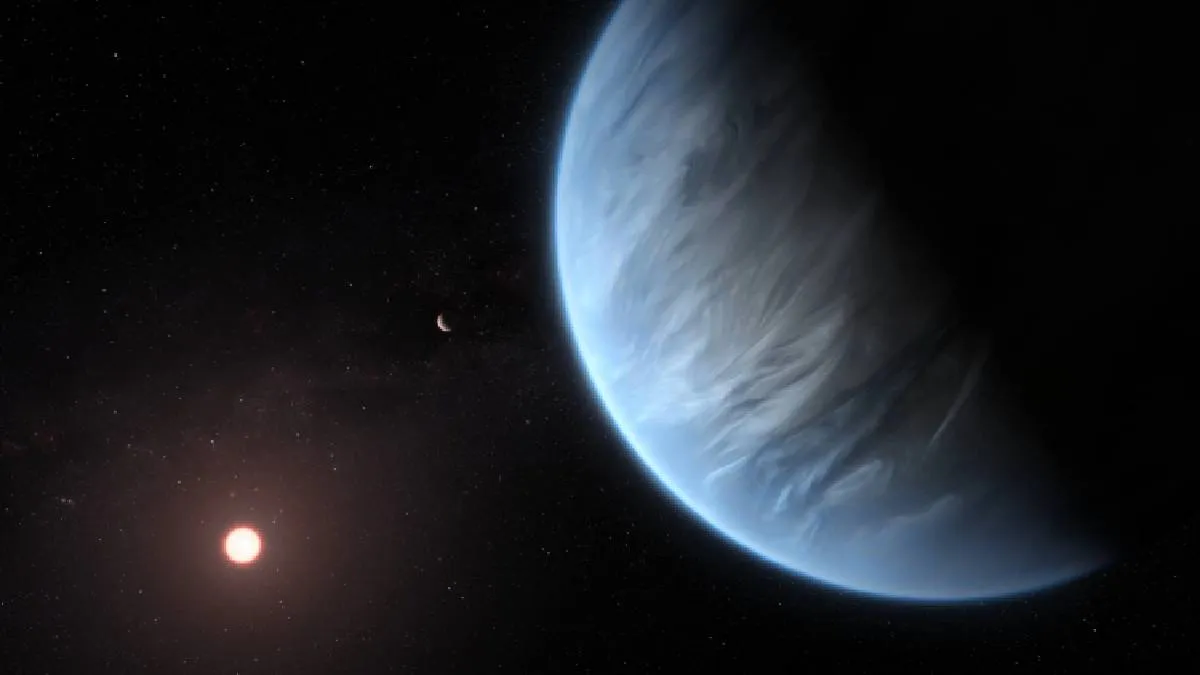
A giant planet located 124 light-years from Earth has provided what astronomers believe to be the strongest evidence to date that extraterrestrial life may be flourishing beyond our solar system. Observations made by the James Webb Space Telescope of a planet known as K2-18 b seemingly revealed the chemical signatures of two compounds that, on Earth, are only associated with biological processes. The detection of dimethyl sulfide (DMS) and dimethyl disulfide (DMDS) would not equate to definitive proof of alien life but could potentially bring humanity closer to answering the question of whether we are alone in the universe.
Professor Nikku Madhusudhan, an astrophysicist at the University of Cambridge who led the observations, commented that this represents the strongest evidence for biological activity beyond the solar system thus far. He emphasised the need for caution, urging a careful evaluation of whether the detected signal is reliable and what its implications might be.
Professor Madhusudhan remarked that in decades to come, we might reflect on this moment as a pivotal turning point—one that brings humanity closer to an answer regarding our solitude in the universe. However, skepticism remains among some experts regarding the overall conditions on K2-18 b and whether DMS and DMDS, primarily produced by marine phytoplankton on Earth, can be definitively categorised as biosignatures.
Planet K2-18 b
K2-18 b is situated in the Leo constellation, being nearly nine times as massive as Earth and 2.6 times its size, while orbiting within the habitable zone of its star, a cool red dwarf less than half the size of the sun. After the Hubble Space Telescope seemed to detect water vapor in its atmosphere in 2019, scientists labeled it as “the most habitable known world” beyond our solar system.
However, subsequent observations by Madhusudhan’s team in 2023 revealed that the supposed water signal was actually methane. Nonetheless, they maintained that K2-18 b's profile suggested it could be a habitable world with a vast, deep ocean—a view that remains contentious. The Cambridge team also reported a tentative indication of DMS.
Does life exist in Planet K2-18 b
Given the vast distances separating us from other planets, capturing images or reaching them with robotic spacecraft remains unfeasible. However, scientists estimate their size, density, and temperature and analyze their chemical composition by tracking exoplanets as they pass across their host stars, measuring the starlight filtered through their atmospheres.
In the latest observations, wavelengths absorbed by DMS and DMDS were noted to drop off sharply as K2-18 b crossed in front of the red dwarf. Madhusudhan described the clarity of the signal, noting the significance of detecting these molecules on habitable planets as a remarkable achievement.
The findings, published in The Astrophysical Journal Letters, indicated concentrations of DMS and DMDS, or both, that were potentially thousands of times stronger than Earth's levels. Though reported with a “three-sigma” level of statistical significance (indicating a 0.3 percent probability that they occurred by chance), this still falls short of the gold standard for scientific discoveries.
Madhusudhan acknowledged the possibility of unknown processes producing these molecules but expressed skepticism that any known non-biological processes could explain their presence. However, others, such as Dr. Nora Hänni, a chemist at the Physics Institute of the University of Berne, urged caution, suggesting that while life is one possibility, there are numerous alternatives that must be considered before claiming biological activity. She pointed out that DMS was also detected on a lifeless icy comet, implying that various mechanisms could create similar chemicals without the presence of life.
Some experts warn that relying solely on atmospheric measurements may never provide unequivocal evidence of life. Dr. Caroline Morley, an astrophysicist at the University of Texas, Austin, noted that technosignatures, such as signals from an advanced civilization, might serve as more convincing evidence, despite the challenges of detecting such signals. Nonetheless, she acknowledged the significance of the new findings. Dr. Jo Barstow, a planetary scientist at the Open University, shared this view, recognising the detection as noteworthy but emphasising that the standards for claiming evidence of life should be exceptionally high. She articulated her skeptical stance on claims related to extraterrestrial life, suggesting that the latest work has not yet crossed the necessary threshold for proof.
ALSO READ: Want to travel to space like Katy Perry? It could cost you crores
