
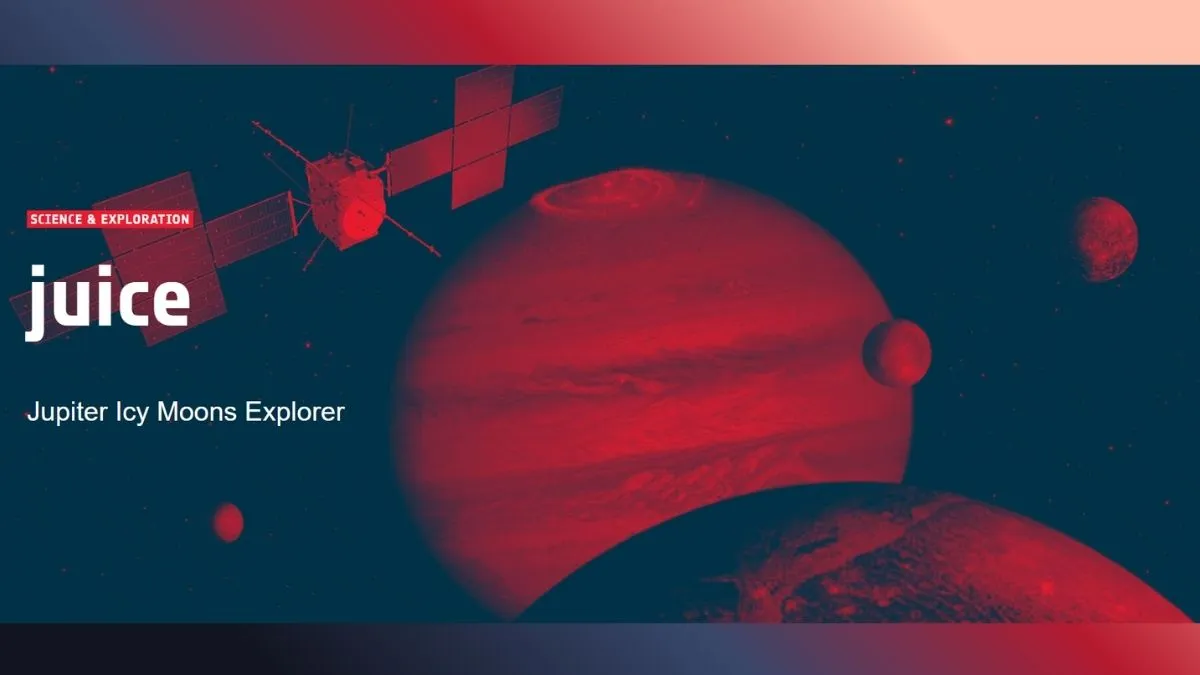
The European Space Agency (ESA) is making major strides in its hunt for alien life with the Jupiter Icy Moons Explorer (JUICE) mission. Recently, the spacecraft conducted a successful test of its radar system during a lunar flyby, focusing on a location called the Earthrise crater, a young impact site located near the Moon's far side.
This crater, named in honour of Apollo 8 astronaut William Anders last year, has long been a symbol of space exploration. Its quiet, geologically stable nature made it the perfect test site for JUICE’s subsurface scanning instruments.
RIME Radar System passes first test
The focus of the test was ESA’s Radar for Icy Moon Exploration (RIME), which is designed to study the subsurface layers of Jupiter’s major moons- Europa, Ganymede, and Callisto- which are believed to host liquid oceans beneath icy crusts.
To ensure accurate readings, all other instruments aboard JUICE were turned off during the radar test. Engineers had to fine-tune an algorithm to correct the radar data. Impressively, the radar maps matched closely with NASA’s previous LOLA elevation models, confirming the effectiveness of the system.
This success is crucial, as RIME will play a central role in exploring the hidden geologies of distant worlds- and perhaps uncovering signs of extraterrestrial life.
Heading to Jupiter via Venus
Launched in April 2023, JUICE is currently en route to Venus, where it will perform a gravity-assist manoeuvre before heading towards Jupiter. Over the next decade, it will carry out 35 flybys of the gas giant’s moons, eventually entering orbit around Ganymede between 2034 and 2035.
A mission of hope and discovery
With its radar system successfully tested on the Moon, ESA’s JUICE spacecraft is now well-equipped for its ambitious journey toward Jupiter. As it prepares to explore the icy depths of Europa, Ganymede, and Callisto, the mission holds the promise of uncovering secrets buried beneath frozen surfaces, and perhaps even signs of alien life.

For scientists and space enthusiasts alike, JUICE represents not just a technological marvel but a symbol of humanity’s quest to understand the mysteries of our solar system and beyond.