
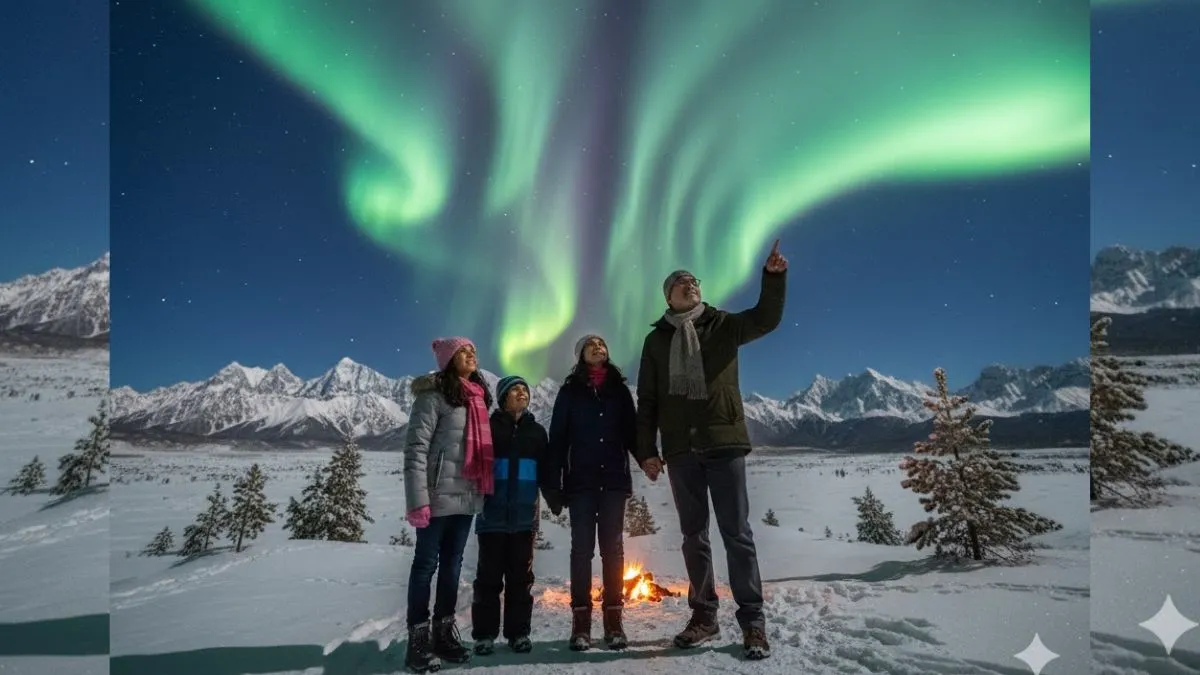
Aurora Borealis 2026: Before we start, let us tell you that the Sun runs on an 11-year cycle. Sometimes it’s quiet, and other times it really turns up the heat. NASA says Solar Cycle 2025 hit its high point, which is termed the ‘Solar Maximum’, in late 2024. That’s when the Sun spits out more sunspots, solar flares, and all sorts of magnetic chaos.
Even though activity technically starts to drop after the peak, it’s not like the sun just chills out overnight. It stays fired up for a few more years, so 2026 looks like a fantastic year to catch the aurora.
How will solar storms set the sky on fire with maximum aurora in 2026?
Auroras are the colourful skylights which are majorly shown in the northern part of the earth. They happen when the charged particles blast out during solar flares or coronal mass ejections, slam into Earth’s magnetic field, and ride the lines right to the poles. Up there, they crash into oxygen and nitrogen high in the atmosphere, and that’s what makes those glowing, swirling curtains of colour. Just look at what happened on November 11, 2025. An X5.1-class flare set off some of the brightest auroras seen in the UK and across Europe. So yeah, even one big flare can light up the night sky long after the official solar maximum has passed.
Why does 2026 look like a dream year for skywatchers?
Experts are claiming that the solar storms will stick around at high levels through 2026, even as the Sun starts its slow slide toward the next quiet period. Exciting news is that we have got steady solar activity teaming up with a bit of seasonal magic.
Aurora Borealis majorly shows up more often around the spring and autumn equinoxes, when Earth’s magnetic field lines up just right with the solar wind. The NOAA Space Weather Prediction Centre says these equinox periods are prime time for aurora watching.
The Russell–McPherron effect: Why timing matters
There is a name for this seasonal boost—the Russell–McPherron effect.
During the equinoxes, Earth’s tilted magnetic field lets solar particles sneak in more easily. That means geomagnetic storms are twice as likely, and auroras get brighter and spread farther than usual, especially around March and September.
Aurora Borealis chasing is easier than ever
These days, satellites and real-time space weather alerts make it way easier to know when to look up. Even your phone camera can catch colours your eyes might miss. So, whether you’re a seasoned aurora chaser or just curious, 2026 is shaping up to be a banner year to see the northern lights for yourself.
