
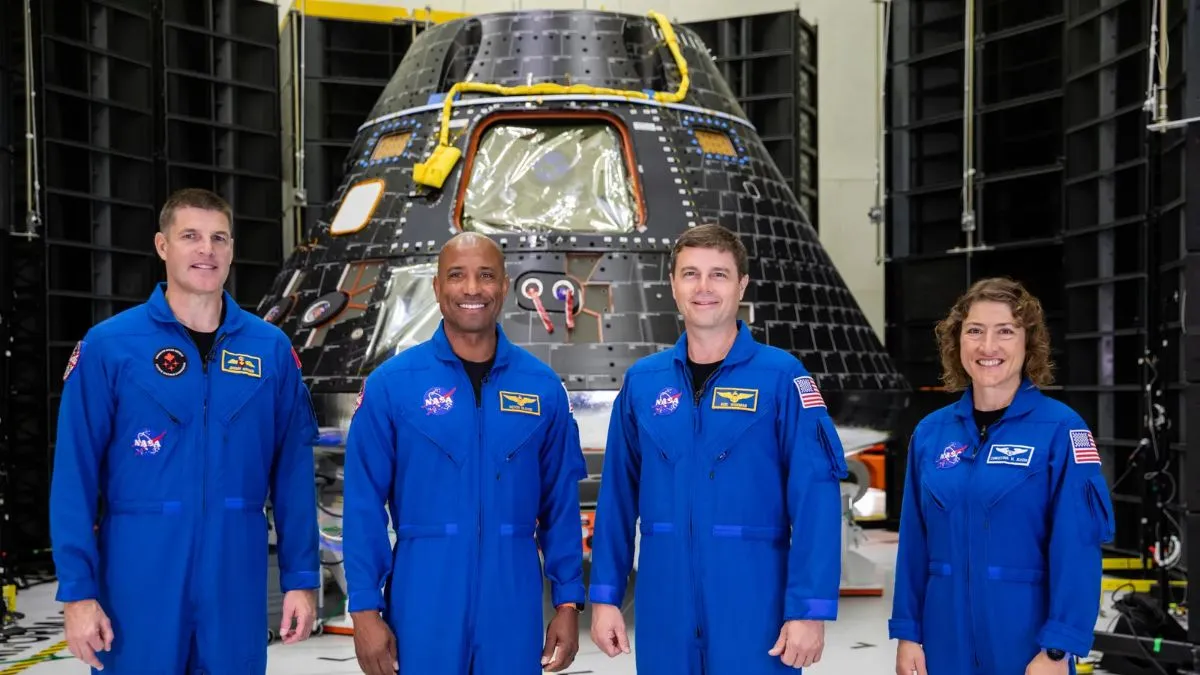
NASA’s Artemis II astronauts have finally set off for the Moon. After circling Earth for about 25 hours, the crew pulled off a perfect ‘translunar injection’ burn, sending their Orion spacecraft out of Earth’s orbit and towards deep space. It is the first time people have left the Earth's orbit since Apollo wrapped up back in 1972.
Charting new milestones
Commander Reid Wiseman, pilot Victor Glover, mission specialist Christina Koch, and Canadian astronaut Jeremy Hansen make up the Artemis II crew.
The flight is not just historic because it is headed to the Moon, but it is breaking barriers. Glover is the first Black astronaut heading to lunar space, Koch is the first woman, and Hansen is the first non-American to make their journey.
Orion shoots into deep space
Currently, Orion is on the path that will send it almost 400,000 km away from Earth. The mission uses a free-return trajectory; this means that the capsule will swing around the Moon and come back home without actually entering the lunar orbit.
The astronauts stated that they watched as Earth shrank behind them, with Hansen calling it a ‘phenomenal’ view.
What Artemis II hopes to prove
This flight is important for testing the life-support systems and deep-space travel for humans. NASA’s counting on Artemis II to pave the way for future Moon landings. If all goes to plan, the spacecraft will swing past the Moon early next week, reaching close to 6,400 km beyond it before turning around for home. Splashdown and reentry are set for April 10.

Handling some glitches
The launch went off without a hitch or glitch, but the crew reportedly hit a few bumps. As per the reports, the toilet system witnessed some glitches for a bit, but NASA fixed it soon, and backup systems kept everything running smoothly. The astronauts also had to prepare backup water supplies after noticing a minor issue with a valve as well.
A fresh chapter in Lunar exploration
NASA is calling ‘Artemis II’ the kickoff to a new era. This mission will lay the groundwork for building a sustainable lunar base and getting astronauts back on the Moon by 2028. With Artemis II on its way, humanity is moving one big step closer to a lasting presence beyond Earth.