
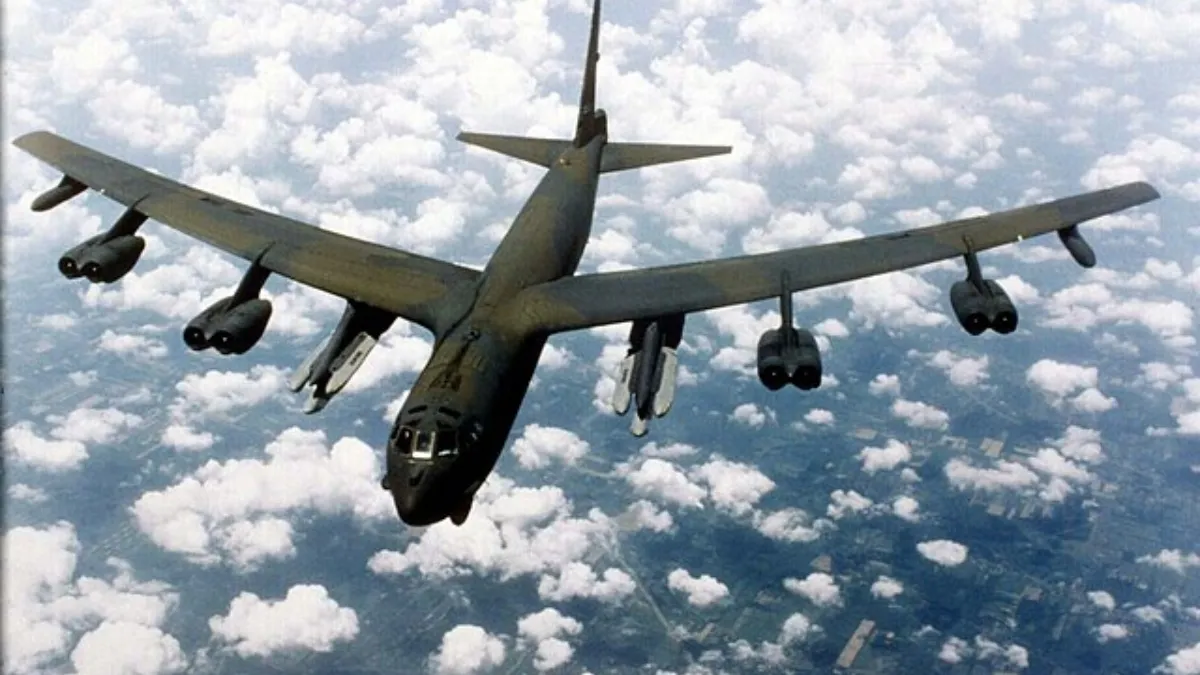
A routine Cold War patrol turned into one of history's most serious nuclear accidents when a US Air Force B-52 bomber carrying four hydrogen bombs crashed near Thule Air Base in northwestern Greenland. On January 21, 1968, a B-52 bomber, part of "Operation Chrome Dome," carrying four B28FI thermonuclear bombs, was flying over Baffin Bay when a fire in the cabin forced the crew to abandon the plane before it could make an emergency landing at Thule.
Six crew members ejected safely, but one died in the crash. While the bomber crashed onto the sea ice of North Star Bay, causing the high-explosives component of the weapons to explode, rupturing and dispersing the nuclear payload across the surface of the ice.
What happened next?
Within hours of the accident, American and Danish authorities launched a massive cleanup effort, Operation Crested Ice. The mission faced immense pressure, as the work had to be completed before the spring thaw, when melting sea ice could carry radioactive contaminants into the ocean. The operation unfolded under brutal Arctic conditions. Temperatures averaged –40 °F (–40 °C) and at times plunged to –76 °F (–60 °C), with winds reaching up to 89 miles per hour (40 m/s). Despite the darkness of the polar winter and the constant threat of exposure, the cleanup teams were tasked with one of the most challenging recovery operations of the Cold War.
It is believed that the high explosives in the outer coverings of the four 1.1 megaton H-Bombs aboard detonated, releasing radiation from the plutonium in the bombs and causing fires that destroyed all four. Wreckage of the plane was widely scattered in an area about 300 yards on either side of the plane's path, much of it in "cigarette box-sized" pieces.
A specialised team of 70 Air Force and civilian radiation experts was immediately deployed to monitor contamination and recover debris, later joined by the Navy's special recovery unit previously involved in the Palomares incident. After about ten days, the bombs' components were located within 1,000 feet of the crash site. A massive collection and removal effort began. The contaminated ice and crash debris were removed to the United States, and the bomb debris was sent to the AEC Pantex plant at Amarillo, Texas, where the bombs had been manufactured.
Radioactive materials at the accident site
The area was highly contaminated with JP-4 aviation fuel and radioactive elements that included plutonium, uranium, americium and tritium. Plutonium levels as high as 380 mg/m2 were registered in the area.
| Nuclide | Half-life | Type of radiation |
| Uranium-238 | 4.5 billion years | Alpha |
| Uranium-235 | 700 million years | Alpha |
| Uranium-234 | 250,000 years | Alpha |
| Plutonium-239 | 24,000 years | Alpha |
| Americium-241 | 430 years | Alpha/Gamma |
| Plutonium-240 | 6,600 years | Alpha |
| Plutonium-241 | 14 years | Beta |
| Tritium | 12 years | Beta |
All four bombs were destroyed?
According to General Hunziker, 93 per cent of the contaminated material was successfully removed from the accident site. However, reports in the Danish press in 1987–88 and again in 2000 suggested that one of the bombs may not have been fully recovered. At the time of the incident, the Strategic Air Command (SAC) had stated that all four bombs were destroyed.
In 2008, the BBC published an article based on partially declassified documents obtained through the United States Freedom of Information Act. These documents indicated that within weeks of the accident, investigators realised only three of the four weapons could be accounted for.
One declassified document, dated January 1968, describes a blackened section of ice with shroud lines from a weapon parachute, noting: "Speculate something melted through the ice such as burning primary or secondary." A follow-up report from July 1968 states that an AEC analysis of the recovered secondary components showed that 85 percent of the uranium and 94 percent, by weight, of three secondaries had been recovered, while no parts of the fourth secondary were identified.
Even today after more than fifty years later, scientists and local residents continue to wonder what lies beneath the ice of North Star Bay and whether the missing fragments of the hydrogen bombs still pose a hidden threat in the Arctic depths.
