
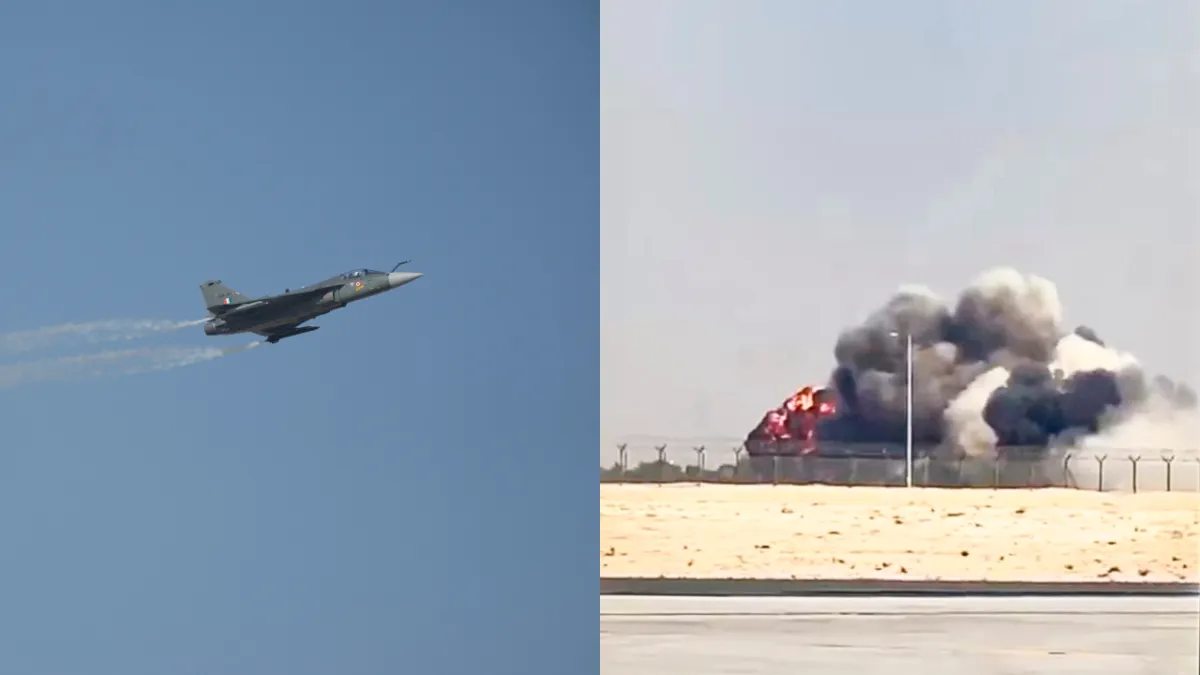
A US aerobatic pilot has issued a critique of the Dubai Airshow’s decision to continue its flying programme after an Indian Air Force Tejas fighter jet crashed, killing Wing Commander Namansh Syal. The pilot, Taylor “FEMA” Hiester, said his team immediately withdrew from their scheduled routine in honour of the fallen IAF officer, calling the organisers’ move to carry on “shocking.”
“The show must go on is what they always say. And they’re right. But just remember someone will say that after you’re too,” he said, reflecting on the jarring normalcy that followed the tragedy.
Team opted out ‘out of respect’ for Wing Commander Syal
Hiester, who later shared his account on Instagram, said he had been flooded with messages asking if his team was involved in the incident. Clarifying that they were already preparing to return to the US, he recounted how his team had been getting ready for their final display when the crash occurred.
Wing Commander Namansh Syal lost his life during an aerobatic manoeuvre on the last day of the event. Hiester wrote that while organisers kept the flying schedule unchanged, several teams including his pulled out of their final performance in a gesture of solidarity.
“Though the show made the shocking decision to continue with the flying schedule, our team along with a few others made the decision to cancel our final performance out of respect to the pilot, his colleagues and family. I have a few personal notes to share which is what this page is for,” he wrote.
Hiester described witnessing the aftermath from afar, a moment that left the team deeply shaken. He wrote about the Indian technical crew standing silently beside the empty slot where the Tejas had been parked, the aircraft ladder still lying on the ground, and the pilot’s belongings undisturbed in his rental vehicle.
“Together and individually, we all quietly watched the aftermath unfold from a distance thinking about the Indian maintenance crew standing on the ramp next to an empty parking spot, aircraft ladder laid on the ground, the pilot’s belongings still in his rental car. I suppose each of us contemplated their new reality that came in an instant,” he wrote.
Crowd cheer continued as if nothing happened
What stunned Hiester further was the atmosphere he encountered when he walked through the venue later. Expecting silence and subdued crowds, he instead found the airshow proceeding almost normally.
“After they put the fire out, and I was notified by the airshow organisers that the flying display would continue, I made the decision that we would cancel… The announcer was still enthusiastic, the crowd still watched the next several routines with excitement and when the show was over, it ended with ‘Congratulations to all of our sponsors, performers and we’ll see you in 2027’,” he wrote.
He said the experience felt “uncomfortable,” noting how the disconnect between tragedy and spectacle forced him to reflect on his own team and the fragility of life in aviation.
Hiester said the surreal normalcy at the event served as a stark personal awakening a reminder that the bonds forged with teammates outweigh the glamour of airshows or the so-called “rockstar treatment” performers often receive.
“Just before the last performance, at the last show, the last time we’d all wear our show uniforms together, I was shaken awake by this truth despite whatever guise, whatever ‘rockstar treatment’, fancy dinners and sponsor chalets, my team who became my family is all I ever had in the first place. It’s a lesson I’ll keep with me long after I’m finished with demonstration flying. It applies to you too,” he wrote.
Hiester ended his note with a philosophical reflection on a phrase often used in airshow culture one that, after witnessing the tragedy, carried deeper meaning.
“The people you invest in, the people that you love and the people that love you back… will be the only way you live past your own individual end,” he wrote, concluding with a simple: “Thanks.”
