
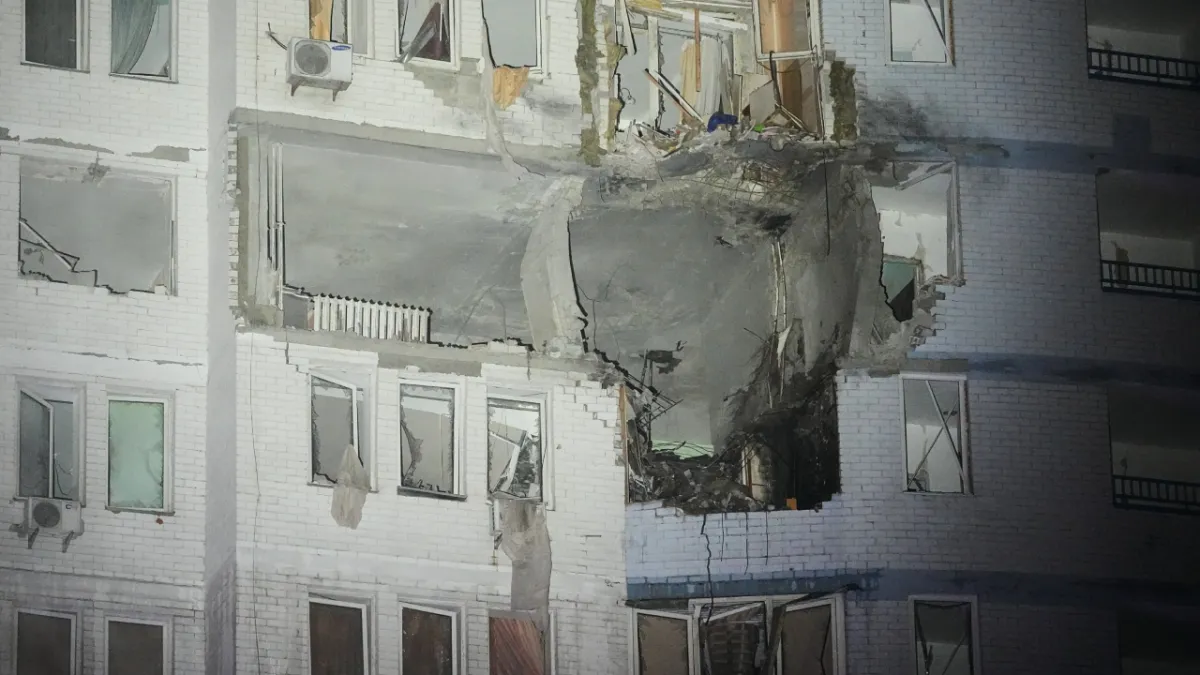
At least 4 people were killed, and around 25 were injured in Kyiv after Russia launched a large-scale overnight assault using hundreds of drones and missiles. Ukrainian officials said the barrage, which continued into Friday, targeted multiple regions and caused damage to civilian infrastructure, particularly in the capital.
Ukrainian authorities described the attack as one of the most intense in recent months. It marked the second time in the nearly 4 year war that Russia deployed its new hypersonic missile, signalling a sharp escalation in both military capability and political messaging.
Use of hypersonic missile a warning?
For only the second time since the war began, Russia used the nuclear capable Oreshnik hypersonic missile, which struck western Ukraine, including the Lviv region. Analysts see the use of this weapon as a deliberate warning to Ukraine’s NATO allies and the West.
The missile was launched amid reports of progress in talks between Ukraine and its allies on long term security guarantees in the event of a US led peace deal. By deploying Oreshnik, Moscow appeared to be underlining its ability to escalate far beyond conventional strikes if it chooses to do so.
Russia’s stated objectives
Russia’s Defence Ministry said its forces used aviation, drones, missiles and artillery to strike Ukrainian energy infrastructure and fuel storage facilities. Ukrainian officials said the aim was to cripple the power grid and deprive civilians of heat, light and running water during winter, a strategy they described as an attempt to weaponise winter.
Russia has repeatedly targeted energy infrastructure in recent months as part of a broader campaign to weaken Ukraine’s economy and civilian morale.
Ukraine’s response
Ukraine’s General Staff said it struck the Zhutovskaya oil depot overnight, which it said supplies fuel to Russian forces. Officials said the extent of the damage was still being assessed.
Ukraine has increasingly relied on long-range drone strikes against Russian energy sites in an effort to cut off oil export revenue that Moscow uses to fund its war effort.
What is the Oreshnik missile
Russia first used the Oreshnik missile in November 2024 against the Ukrainian city of Dnipro. President Vladimir Putin said the missile travels at Mach 10, or 10 times the speed of sound, and claimed it is immune to existing missile defence systems.
Putin said several such missiles, even with conventional warheads, could have an effect comparable to a nuclear strike. He also claimed the missile can destroy underground bunkers located 3 or 4 floors below the surface.
Capabilities and controversy
The Russian military says Oreshnik can carry either nuclear or conventional warheads and has the range to reach any target in Europe. The Pentagon has described it as an experimental intermediate range ballistic missile derived from Russia’s RS 26 Rubezh intercontinental ballistic missile.
Intermediate range missiles, with ranges between 500 and 5,500 kilometres, were banned under a Cold War era treaty that the United States and Russia abandoned in 2019.
When first used, Ukraine’s military said Oreshnik carried 6 independently targetable warheads, each containing 6 submunitions. Russian military bloggers suggested these submunitions were unarmed but delivered enormous kinetic energy, producing destruction equivalent to several tonnes of explosives.
Why this matters for Trump and NATO
The timing and nature of the strike are widely seen as a strategic signal. By showcasing a hypersonic missile with nuclear capability, Russia appears to be warning NATO countries against deeper military involvement and signalling to future US leadership, including Donald Trump, that Moscow retains escalation dominance.
The message is clear. Any security guarantees for Ukraine backed by NATO could carry risks that extend far beyond the battlefield, into a confrontation with weapons designed to overwhelm existing defence systems.
Since launching its full scale invasion in 2022, Russia has used a wide range of drones and missiles, but none with the speed, range and psychological impact of the Oreshnik. Its deployment marks a new and dangerous phase in the conflict.
| Maduro-style capture on Russian President Putin? Here's what Trump said |
|
Trump says US will 'do something on Greenland', cites risk of Russia, China taking over |
