
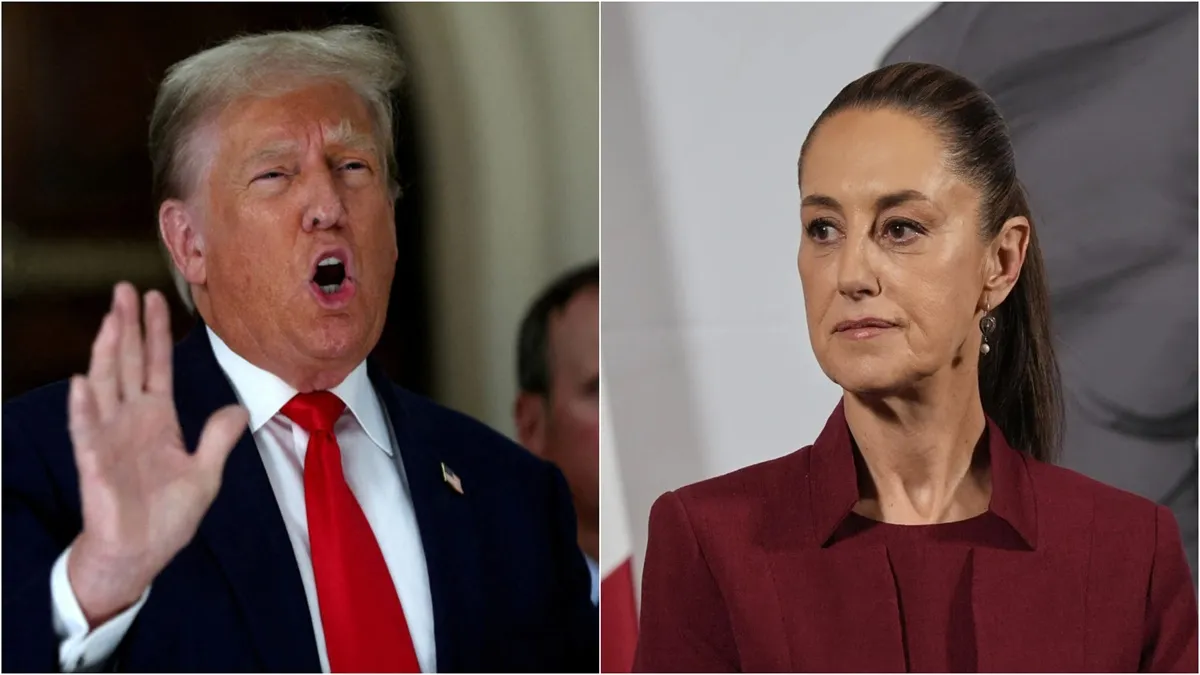
The debate over a possible United States military strike on Mexican drug cartels has intensified after the recent US intervention in Venezuela. However, the Mexican government and several analysts insist that Washington is unlikely to embark on a unilateral operation in Mexico, despite President Donald Trump's repeated warnings. They believe Mexico's strategic importance and strong economic ties with the United States make such a move highly improbable. Still, no one is willing to completely dismiss a sudden, unexpected decision from the White House.
Earlier on Monday, Mexican President Claudia Sheinbaum reiterated that she does not foresee any real danger of US military action. "I don't see risks (of that). There is coordination, there is collaboration with the United States government. I don't believe in the possibility of invasion and I don't believe even that it's something they are taking seriously. Organised crime is not taken care with (foreign military) intervention," she was quoted as saying by The Associated Press (AP).
Why Mexico is not another Venezuela
Experts highlight that Mexico's political and economic scenario is drastically different from that of Venezuela or Cuba. Sheinbaum is widely viewed as a legitimate and popular leader, and Mexico is currently the United States' biggest trading partner with nearly 40 million Mexicans living across the border. Former Mexican ambassador to the US Martha Barcena pointed out that even US Secretary of State Marco Rubio has acknowledged the "high-level cooperation with Mexico".
Threats as diplomatic pressure tactics
Trump has talked about striking Mexican cartels since his campaign days, though such remarks have become more calculated over time. Sheinbaum has disclosed that the topic of US intervention has come up more than once in her conversations with Trump but says she has firmly dismissed it every time. Analysts believe these warnings function more as bargaining tools, much like past tariff threats that were sometimes enforced and sometimes withdrawn.
Security analyst David Saucedo described these remarks as a tactic to extract "commercial, diplomatic and political advantages." He added that Rubio and Trump often operate as "good cop, bad cop", with Trump issuing threats and Rubio toning down the rhetoric.
Mexico aligns with Washington's demands
Analysts note that Mexico has largely complied with Washington's expectations since Trump imposed tariffs. Sheinbaum's administration has intensified operations against drug cartels, leading to more arrests, major drug seizures and increased extraditions. Mexico has also accepted more deported migrants from other nations.
According to Carlos Perez Ricart from CIDE, any US military operation in Mexico would instantly disrupt this collaboration. He cautioned that the United States would lose a crucial ally on security matters. Saucedo added that launching a military campaign would demand extensive money, logistics and risk, while "a comment, a post on social networks doesn't cost anything".
Expect more pressure as USMCA review nears
Analysts predict that these threats will continue as part of the Trump administration's negotiating strategy, particularly with the US-Mexico-Canada Agreement coming up for review. Saucedo believes Washington could push for broader access to Mexican territory for US security agencies or demand more high-profile arrests. There may even be pressure on Mexico to halt oil shipments to Cuba or face fresh tariff threats.
Former Mexican ambassador Arturo Sarukhán cautioned that Mexico will need to be extremely careful in its public messaging during trade and security negotiations. He warned that openly backing leaders like Maduro could "cost Mexico dearly".
Barcena said Mexico must still confront its deep-rooted political corruption linked to organised crime while upholding international law. Though unlikely, analysts refuse to completely rule out a US strike. "The United States does not function under rational logic. At this moment, all possibilities are open, including those unimaginable a year ago," Perez Ricart noted.
ALSO READ: Explainer: Five more countries on Trump's radar after Venezuela and what's behind his tough stance
