
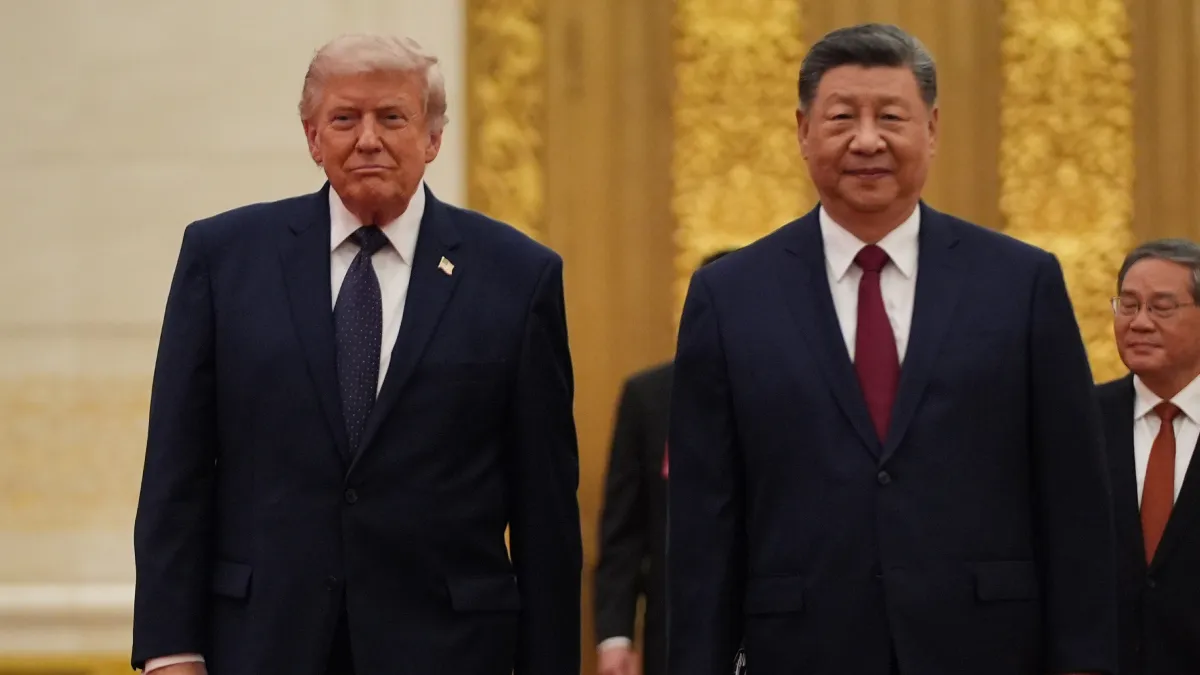
The US and China unilaterally agreed that the Strait of Hormuz should remain open for the free flow of trade and energy supplies and that Iran can never have a nuclear weapon after Donald Trump and Xi Jinping held high-stakes talks in Beijing on Thursday. The meeting between the two leaders is the first since the war broke out in the Middle East in February, leading to an energy supply crisis across the world.
The White House said Trump had a good meeting with President Xi of China, and the two sides discussed ways to enhance economic cooperation between our two countries, including expanding market access for American businesses into China and increasing Chinese investment into our industries.
Key takeways
On Iran and Hormuz
"Leaders from many of the United States' largest companies joined a portion of the meeting. The presidents also highlighted the need to build on progress in ending the flow of fentanyl precursors into the United States, as well as increasing Chinese purchases of American agricultural products," the White House statement said.
The US and China have agreed that the Strait of Hormuz, off the Iranian coast, must remain open to support the free flow of energy. "Both countries agreed that Iran can never have a nuclear weapon," the White House added.
President Xi also reiterated China’s opposition to the militarisation of the Strait and any effort to charge a toll for its use, and he expressed interest in purchasing more American oil to reduce China’s dependence on the Strait in the future.
The Strait of Hormuz is a critical global shipping sea route through which around 20 per cent of the world's crude oil and natural gas is supplied, while Iran's nuclear programme continues to remain the biggest hurdle in the ongoing peace talks between Tehran and Washington.
New vision for US-China ties
China and the United States have agreed on a "new vision aimed at building constructive bilateral ties based on strategic stability," Xi Jinping said.
According to Chinese state media, Xi said he and President Donald Trump had reached an understanding on shaping a stable and constructive China-US relationship that would guide bilateral ties over the next three years and beyond.
Xi added that the new framework would benefit not only the people of both countries but also the wider international community.
Warning to US over Taiwan
Xi emphasised that the Taiwan issue remains the most sensitive and important matter in China-US relations.
According to Chinese state media, Xi warned that if the Taiwan question is handled properly, bilateral ties could maintain overall stability. But if mishandled, it could lead to "clashes and even conflicts", seriously damaging relations between the two countries.
The Chinese President also urged the United States to act with extreme caution on matters related to Taiwan.
China considers self-ruled Taiwan a breakaway province that must eventually be reunified with the mainland, by force if necessary. Beijing opposes formal diplomatic relations between Taipei and countries that officially recognise China.
While the United States established diplomatic ties with China in 1979 and formally acknowledges Beijing's position that Taiwan is part of China, Washington has continued to maintain unofficial relations with Taiwan and supply arms to the island.
