
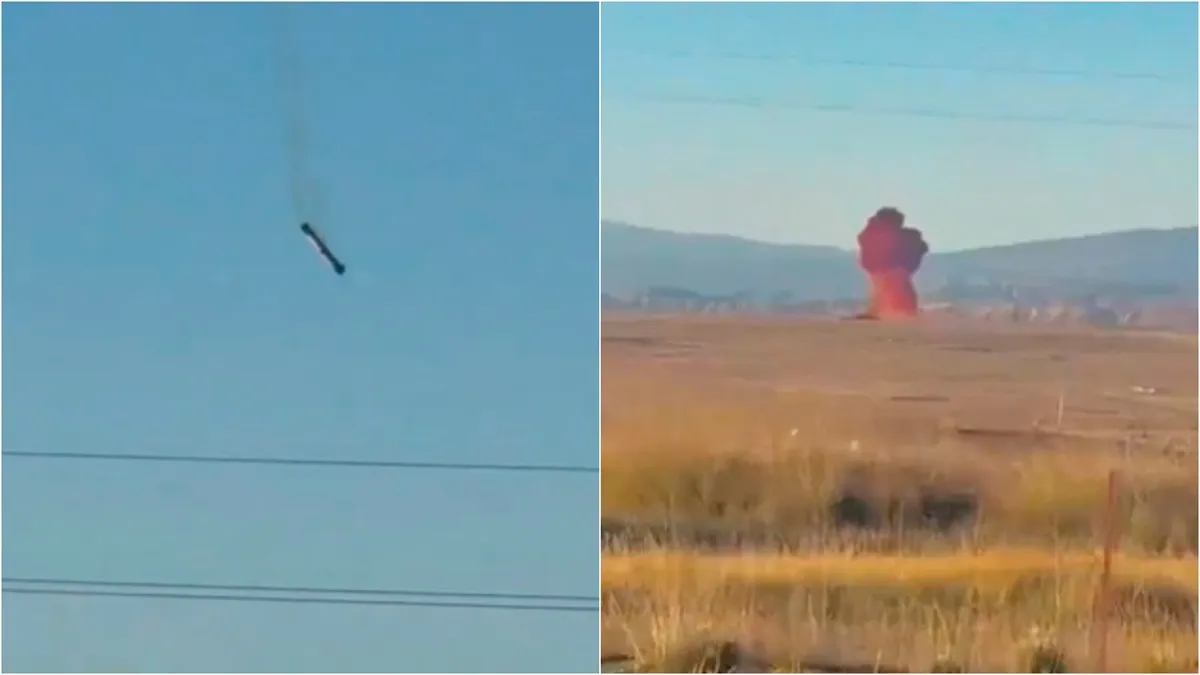
A Chinese Long March 2D rocket stage crashed in Qinghai province's Guinan County just days after launching the Shiyan-31 satellite on October 13, 2025. The rocket was launched from the Jiuquan Satellite Launch Center in northwest China and successfully placed the Shiyan-31 test satellite into orbit. However, the rocket's first stage fell uncontrollably back to Earth, causing panic among residents after it crashed onto grasslands, releasing toxic fumes and igniting small fires. The Long March 2D, a two-stage orbital launch vehicle, is frequently used by China to deploy low-Earth and sun-synchronous orbit satellites. This flight marked the 599th mission of the Long March series, according to the China Aerospace Science and Technology Corporation (CASC).
Residents witness fiery debris and toxic smoke
The launch was reportedly conducted without standard public airspace notifications, an indication of an unusually discreet operation. Following the uncontrolled descent, residents in Guinan County and nearby areas recorded videos showing flaming fragments falling from the sky and thick orange smoke rising after impact. The smoke was caused by the decomposition of hypergolic rocket fuels, such as dinitrogen tetroxide, which are known to be hazardous and pose serious health and environmental risks. Eyewitness videos circulating on social media showed people running in panic as debris scattered across open fields.
Concerns over China's rocket launch practices
China has often faced criticism for allowing rocket stages to fall uncontrollably over inhabited areas, particularly in Tibet and western China. These incidents have repeatedly raised alarms over public safety and environmental pollution. While the Shiyan-31 satellite mission successfully achieved its objective of testing new optical imaging technologies, the uncontrolled crash of the Long March 2D stage has once again drawn international attention to China’s debris management policies. Despite being one of the country’s most reliable rockets with hundreds of successful flights, the Long March 2D continues to face scrutiny for debris safety and fuel contamination risks following re-entry.
ALSO READ: China launches powerful rocket with classified communication satellite: All you need to know
