
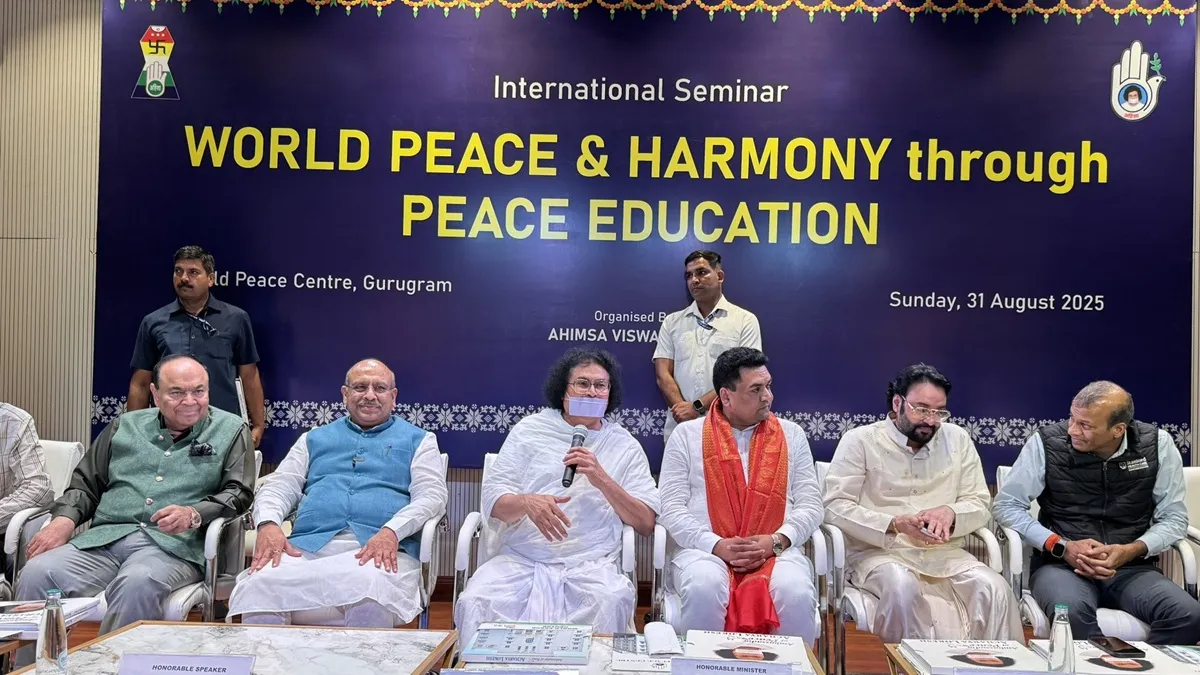
Stanford University has signed a Memorandum of Understanding (MoU) with the World Peace Center in Gurugram to promote ‘peace education’. The collaboration aims to develop joint initiatives focusing on global harmony, intercultural dialogue, and conflict resolution. As part of the agreement, Stanford students will visit India to engage in specialised peace education programs, while the World Peace Center will provide academic and cultural support. Leaders from both institutions described the MoU as a landmark step in fostering international cooperation and nurturing future ambassadors of peace.
Professor Anurag from Stanford University, United States, announced that Stanford students will soon visit India to pursue 'peace education' at the World Peace Center (Vishva Shanti Kendra) in Gurugram. The initiative is expected to foster international collaboration in peace research and cross-cultural understanding.
Stanford-World Peace Center collaboration announced
The upcoming exchange program is part of a broader agreement between Stanford University and the World Peace Center in India. The partnership will serve as a milestone in the global movement for peace, offering young minds from one of the world’s leading universities exposure to India’s traditions of non-violence, mediation, and dialogue.
Professor Anurag emphasised the importance of the initiative, stating that academic institutions must go beyond conventional learning and integrate lessons on sustainable peace, compassion, and coexistence.
Acharya Lokesh terms agreement a 'milestone'
Renowned Jain acharya and peace ambassador Acharya Lokesh, founder of the World Peace Center, hailed the agreement as a turning point in strengthening international efforts towards global harmony. “The agreement between Stanford University and the World Peace Center will prove to be a milestone for world peace,” Acharya Lokesh said.
He pointed out that collaborations like this symbolise a “meeting of East and West,” where the oldest philosophies of peace in India meet modern academic frameworks, creating new pathways for conflict resolution, character building, and leadership training.
Focus on peace education and global youth
The program will encourage Stanford students to engage with Indian spiritual traditions, meditation practices, and interfaith dialogues, enabling them to become ambassadors of peace in their respective countries. Acharya Lokesh stressed that the younger generation, especially students from globally reputed institutions such as Stanford, must be equipped with values of non-violence, empathy, and responsibility towards humanity.
Global significance of the partnership
The agreement is being seen as part of India’s rising role as a global center for peace studies and moral education. By bringing together cutting-edge Western research and India’s centuries-old wisdom on non-violence, the initiative hopes to create a model that can be replicated across universities worldwide.
