
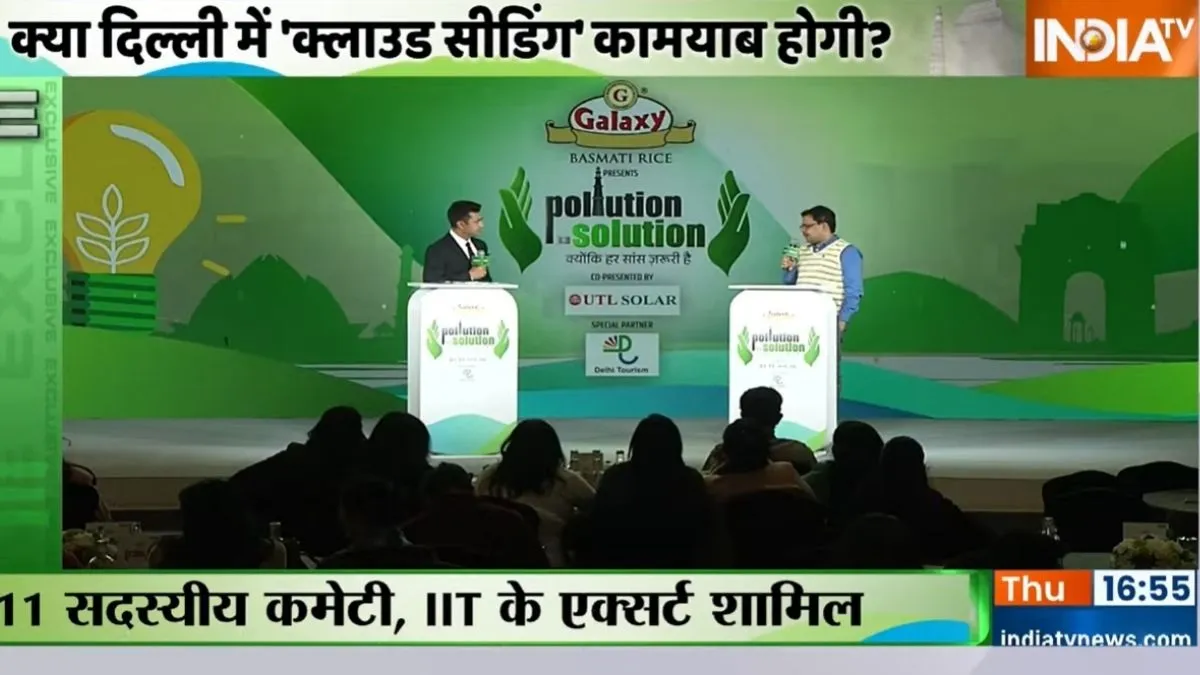
Delhi is reeling under severe pollution and can Cloud Seeding be a solution to the national capital's pollution? Addressing the India TV conclave- 'Pollution Ka Solution', Abhishek Chakraborty from IIT Bombay said that Cloud Seeding could not be a solution for Delhi's pollution and the Cloud Seeding process has a minimal success rate. According to the IIT Bombay Professor said, "To have a successful Cloud Seeding, factors like moisture-rich weather, suitable clouds, specific temperature, humidity above 50 per cent required."
Explaining the process of Cloud Seeding the IIT Bombay Professor said that technique of cloud seeding artificially modifies a cloud so that it produces more rainfall. "Particles like silver iodide or chemical solutions are added to a cloud which act as "seeds" and around which water vapour condenses. In cold clouds, particles of silver iodide are added to a cloud, which accumulate water and ice. In warm clouds, chemical solution, such as sodium chloride (NaCl) or potassium chloride (KCl), is used as a "seeding agent" to promote fusing of water droplets and improve efficiency of rain formation," he said.

Whether Cloud Seeding is possible in Winter, the IIT Bombay professor said, "Winter is not a favourable session for Cloud Seeding. However, Cloud Seeding is possible in a foggy weather. Cloud and moist weather is required for a successful cloud seeding."
Any permanent sollution on Delhi pollution?
Talking on permanent remedies for the pollution, the IIT Bombay professor said that government should take steps on stubble burning and should tackle the pollution caused from industry areas and vehicles. "There are technologies available in foreign countries which can tackle the industrial pollution, but we need policies and man power to implement," the IIT Bombay professor said.
Delhi earlier in October conducted cloud seeding trials to induce artificial rain amid worsening pollution levels. The state government in collaboration with IIT-Kanpur, conducted the trials in several areas, including Burari, north Karol Bagh, Mayur Vihar and Badli.
First artificial rain attempt was made in 1946
First attempts of artificial rain or snowfall are said to have been made in 1946, when American chemist and meteorologist Vincent Schaefer conducted experiments to understand the physics of precipitation. Schaefer added dry ice to a chilled chamber and saw that a cloud instantly formed around the ice particles. The instance is the first documentation of clouds made artificially in a laboratory. Atmospheric scientist Bernard Vonnegut took artificial rain-making attempts forward in 1947, when using silver iodide crystals produced better results in cloud seeding, compared to dry ice.
Also Read