
Highlights
- The use of green hydrogen will reduce dependence on electricity generated from fossil fuel.
- India's hydrogen train features a 10-coach configuration, making it the longest passenger train.
- Its 3,200 HP propulsion system makes it one of the most powerful trainsets in operation.
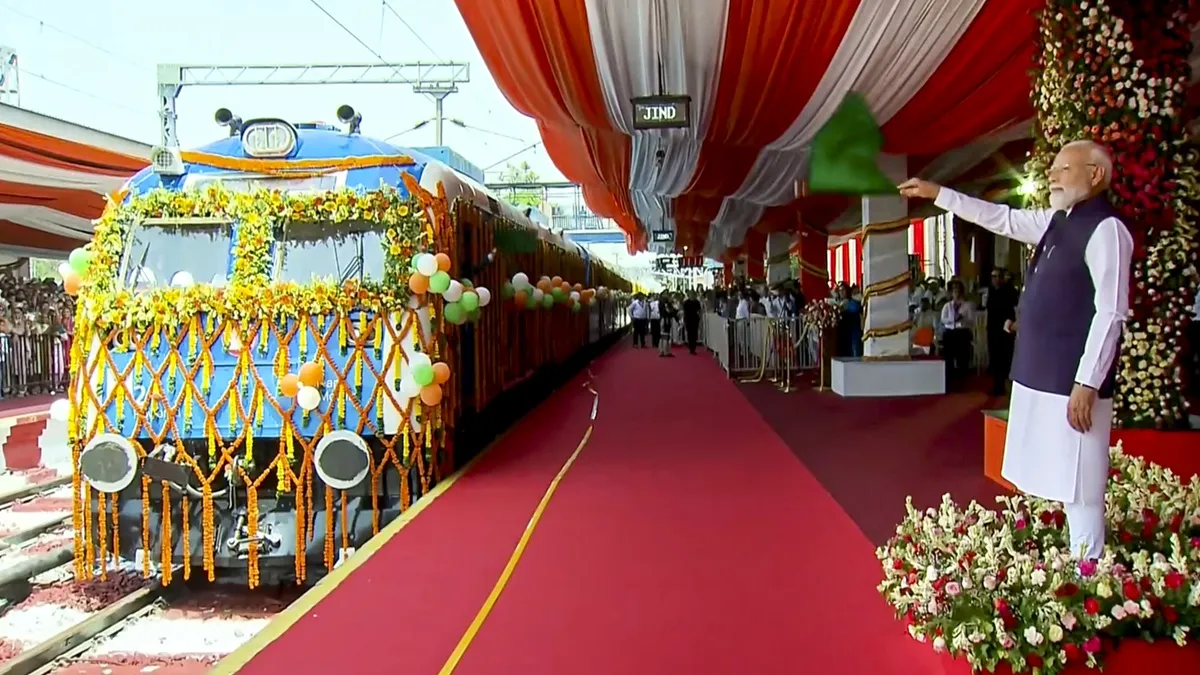
Prime Minister Narendra Modi on Friday flagged off the country's first hydrogen-powered train from Jind to Sonipat and said there are only 3–4 countries around the world that have the capacity to operate a hydrogen-powered train. He said India's first hydrogen train is the strongest as well as the longest hydrogen-powered train anywhere in the world. With the launch of this train, Indian Railways' claims proved true as the hydrogen train moved forward smoothly at a speed of 70 kilometers per hour. One can enjoy a comfortable journey on this train, free from noise and jerks.
Railways' claims proved true as the hydrogen train moved forward smoothly at a speed of 70 kilometers per hour. One can enjoy a comfortable journey on this train, free from noise and jerks. With this, India would join a select group of countries that have operational hydrogen-powered trains.
Visiting Jind is like revisiting cherished memories: PM Modi
PM Modi said, "... For me, visiting Jind is like revisiting cherished memories. As I sat here, I saw many faces, familiar faces from the past. There must be many who claim that I used to ride pillion on their scooters when visiting Jind. I first came to Jind decades ago for organizational work. I have never forgotten the warmth and affection you showered upon me back then... While Jind’s ghee and ghevar have remained unchanged over the years, the spirit and outlook of life in Jind have certainly transformed."
Train has been developed using indigenous technology
Designed, engineered and integrated in India, the train has been developed using indigenous technology, reflecting the country's growing capabilities in advanced railway engineering.
The train is powered by hydrogen fuel cell technology, which converts hydrogen into electricity to propel the train. The process produces only water vapour as a by-product, resulting in zero carbon emissions during operation. Compared to diesel trains, they eliminate tailpipe emissions, lower dependence on fossil fuels and fossil fuel imports, and operate with significantly less noise.

Hydrogen train reduces dependence on electricity
Unlike conventional electric trains, they do not require continuous overhead electrification infrastructure, as electricity is generated onboard through hydrogen fuel cells, making them a clean and efficient solution. The use of green hydrogen also reduces dependence on electricity generated from fossil fuel-based thermal power plants, supporting India's transition to sustainable transport.
India's hydrogen train features a 10-coach configuration, making it among the longest hydrogen-powered passenger trains developed so far. Its 3,200 HP propulsion system makes it one of the most powerful hydrogen-powered trainsets in operation.
This train draws power from hydrogen and oxygen
Unlike conventional electric trains that draw power from overhead lines, the Hydrogen Fuel Cell Trainset generates electricity on board through a chemical reaction between hydrogen and oxygen, with water vapour and heat as its only by-product.
"In a sense, the train once again carries its own source of power, as steam and diesel locomotives once did. But instead of burning traditional fuels, such as coal or diesel, hydrogen generates electricity inside the train using oxygen from the atmosphere, eliminating combustion and dependence on an external power supply," according to an official statement issued on Thursday.
Hydrogen train represents greenest form of rail propulsion
As electricity is generated on board through clean-hydrogen technology, the train represents the greenest form of rail propulsion, powering the future of sustainable mobility. "To complement this advanced propulsion system, India has equipped the train with multi-layer safety systems capable of detecting hydrogen leaks, heat, flames and smoke," the statement said. With an operational speed of 75 kmph and a design speed of 110 kmph, the train is not only safer but also faster on the 89-km Jind-Sonipat section.
Germany was the first country to introduce commercial hydrogen passenger trains, while France, Italy, China, Japan and a few other countries are pursuing pilot projects or limited deployments. However, these trains typically comprise two to four coaches and are intended primarily for regional passenger services.
Also Read: