
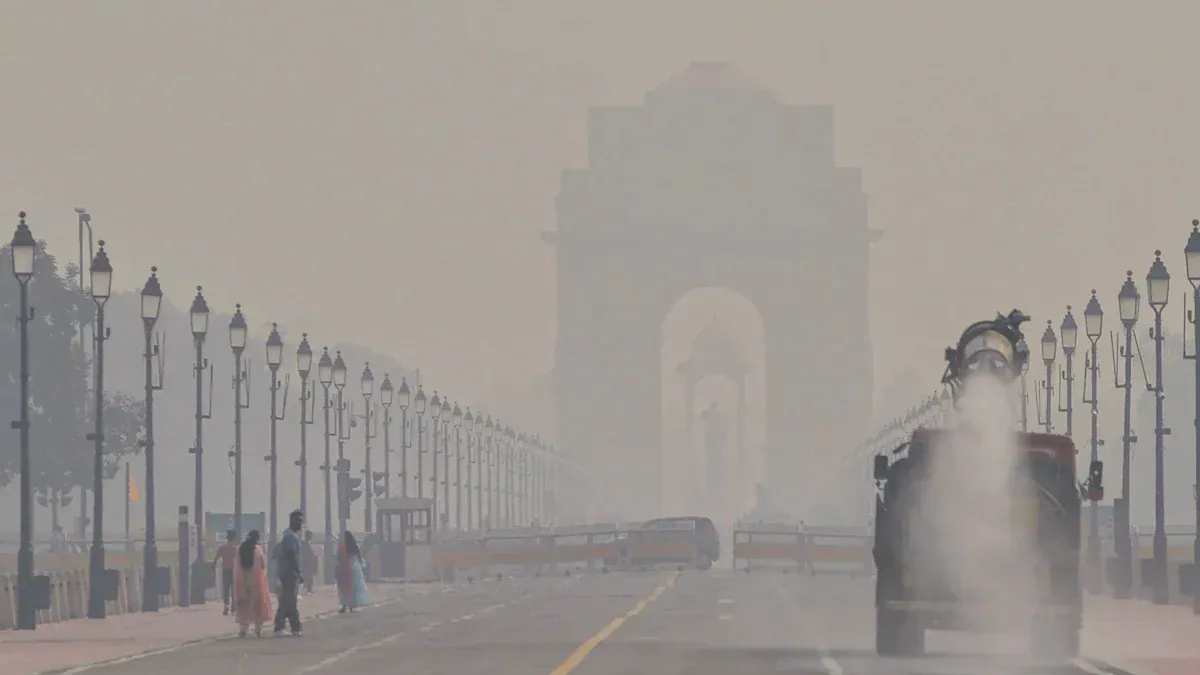
As air pollution levels slipped to the 'severe' category across the Delhi-NCR, authorities on Saturday enforced the toughest measures under Stage IV of the Graded Response Action Plan (GRAP), imposing emergency restrictions throughout the region. The move came just hours after Stage III of GRAP had been implemented in the National Capital Region.
The Commission for Air Quality Management (CAQM) said its GRAP sub-committee had decided to enforce all measures under Stage IV or 'Severe+' air quality with immediate effect in view of the prevailing trend of air quality.
"Keeping in view the prevailing trend of air quality and in an effort to prevent further deterioration of air quality in the region, the CAQM Sub-Committee on GRAP decides to invoke all actions as envisaged under Stage-IV of the extant GRAP ‘Severe+’ Air Quality (DELHI AQI > 450), with immediate effect, in the entire NCR." It added that these steps would be in addition to restrictions already in force under Stages I, II, and III.
Further, the NCR Pollution Control Boards/Committee and other concerned agencies have been asked to intensify preventive measures to prevent further deterioration of air quality in the region, the order stated.
What's NOT allowed under GRAP-IV?
- Entry of all diesel-powered medium and heavy goods vehicles into Delhi, except those carrying essential goods
- Entry of trucks into Delhi is banned except for those carrying essential goods and services. All LNG, CNG, electric, BS-VI diesel trucks will be allowed to enter Delhi.
- Entry of LCVS registered outside Delhi, other than EVs, CNG, and BS-VI diesel, to enter Delhi, except those carrying essential commodities or providing essential services, is banned.
- All construction and demolition activities, including earthwork, excavation, piling, and structural work
- Operation of stone crushers, brick kilns, hot mix plants, and mining activities
- Functioning of industries using coal, furnace oil, or other non-approved fuels
- Use of diesel generator sets, except for emergency and essential services
- Open burning of any kind, including waste and biomass
- Any activity likely to increase dust levels or air emissions
What's allowed under Grap-IV?
- Construction work linked to essential services such as metro, railways, airports, highways, defence, healthcare, and sanitation
- Emergency repair and maintenance activities, subject to strict dust-control measures
- Movement of electric vehicles, CNG vehicles, and BS-VI compliant vehicles
- Operation of public transport services, including buses and metro rail
- Vehicles used by persons with disabilities
- NCR state government or GNCTD to take a decision on allowing public, municipal, and private offices to work at 50 per cent strength, and the rest to work from home.
- The central government may take an appropriate decision on permitting work from home for employees in central government offices.
- State governments may consider additional emergency measures like closure of colleges or educational institutions and closure of non-emergency commercial activities, permitting running of vehicles on an odd-even basis of registration numbers, etc.
- Functioning of power generation units supplying electricity
- Use of diesel generators permitted for hospitals, data centres, telecom services, and other emergency situations
Also Read: GRAP IV imposed in Delhi-NCR hours after GRAP III amid rising air pollution levels
Also Read: Delhi imposes Grap-3 restrictions after air quality moves to severe category, smog envelopes city
