
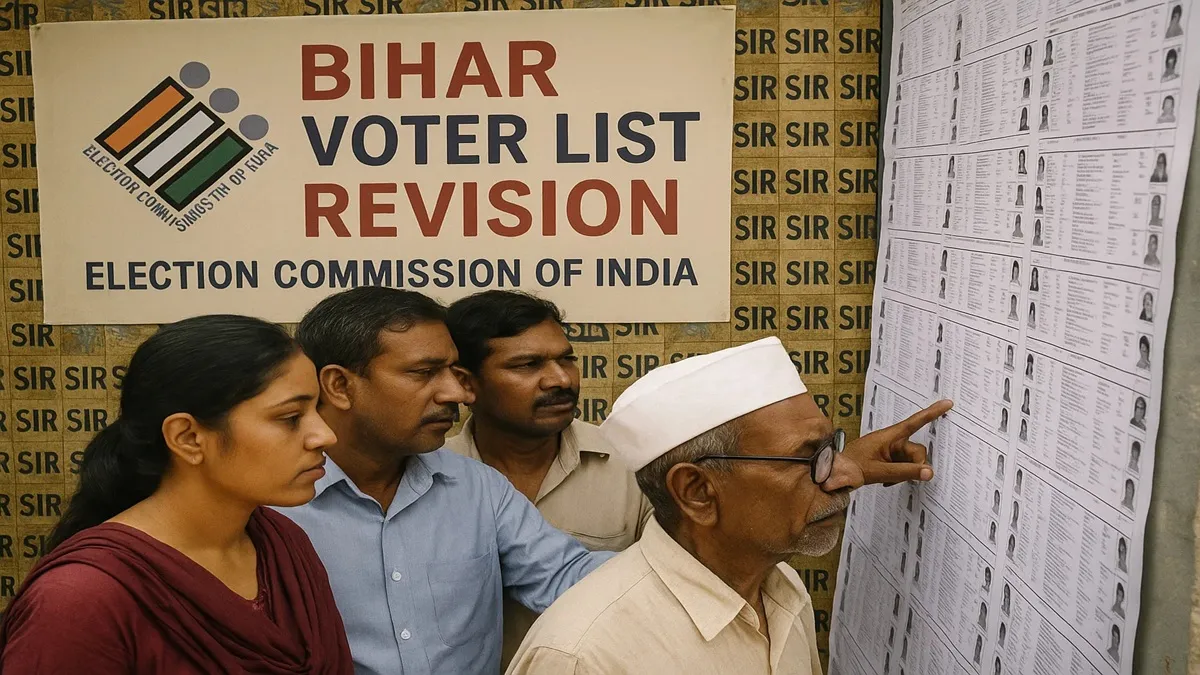
The Election Commission of India (ECI) published the draft electoral rolls for Bihar on Friday (August 1), covering all 243 Assembly constituencies and 90,817 polling stations. At 11:00 am, the 38 District Collectors distributed the drafts to all political parties, while the rolls are now published for public access. This release follows a month-long Special Intensive Revision (SIR) exercise aimed at updating the voter lists ahead of the upcoming Assembly elections. No compiled list was made available, but voters can check their names on the EC's website.
Claims and objections window opens as voters raise concerns
With the draft rolls published, a 'claims and objections' period has begun, running until September 1. During this time, voters who believe their names have been wrongly omitted or have other complaints may approach authorities to seek corrections. This phase is critical in addressing issues of voter exclusion raised by opposition parties and election watchdogs.
DATA
Special Intensive Revision: Overview and statistics
Before the revision, Bihar had approximately 7.93 crore registered voters. The SIR process involved distributing enumeration forms either through booth-level officers (BLOs) or booth-level agents (BLAs) nominated by political parties. Voters were required to sign and submit these forms with valid identity proofs, either physically or via online submission.
According to the EC, 7.23 crore voters submitted their forms by the July 25 deadline. The revision identified 35 lakh voters as permanently migrated or untraceable, 22 lakh as deceased, and about 7 lakh registered in multiple locations. Additionally, 1.2 lakh voters did not submit their enumeration forms. The entire operation was managed through 77,895 polling centres, supported by 1.6 lakh BLAs and volunteers, under the supervision of 243 Elector Registration Officers (EROs) and 2,976 Assistant EROs.
Opposition voices skepticism and legal challenges
Opposition parties and critics have protested the revision process, alleging it disproportionately targets voters opposed to the ruling NDA coalition in Bihar, which has governed for 20 years. Concerns about mass deletion fueled a petition to the Supreme Court, which recently emphasised that the revision should promote voter inclusion rather than exclusion.
Notable critics include CPI(ML) Liberation general secretary Dipankar Bhattacharya and Bihar’s Opposition Leader Tejashwi Yadav. Yadav has even threatened to boycott the elections if the concerns are not adequately addressed.
What are the upcoming steps and political significance?
The claims and objections period will serve as a decisive phase to ensure the electoral rolls are accurate and inclusive. The process and its outcome will be crucial in shaping the politically charged atmosphere ahead of Bihar’s Assembly elections, with both the ruling alliance and opposition watching closely. The EC must balance thoroughness in revision with fairness to prevent disenfranchisement and maintain public trust in the electoral process.
Here are some related stories of Bihar voter list revision:
