
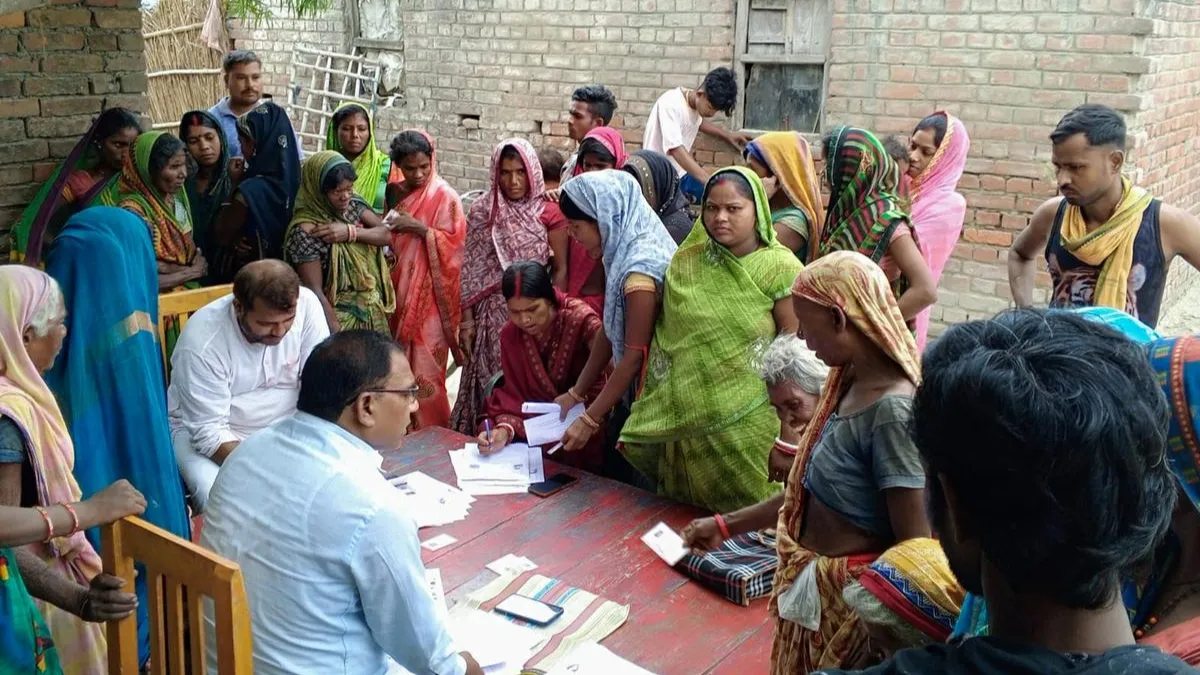
The Election Commission of India (EC), empowered under Article 324 of the Constitution, has ordered a Special Intensive Revision (SIR) of electoral rolls in Bihar—a critical move ahead of the Assembly elections scheduled for November 2025.
This decision is rooted in the Commission’s constitutional duty to ensure the sanctity and integrity of the electoral roll, as mandated under the Representation of the People Act, 1950 (RP Act). Sections 16, 19, and 20 of the Act lay down clear eligibility criteria: only Indian citizens aged 18 and above and ‘ordinarily resident’ in a constituency are entitled to be registered.
Over the past two decades, Bihar, like many Indian states, has experienced rapid urbanisation, large-scale migration, and demographic shifts. These developments have resulted in extensive additions and deletions in the electoral rolls, raising concerns about duplicate, ineligible, or missing entries.
The last SIR in Bihar was conducted in 2003. With electoral dynamics changing significantly since then and the upcoming polls drawing near, the EC deemed it necessary to update the rolls using a more structured and document-driven process.
Why is it relevant now?
The timing of the SIR is critical. With the qualifying date set as July 1, 2025, the EC aims to ensure that every eligible citizen in Bihar is accurately registered before the elections. The revised process mandates every voter to submit an enumeration form, marking a departure from the previous house-to-house verification method used in 2003.
The relevance of this exercise goes beyond Bihar. The EC plans to initiate similar revisions nationwide, starting with Bihar as a model state. The goal: to enhance electoral integrity by rooting out fraudulent or duplicate entries while ensuring no eligible voter is left behind.
However, this approach has raised concerns about feasibility and inclusivity. Over eight crore voters are required to submit forms, and around three crore must also provide supporting documents for their date and place of birth—and that of their parents—if registered after 2003.
Weighing the pros and cons
Supporters of the SIR cite that in 2003, a similar exercise was completed in just 31 days—without the benefit of today’s technology. With the deployment of over one lakh BLOs, four lakh volunteers, and 1.5 lakh Booth Level Agents, they argue that the logistical groundwork exists for smooth execution.
Critics, however, caution that such a large-scale documentation exercise has never been undertaken before. Concerns are particularly strong for migrant workers and students, many of whom may miss deadlines due to their mobile lifestyles and lack of valid documentation. Errors in inclusion or exclusion, they argue, could undermine the democratic process.
Another contentious issue is the exclusion of Aadhaar as a valid document. While the EC maintains that Aadhaar is not proof of citizenship, critics point out that Form 6 under the Registration of Electors Rules (RER), 1960, lists Aadhaar as an accepted ID for new voter registration.
The way forward
To maintain the fine balance between inclusion and accuracy, the EC must exercise caution and adaptability. First, timelines may need to be extended to ensure a thorough and error-free enumeration. Active participation by BLOs and BLAs is crucial in minimising mistakes.
Secondly, document flexibility must be considered. If Aadhaar is widely used by the underprivileged, then rejecting it outright—without reasonable alternatives—could lead to disenfranchisement. The claims and objections phase should be tailored to accommodate such realities.
Lastly, the treatment of migrant voters must be re-examined. The RP Act clarifies that a temporary absence does not disqualify one’s ordinary residency. Hence, blanket exclusions based on physical absence could unfairly penalise millions who still maintain deep ties with their home constituencies.
The EC's recent consultations on Aadhaar seeding may eventually address duplicate entries. Until then, SIR must walk the tightrope between security and inclusivity—a test of India's electoral resilience.
