
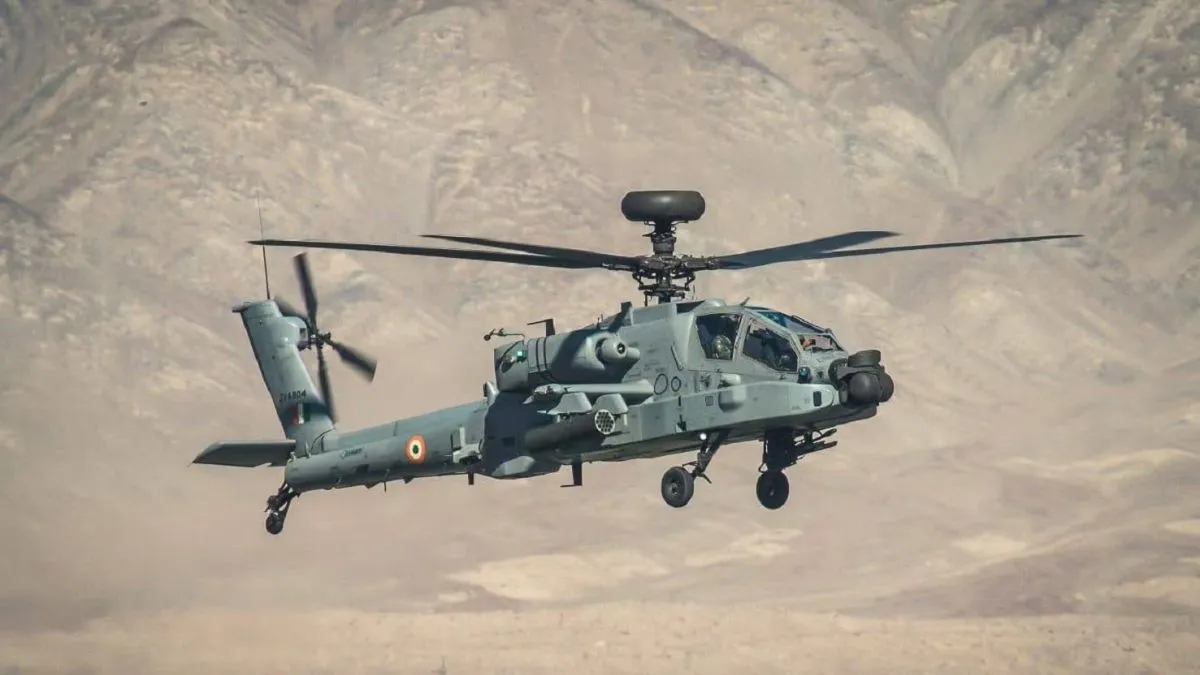
An Apache attack helicopter belonging to the Indian Air Force made an emergency landing on Thursday morning in Haled village, which falls under the jurisdiction of Nangalpur Police Station in Punjab’s Pathankot district. Initial reports indicate that there were no injuries or damages. The helicopter, which took off from Pathankot Air Force Station, had to land in an open field as a precaution after reportedly encountering technical issues. This incident comes just days after another Indian Air Force Apache helicopter made a precautionary landing on June 6 during a routine training mission near Saharanpur in Uttar Pradesh. Earlier, on April 3, an IAF Apache helicopter on a regular sortie in Ladakh also had to make an emergency landing at around 12,000 feet near the Khardungla pass.
Recently, several Apache attack helicopters manufactured by Boeing have been involved in a series of accidents that have raised safety concerns. Last year, the US Army experienced four incidents, highlighting the need for increased vigilance. These accidents occurred on February 12, February 23—where both pilots tragically lost their lives—March 24, and March 26. In India, the Air Force currently operates 22 Apache helicopters, and the Army has placed an order for an additional six units from Boeing. Here’s everything you need to know about these helicopters and the reasons behind the growing number of accidents.
What are Apache attack helicopters

The AH-64E Apache Guardian is hailed as the world's most advanced multi-role combat helicopter. Originating from the United States and manufactured by Boeing, this latest version of the Apache is a key asset for the US Army.
The AH-64E Apache Attack Helicopter is designed to be all-weather capable, easily maintainable, and highly agile, ensuring robust survivability against battle damage. Its capabilities include:
- Conducting precision attacks from standoff distances while operating in hostile airspace, even with ground threats present.
- Transmitting and receiving a comprehensive battlefield picture through data uplinking and networking, enhancing situational awareness.
- Engaging targets with fire-and-forget anti-tank guided missiles, air-to-air missiles, and rockets, providing versatility in network-centric aerial warfare.
- Featuring a fire control radar with 360° coverage, alongside a nose-mounted sensor suite for effective target acquisition and advanced night vision systems.
Apache attack helicopters with IAF
India stands out as one of the 17 countries to have chosen the Apache helicopter, specifically operating the highly advanced AH-64E variant. This impressive model is also utilised by the United States and several other nations around the globe.
Ihe Indian Air Force's (IAF) has a fleet of 22 AH-64Es, inducted between 2019 and 2021 under a $3.1 billion deal. In September 2015, the Indian Ministry of Defence completed its agreement with Boeing for the production, training, and support of 22 AH-64E Apache helicopters.
The Indian Air Force has successfully deployed 22 Apache helicopters in Pathankot and Jorhat, demonstrating their effectiveness through operations in Ladakh and Arunachal Pradesh near the Line of Actual Control (LAC) with China.
Apache attack helicopters with Indian Army
The Indian Army placed an order for six Apache helicopters during U.S. President Donald Trump’s visit to New Delhi in 2020, with a total value of around Rs 24,100 crore ($600 million). These helicopters are set to be deployed in the desert sector along the India-Pakistan border, boosting offensive and reconnaissance capabilities against armored threats.
To facilitate their operation, the Indian Army has established the 451 Aviation Squadron in Jodhpur, where pilots and ground crew have already undergone training in the U.S. The original delivery schedule, as stated in the 2020 agreement, anticipated the arrival of the first three Apaches by May-June 2024, followed by the remaining three by July 2024. However, as of June 11, 2025, no helicopters have been delivered.
Why Apaches’ delivery to Indian Army has been delay
The delays in the Indian Army's Apache deliveries can be attributed to several technical issues on the U.S. side. Sources from the Indian Ministry of Defence indicate that concerns over electrical power generator failures, which could lead to hazardous smoke accumulation in the cockpit, have led Boeing to pause all AH-64E deliveries for further testing.
Additionally, these delays are exacerbated by safety concerns stemming from recent crashes in the U.S. Army Apaches, which pointed to potential electrical failures. As a result, Boeing has put a hold on deliveries until thorough testing confirms that the necessary fixes are effective. Consequently, the prolonged delays have rendered the 451 Aviation Squadron non-operational, leaving trained pilots and ground personnel sidelined despite their extensive training in the U.S.
ALSO READ: Apache attack helicopter of IAF makes emergency landing in Pathankot | Video