
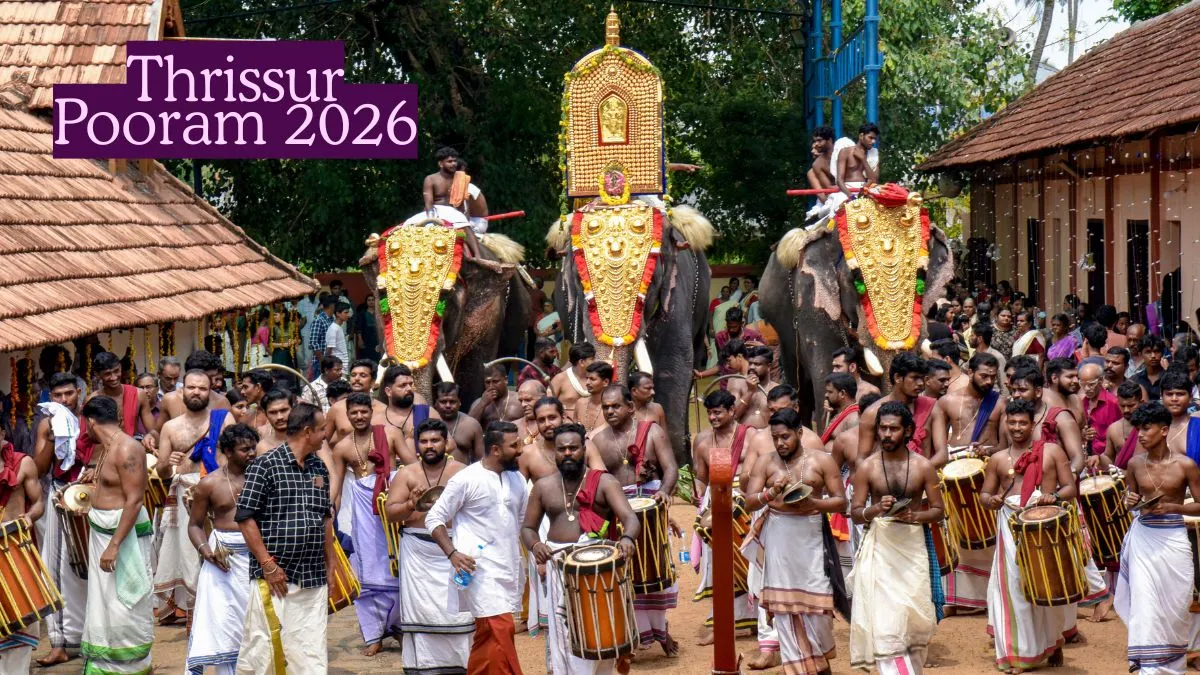
Thrissur Pooram 2026: Every year, there is one particular festival in India that does not seem like an ordinary festival but seems like a visual treat in terms of sounds, colours, and devotion. In 2026, that moment returned on April 26, as Thrissur Pooram once again brought together tradition, temple culture, and sheer visual drama in the heart of Kerala.
This annual festival takes place at the famous Vadakkunnathan Temple and is usually known as the “Mother of all Poorams,” a name well-deserved due to its centuries-old traditions, immense involvement, and huge cultural significance.
What makes Thrissur Pooram unique among festivals
Unlike other Indian festivals, Thrissur Pooram is not associated with a single temple. In fact, it represents the coming together of gods from ten temples in procession to honour Lord Shiva. Thrissur Pooram can trace its origins to the late 18th century, when it came about through the efforts of Sakthan Thampuran and changed the course of temple festivals in Kerala.
What makes it unique is its structure. Everything unfolds with timing, rhythm, and almost theatrical precision.
How the 2026 celebrations began
The festivities don’t begin on the main day. They build up.
It starts with Kodiyettam (flag hoisting), marking the official beginning of the week-long rituals. Temples across Thrissur participate, setting the stage for what follows.
From there, each day adds layers, temple visits, rituals, and cultural build-up, leading to the main Pooram day.
The first arrival that sets everything in motion
One of the most important moments comes early on the main day.
The arrival of the Kanimangalam Sastha Temple leads the Pooram proceedings.
This is not just symbolic. Traditionally, Kanimangalam Sastha is believed to be the first to enter and prepare the ground for the other deities.
From there, processions begin to flow in, each one more elaborate than the last.
Elephants, beats, and rituals
When it comes to the Thrissur Pooram, here’s what you can’t forget:
A line of majestic elephants bedecked in gold ornaments, arrayed in a line amidst beats.
Here’s what you’ll see at the festival:
- Panchavadyam and Ilanjithara Melam, ancient beat bands
- Parades with magnificent elephants
- Religious ritualistic entries and exits
This isn’t entertainment. This is heritage.
Kudamattam: The moment everyone waits for
At the peak of the festival comes Kudamattam, a ritual that has become iconic.
Two groups of temples, led by
- Paramekkavu Bhagavathy Temple
- The Thiruvambady Sri Krishna Temple
faces each other with elephants lined up in symmetry. What follows is a rapid, rhythmic exchange of colourful parasols.
It’s not competitive in the usual sense, but it carries energy, pride, and crowd excitement like few other rituals in India.
Not only a festival, but also a cultural phenomenon
The Thrissur Pooram attracts an enormous crowd, usually numbering in lakhs, making it one of the biggest religious congregations in Asia.
However, apart from numbers, it signifies much more.
It is:
A confluence of temples, customs, and people
An acknowledgement of the rich rhythmic culture of Kerala. A perfect illustration of how ritual and show go hand in hand. The Thrissur Pooram is not all about elephants, beats, and fireworks. It is also all about rhythms, rhythms of tradition, time, and devotion.
Once you witness it, even remotely, you will know why it is termed “the mother of all Poorams.”
Also read: Jyeshtha month 2026 begins May 2: What to do and what to avoid this holy month
