
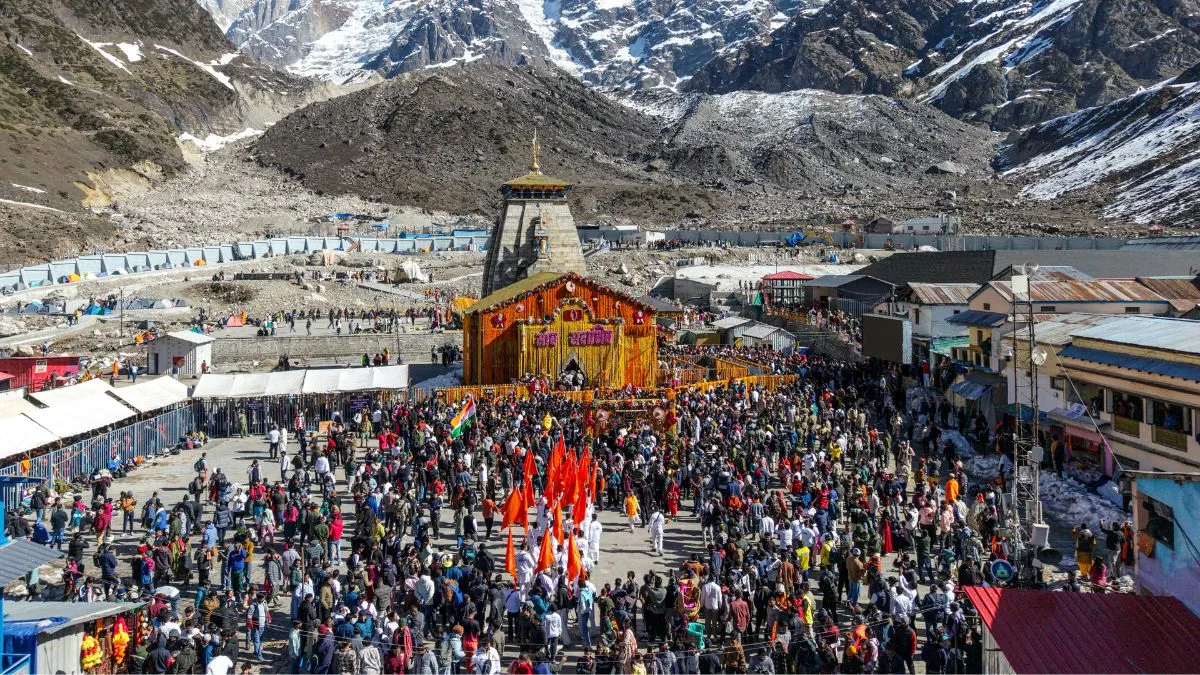
The Char Dham Yatra 2026 is now underway, and Kedarnath has reopened its doors at 3,583 metres. The temple this year has been decorated with nearly 51 quintals of fresh flowers. Among the floral patterns, one phrase stands out. Samb Sadashiv.
It is not just decoration. It sits right at the point where a devotee enters. Almost like a marker. A quiet reminder before darshan begins. The phrase carries meaning, and understanding it adds a different layer to the experience.
Meaning of ‘Samb Sadashiv’ explained clearly
The phrase can be broken into two parts.
“Samba” comes from two Sanskrit elements. “Sa” means with, and “Amba” refers to the Mother Goddess, Parvati. Together, it points to Shiva along with Shakti. This is the form of Shiva with attributes, with energy. The creative aspect. The idea that consciousness and energy exist together.
“Sadashiv” refers to the eternal aspect of Shiva. The form that remains unchanged. Beyond birth and death. Beyond cycles. It is often understood as the underlying reality that exists even when everything else dissolves.
When used together, “Samb Sadashiv” reflects both aspects at once. The formed and the formless. Movement and stillness. It is also linked to the Ardhanarishvara principle, where masculine and feminine energies exist in balance.

Why this mantra is considered safe to chant
In many traditions, certain mantras require initiation from a guru before they are chanted. These are often specific beej mantras that are treated as more intense in nature.
“Samb Sadashiv” is generally understood as a nama mantra. A mantra based on the name of the divine. Because of this, it is seen as more accessible.
Spiritual teacher Premanand Ji Maharaj has, in one instance, advised a Shiva devotee to chant this mantra, noting that it can be taken up without formal initiation. It is often described as a safe mantra, without strong or “ugra” effects. It does not demand strict ritual conditions. The emphasis is on sincerity rather than method.
What happens when you chant ‘Samb Sadashiv’
The effects of chanting are usually understood across different levels.
- Psychological level
The repetition creates rhythm. It helps reduce overthinking and brings the mind back to a single point of focus.
- Physiological level
Chanting produces steady, low-frequency vibrations. These may help slow the heart rate and create a sense of physical calm.
- Metaphysical level
In spiritual understanding, chanting is seen as aligning the individual self with a larger consciousness. It is often associated with a sense of grounding and inner steadiness.
These effects are not instant or guaranteed. They build gradually, and they depend on individual experience and belief.
What the phrase represents at Kedarnath
At Kedarnath, the setting itself shapes how such a phrase is felt. The altitude, the silence, the scale of the surroundings. Everything slows down a bit.
Seeing “Samb Sadashiv” written in flowers becomes more than a visual detail. It acts as a point of recall. A moment to pause before stepping inside.
It shifts the focus slightly. From just reaching the temple to understanding what it stands for. The idea of completeness. Of something that does not change even when everything else does.
In that sense, the phrase stays simple. But it holds its place. Quietly.