
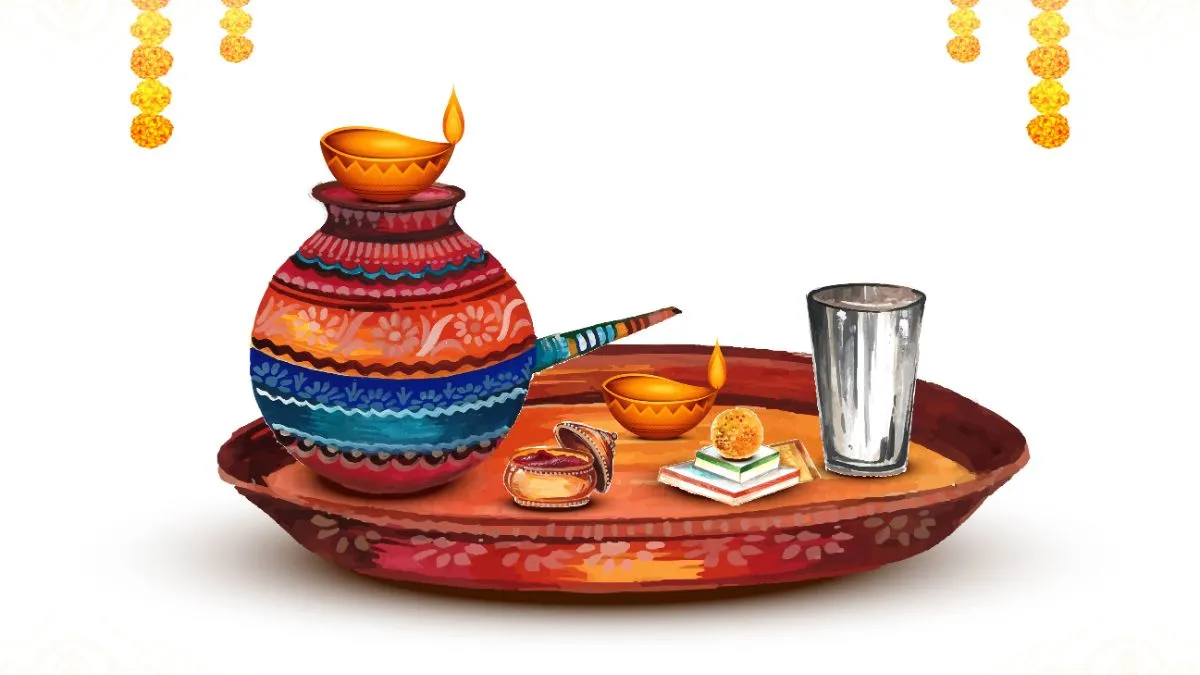
Karwa Chauth is one of the most celebrated festivals for married women. On this day, married women observe a fast for their husbands and pray for their husbands' long and healthy lives. On this day, karwa, an earthen pot, is considered a vital part of the rituals.
Karwa is not only a symbol of tradition but also represents the five elements. Let us know why it is auspicious to use an earthen pot in the worship of Karwa Chauth Vrat and what is done with it after the puja.
1. Symbol of purity and Earth's connection
Clay is taken straight from the ground, unprocessed, pure, and natural. Employing a clay pot in rituals enhances the association with Mother Earth and the concept of giving things back to nature. In contrast with metal or man-made containers, mitti ka karwa is thought not to have any energetic carryover or residual impurities, thus becoming spiritually charged.
2. Absorption and sanctification
In most cultures, clay is also believed to take up subtle energies. Throughout the day, as offerings and prayers are made, the karva gets blessed; it takes in the intention, devotion, and blessings of the fast. The idea is that the earth element, in the form of clay, takes in the spiritual vibrations the best.
3. Passed down through generations
Mitti ka karwa is not only symbolic, it's also culturally deep. Many families reuse the same clay pot year after year, generation after generation. Its existence is a living heirloom, linking marriages, lineages, and narratives into each Karwa Chauth.
4. Practical and ritual benefits
- Heat retention and safety: Clay retains coolness or warmth better; it is safer to transport boiling water, offerings, or Kesar-yog mixes without imparting heat to hands.
- Aesthetic and purity: Unpolished clay finish is plain and auspicious, appropriate for rituals where minimalism is preferred over ornateness.
- Eco-friendly: Natural clay use promotes sustainability over plastic or non-biodegradable materials.
5. Spiritual renewal and humility
Employing something as mundane as clay in a ritual of love and respect is an indication of humility, that religious things do not require pomp. The mitti ka karwa is now a reminder that the essence of the ceremony is devotion, not finery.
In Karwa Chauth, mitti ka karwa exists not as a prop but as an instrument of faith, Earth and intent converging, tradition and devotion converging. Even today, in 2025, where contemporary accessories are prevalent, the clay pot takes centre stage, reminding us that rituals are not about bling but about anchoring and the sanctity behind each move.
