
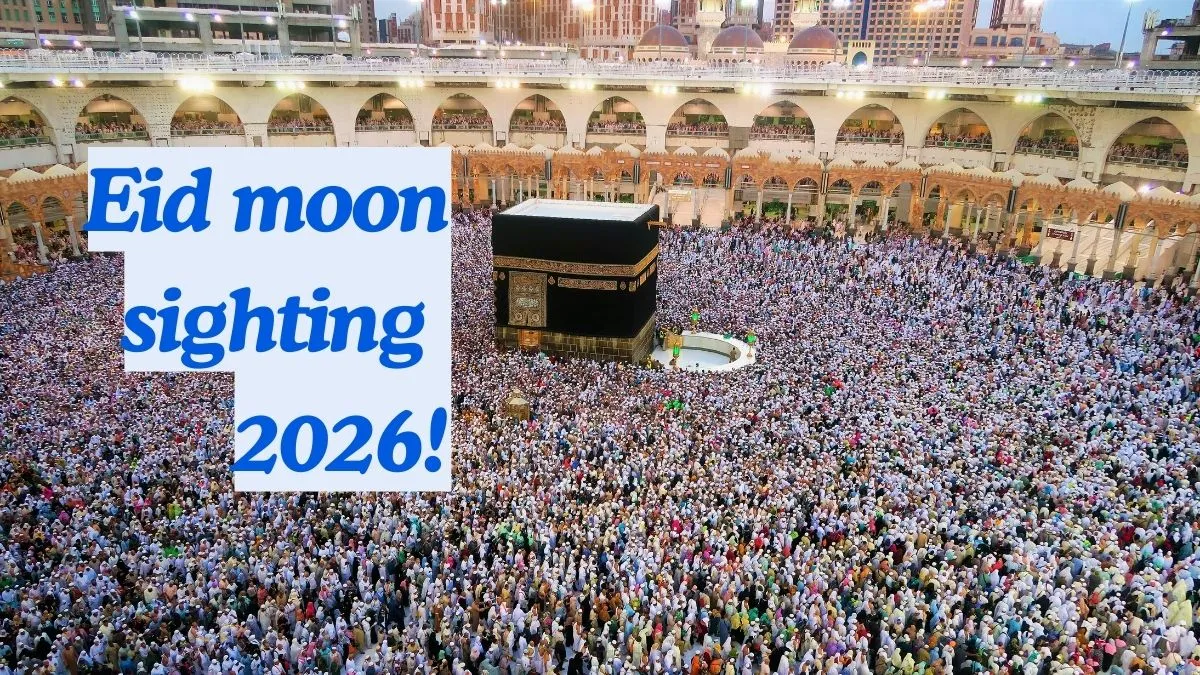
The holy month of Ramadan is now in its final stages, and all eyes are fixed on the sighting of the Shawwal moon in the sky. According to the Islamic calendar, the festival of Eid-ul-Fitr is celebrated on the first day of the month of Shawwal, and the exact date of Eid depends on the sighting of the moon.
At this moment, everyone's gaze is fixed on the moon over Saudi Arabia. If the Eid moon is sighted in Saudi Arabia on March 19, then Eid will be celebrated there on March 20. Conversely, in India, this festival will be celebrated one day later, that is, on March 21.
When is Eid in Saudi Arabia in 2026?
The Eid moon is expected to be sighted in Saudi Arabia on the evening of March 18, 2026. If the moon is sighted there on this day, the festival of Eid-ul-Fitr will be celebrated in Saudi Arabia on March 19, 2026.
However, if the moon is not sighted on March 18, then the moon will be looked for in Saudi Arabia on March 19; in this scenario, Eid will be celebrated there on March 20. Most astronomical experts predict that Ramadan may last for 30 days this time around, making it highly probable that Eid will fall on March 20 across various Gulf nations, including Saudi Arabia.
Nevertheless, the official announcement regarding Eid will be made only after the moon has been sighted.
When is Eid in India in 2026?
In India, the festival of Eid is observed on the day after it is observed in Saudi Arabia. Therefore, if the festival of Eid-ul-Fitr is observed on March 20 in Saudi Arabia, the festival of Eid is observed on March 21 in India.
How is the festival of Eid al-Fitr celebrated?
The festival of Eid-ul-Fitr is observed with the aim of celebrating the happy culmination of the hard fasting (Roza) observed during the month of Ramadan. On this day, Muslims wake up early in the morning to offer congregational prayers at mosques.
Prior to the prayers, donations are given to the poor so that they, too, may partake in the celebrations of Eid. This is known as Fitra. On this day, a special dish called sewai is prepared in households. Furthermore, the elders of the family give money or gifts to the younger ones as a token of affection, a tradition known as Eidi.
