
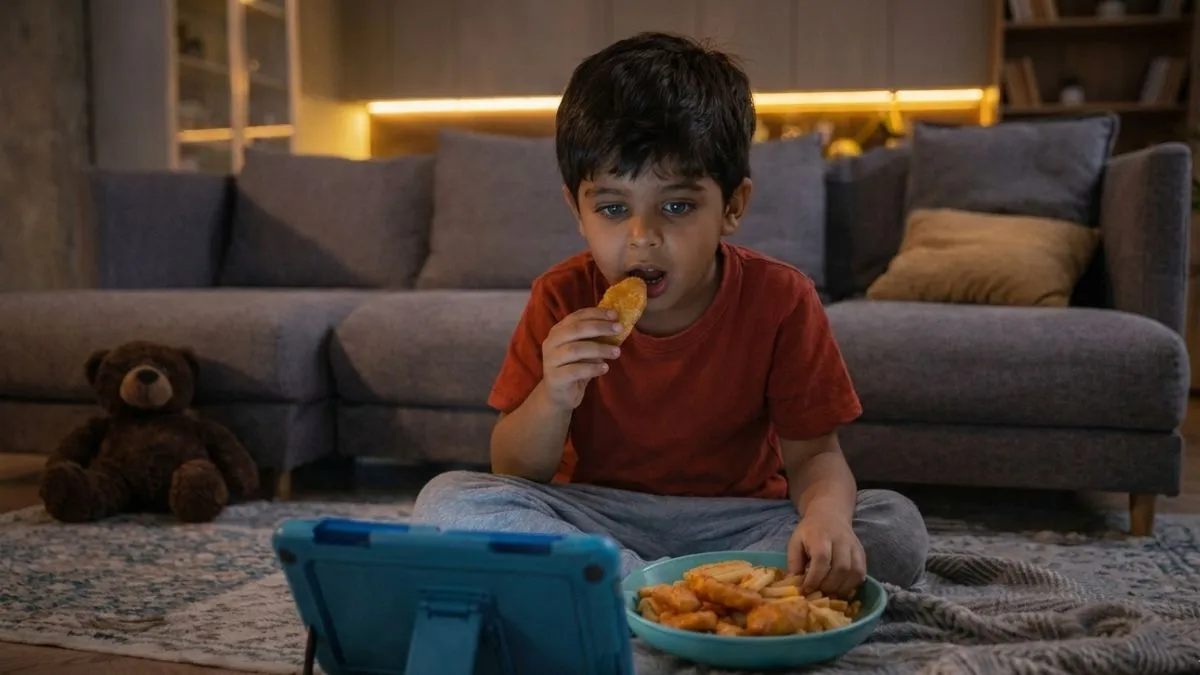
Mealtimes used to be slower. A bit calmer. People actually sat together, spoke, noticed what they were eating. That rhythm has changed. Now, screens are often part of the plate. Especially for children.
It may feel like a quick fix. Put on a cartoon, the child eats without fuss. But over time, that small habit starts doing something bigger. Quietly. It changes how children understand food, hunger, even satisfaction.
Screen eating habits in children: What experts are noticing
Dr Manan Vora, a Mumbai-based orthopaedic surgeon, health educator, and co-founder of NutriByte Wellness, is raising concern around this shift. In an Instagram video shared on April 13, he explained how eating in front of screens is beginning to rewire children’s brains.
“Parents, listen up. We’re raising the first generation that can’t eat without a screen, and it’s making our children obese. Children between the age of 10 to 13 with fatty liver and insulin resistance,” Dr Vora said.
He points out that what looks harmless now could lead to early-onset metabolic issues, including obesity, fatty liver disease, and insulin resistance.
Food and screen connection: How the brain links eating with entertainment
According to Dr Vora, one major issue is how children begin to connect food with constant stimulation.
“They learned that food needs entertainment. Cartoons during meals became the norm. Now, their brain can’t register hunger or fullness without that external stimulation. They’re eating mindlessly, the same way you finish popcorn at the movies without even realising,” he explained.
Over time, this weakens natural hunger cues. Kids stop noticing when they are actually hungry or full. Eating becomes automatic. Distracted.
Hunger hormones and screen time: What happens inside the body
The concern is not just behavioural. It is also biological.
Dr Vora explained, “The screens hijack their hunger hormones. Blue light suppresses melatonin and disrupts ghrelin (the hunger hormone) and leptin (the satiety hormone). So they feel hungrier, crave sugar, and never feel full even after eating.”
So even if the child has eaten enough, the body may not signal it properly. That imbalance builds slowly.
Junk food and screen time: The dopamine loop explained
There is also a reward cycle at play. And it is quite strong.
“The dopamine loop made junk food addictive. Scrolling gives dopamine, junk food gives dopamine. Together they rewire your child’s brain to crave junk the moment they hold a phone,” Dr Vora said.
Screens and junk food together create a pattern. One reinforces the other. And the brain starts expecting both at the same time.
Parenting habits and children’s food behaviour: A long-term impact
Dr Vora ended with a direct message to parents.
“Now, you as a parent used the phone as a pacifier during their meals. You thought it made feeding easier, but somewhere along the way, you rewired how their brain processes food. So, if you’re a parent who lets their child eat with a screen, remember your child’s relationship with food is being shaped right now, not when they turn 18,” he said.
It is not about one meal. Or one day. It builds quietly, over time. And that is where the real impact sits.
Disclaimer: Tips and suggestions mentioned in the article are for general information purposes only and should not be construed as professional medical advice.
ALSO READ: Understanding rare diseases in children: Importance of early diagnosis and treatment
