
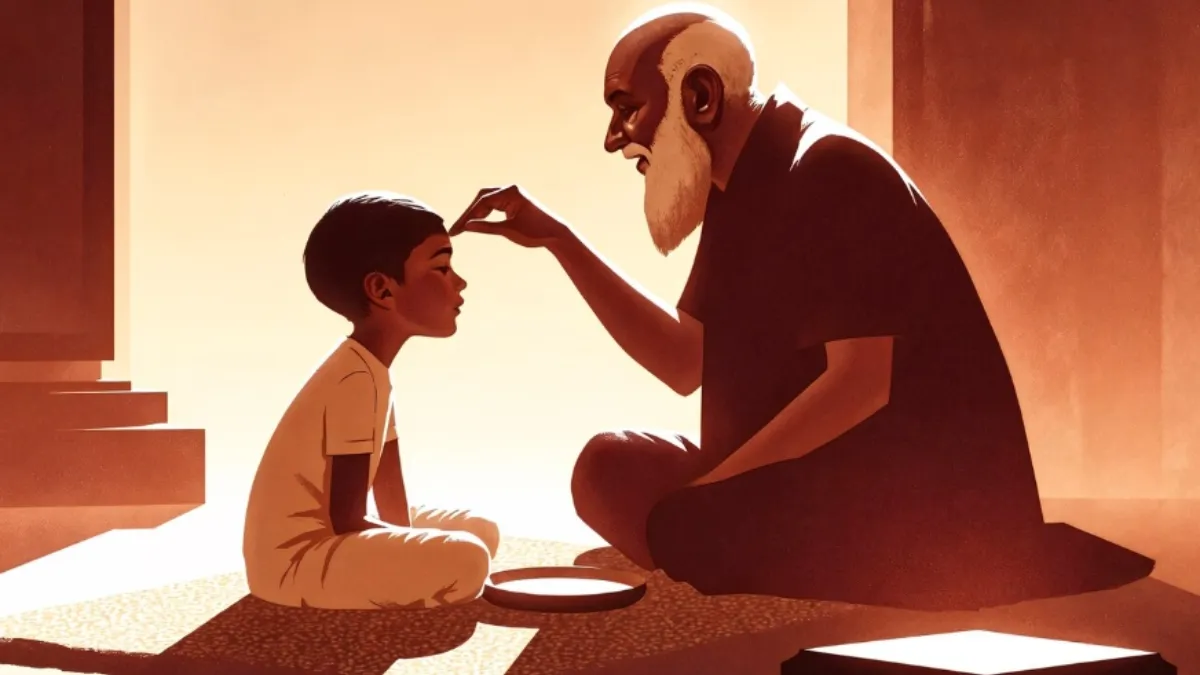
Without fail, every year on Teacher’s Day, we ritualistically recite praises of appreciation to a person we revere as a teacher, and we do this with enthusiasm and vigour. Many of us do not stop to ponder why we even have coaches, senior confidants, and, at times, blind acquaintances speaking to us earnestly and guiding us through life.
There is much joy in the form of cards, speeches, and celebrations, but one can also pay homage in a more deep and meaningful way through the recitation of a Sanskrit shloka that is packed with ancient knowledge.
The timeless Guru Shloka

Transliteration:
Gurur Brahmā Gurur Viṣhṇuḥ Gurur Devo Maheśhvaraḥ
Guruḥ Sākṣhāt Paraṁ Brahma Tasmai Śrī Gurave Namaḥ
Translation:
The Guru is Brahma (the creator), Vishnu (the preserver), and Shiva (the destroyer).
The Guru is the embodiment of the Supreme Divine.
To that revered teacher, I offer my salutations.
What makes this shloka so special?
At first glance, this verse may seem like just another tribute to the spiritual role of a teacher. But when you read between the lines, it reveals a truth that’s as relevant today as it was centuries ago: a teacher is not just someone who instructs; they shape, sustain, and transform our lives.
Brahma (The Creator): A teacher gives birth to knowledge within us, helping us discover who we are.
Vishnu (The Preserver): They help us hold onto our values, nurture our skills, and keep us grounded.
Maheshwar (The Destroyer): They challenge us, push our limits, and destroy our ignorance, fears, and self-doubt.
The modern guru: More than a classroom figure
Today’s teachers are not confined to classrooms or chalkboards. They are mentors, counsellors, cheerleaders, and even second parents. Whether it’s a math teacher simplifying algebra or a music guru patiently guiding you through a tough raga, their role goes far beyond academic instruction. The spirit of this shloka honours all of them.