
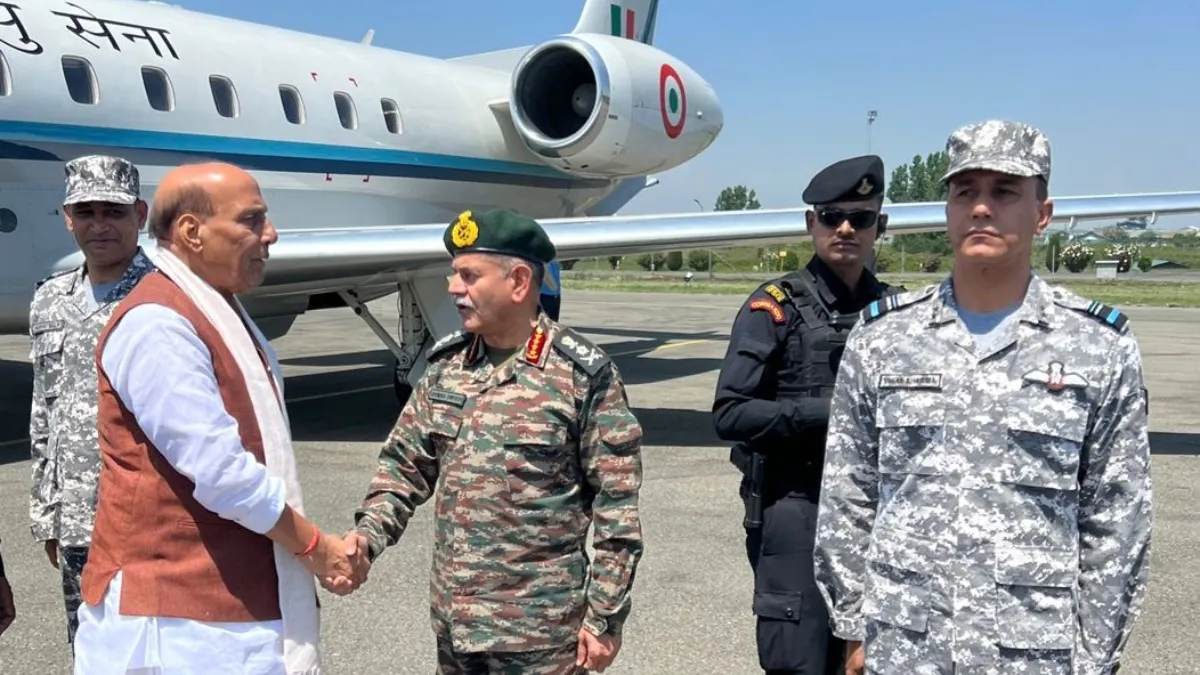
Defence Minister Rajnath Singh interacted with the soldiers of the Indian Armed Forces at the Badami Bagh cantonment on the outskirts of Srinagar in Jammu and Kashmir on Thursday. He also addressed the jawans at the Badami Bagh Cantonment.
Rajnath Singh expresses gratitude to soldiers
Addressing the soldiers of the Indian Army at Badami Bagh Cantt, Srinagar, the Defence Minister expressed his gratitude to the soldiers of the Indian Armed Forces for their role in the success of Operation Sindoor. He also paid tribute to the brave jawans who laid down their lives fighting terrorism, as well as the innocent civilians who lost their lives in the Pahalgam attack.
"First of all, I would like to bow to the supreme sacrifice of the brave jawans while they fought terrorism and terrorists. I pay respect to their memory. I also pay respect to the innocent civilians who were killed in Pahalgam. I also salute the valour of the injured soldiers and pray to God that they may recover at the earliest," said Singh.
"I feel proud to be here among you amid such adverse conditions. The entire nation is proud of whatever you all did during Operation Sindoor, under the able leadership and guidance of PM Narendra Modi. Before being your Defence Minister, I am an Indian citizen. Besides being the Defence Minister, I am here to express gratitude to you as an Indian citizen," he added.
"After the Pahalgam attack, the manner in which the people of Jammu and Kashmir expressed their anger against Pakistan and terrorists - I also salute the people of Jammu and Kashmir. I am here to feel that energy that destroyed the enemies. The manner in which you destroyed Pakistani chowkis and bunkers across the border, I think the enemy will never be able to forget it," Singh further said.
India can go to any extent against terrorism: Rajnath Singh
He further said that through Operation Sindoor, India has demonstrated to the world its unwavering resolve and readiness to go to any extent to combat terrorism.
"India has shown that it is not just capable of self-defence but also of taking strong retaliatory action. Operation Sindoor stands as the most significant counter-terror operation in history. Through this, India has sent a clear message to the world — it is prepared to go to any extent to eliminate terrorism. When terrorists struck at India's forehead, we struck back at their heart."
"They chose their targets based on religion, but we responded based on their actions. Our response was driven by justice, not prejudice," he added.
Singh said that Pakistan has deceived India repeatedly and made us pay a heavy price.
Are nuclear weapons safe in the hands of Pakistan?
Singh also questioned Pakistan's ability to handle the nuclear weapons and asked whether the nuclear weapons are safe in the hands of such a "rogue" nation like Pakistan.
"Today, from the land of Srinagar, I want to raise this question: whether nuclear weapons are safe in the hands of such an irresponsible and rogue nation. I believe that Pakistan's nuclear weapons should be taken under the supervision of the International Atomic Energy Agency (IAEA)," he said.
Rajnath Singh inspects Pakistani shells
Singh inspected Pakistani shells that were dropped in Jammu and Kashmir during the recent military conflict. Some debris were displayed at the Badami Bagh Cantonment.
Singh arrived in Srinagar today to review the overall security scenario and the combat readiness of the armed forces in Jammu and Kashmir. This is the first Jammu and Kashmir visit of the Defence Minister following the Pahalgam terror attack, Operation Sindoor, and the cessation of hostilities agreement between India and Pakistan. The Defence Minister was accompanied by Jammu and Kashmir Lieutenant Governor Manoj Sinha.
Operation Sindoor
India launched Operation Sindoor on May 7 as a decisive military response to the April 22 Pahalgam terror attack in which 26 people were killed. Indian Armed Forces targeted terror infrastructure in Pakistan and Pakistan-occupied Jammu and Kashmir, leading to the death of over 100 terrorists affiliated with terror outfits like the Jaish-e-Mohammed, Lashkar-e-Taiba and Hizbul Mujahideen.
India used Rafale jets armed with SCALP missiles and HAMMER bombs to target nine terror infrastructure sites in Pakistan and Pakistan-occupied Jammu and Kashmir on May 7. The Indian Air Force completed the mission in just 23 minutes without any losses, exposing the weaknesses of Pakistan's air defence systems, news agency ANI reported, citing sources.
After the attack, Pakistan retaliated with cross-border shelling across the Line of Control and Jammu and Kashmir as well as attempted drone attacks along the border regions, following which India launched a coordinated attack and damaged radar infrastructure, communication centres, and airfields across 11 airbases in Pakistan. After this, on May 10, an understanding of the cessation of hostilities between India and Pakistan was announced.
(With agencies input)
Also Read: Terrorist killed in encounter with security forces in J-K's Pulwama, operation underway
Also Read: India pushes for UN listing of LeT front TRF, delegation meets top counter-terror officials
