
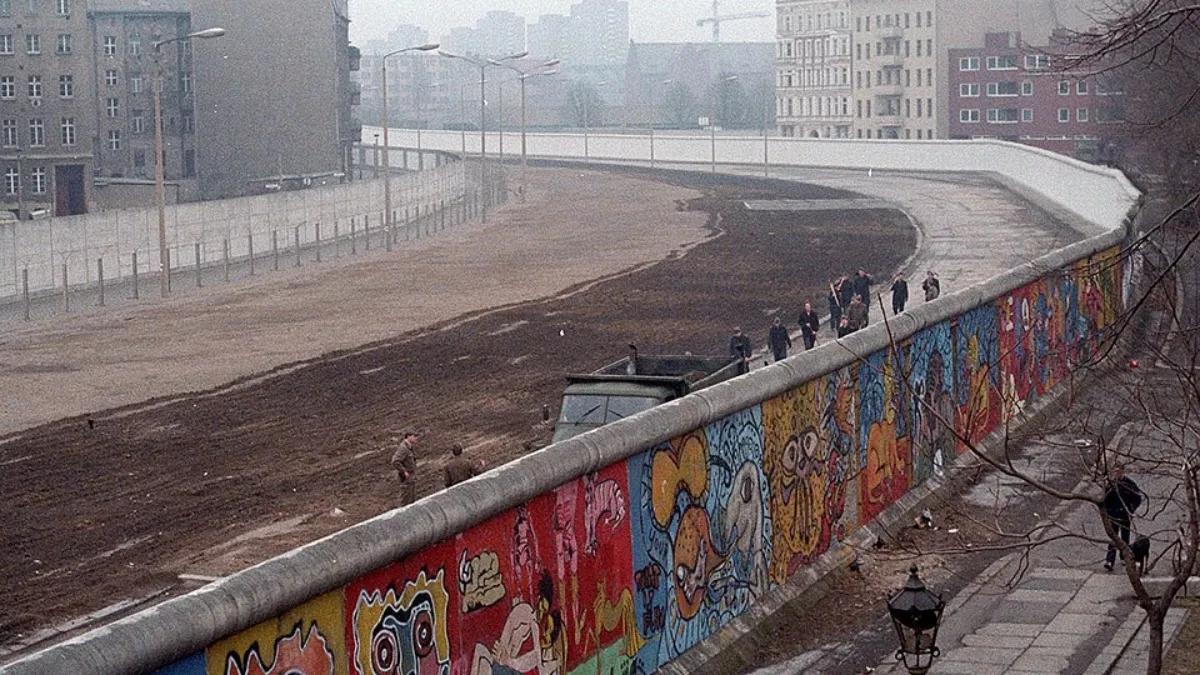
The Berlin Wall, a powerful symbol of the Cold War that divided East and West Berlin for 28 years, was opened for the first time on November 9, 1989. Built in 1961 by the German Democratic Republic (East Germany), the wall stood as a physical and ideological barrier between communist and democratic Europe.
Its fall in 1989 marked a defining moment in world history, signaling the end of the Cold War and reshaping the geopolitical landscape of Europe. The collapse was driven by a combination of political, social, and economic pressures that ultimately led to the reunification of Germany and the decline of Soviet influence in Eastern Europe.
The Berlin Wall
At the end of the Second World War, Germany was divided into four zones of occupation controlled by the United States, Britain, France, and the Soviet Union. Although Berlin lay within the Soviet zone, the city itself was similarly partitioned among the four powers. The American, British and French sectors would form West Berlin and the Soviet sector became East Berlin.
This arrangement soon became a focal point of ideological confrontation — with the Western Allies promoting democracy and capitalism, while the Soviet Union advanced communist ideology.
The construction of the Berlin Wall in 1961 deepened this divide. Built to stop the mass exodus of East Germans to the more prosperous West, it came to embody the Iron Curtain that separated Europe. What began as a physical barrier to stem migration evolved into a powerful symbol of oppression and division between the East and the West.
By the late 1980s, cracks began to appear in the communist bloc. Economic stagnation, political repression, and the growing influence of Western media fueled widespread discontent in East Germany and across Eastern Europe.
- The Berlin Wall was not a single structure but a complex barrier system consisting of two parallel walls.
- Stretching 155 kilometres (96 miles) in length and standing about four metres (13 feet) high, the two walls were divided by a wide, fortified corridor infamously known as the "death strip."
- This zone was filled with barbed wire, landmines, guard dogs, and floodlights, and it was patrolled around the clock by armed East German border guards who had orders to shoot anyone attempting to flee to the West.
- By 1989, the Wall was reinforced with 302 watchtowers and numerous bunkers for surveillance and defense.
- Over its 28-year existence, more than 100 people were killed while trying to cross it, though historians believe the true number could be higher.
- The Berlin Wall was only one part of a much larger fortified boundary — the inner German border — that divided East and West Germany.
Why fall of Berlin Wall pivotal moment in world history?
The fall of the Berlin Wall on November 9 is considered a pivotal moment in world history because it symbolised the end of the Cold War, the collapse of communist regimes in Eastern Europe, and the triumph of democratic ideals over totalitarianism.
The Berlin Wall had long symbolised the deep divide between the communist East and the democratic West — separating families, restricting freedom, and serving as a stark reminder of Cold War tensions.
Its fall was sparked by growing demands for political reform across Eastern Europe. In East Germany, weeks of widespread protests called for greater liberty and the lifting of travel restrictions. In an effort to calm the unrest, the East German government decided to loosen travel rules. However, on November 9, 1989, government spokesman Gunter Schabowski mistakenly announced during a press conference that East Berliners could cross into West Berlin "immediately."
Crowds of ecstatic East Germans surged toward the border checkpoints, overwhelming the guards. Amid confusion and a lack of clear instructions, border officers eventually opened the gates. Thousands of people poured through, welcomed by jubilant cheers, embraces, and celebrations from West Berliners. Many climbed atop the Berlin Wall, dancing, singing, and chipping away at the concrete barrier that had divided their city — and their lives — for almost 30 years.
It became a powerful symbol of freedom and unity, marking the beginning of the end for communist regimes in Eastern Europe. Within a year, Germany was reunified, and the Cold War was drawing to a close. Germany reunited on October 3, 1990, 11 months after the fall of the Berlin Wall.
Also Read: US airlines cancel hundreds of flights amid govt shutdown, causing travel disruptions
Also Read: Ready for war: Taliban warns as Afghanistan, Pakistan peace talks collapse
