
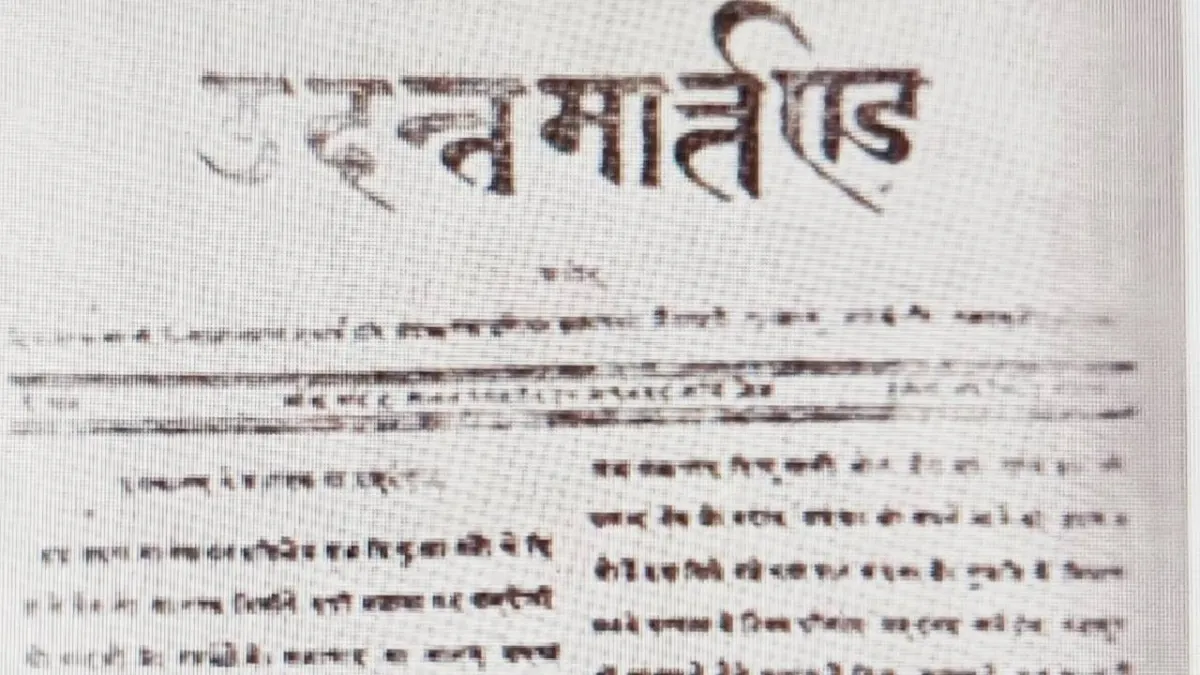
It was on May 30, 1826, during the colonial period, when Calcutta witnessed the birth of a newspaper that would leave an indelible mark on the world and on Indian journalism. Udant Martand, meaning 'the rising Sun', became the world's first newspaper to be published in Hindi, using the Devanagari script at a time when English, Bengali and Urdu papers dominated the landscape. Its arrival was not just about news in Hindi on paper, but about giving voice to a community in its own language.
The man behind this historic step was Pandit Jugal Kishore Shukla, a lawyer from Kanpur who had settled in Calcutta. He recognised that millions of Hindi speakers across India had no access to newspapers in their mother tongue, which limited their participation in debates and ideas shaping society. With limited resources, and in the face of colonial bureaucracy, Shukla launched Udant Martand, a weekly publication that would begin the journey of Hindi journalism in India.
What drove Jugal Kishore Shukla to start the Hindi daily
Shukla, who worked as a pleader and earlier as a proceedings reader in the colonial courts, sought to bridge a cultural gap. Although several newspapers in English and Bengali circulated in Calcutta, and Urdu had its presence in northern India, there was none that spoke to the growing Hindi-speaking public. On February 16, 1826, Shukla, along with Munnu Thakur of Banstala Gali, Calcutta, obtained government permission to start a Hindi newspaper.
Launch and publication
The first issue of Udant Martand came out on May 30, 1826, from 37 Amartalla Lane in Kolutolla near Barabazar Market, Calcutta. It was published weekly on Tuesdays. The language blended Khari Boli with Braj Bhasha, making it accessible to readers familiar with both styles. About 500 copies of the first issue were printed, carrying news, social commentary and stories of general interest.
Why Udant Martand shut down
The newspaper attempted to cover local events in Calcutta while also connecting with the wider concerns of people in Hindi-speaking regions. However, geographical distance created distribution problems. Sending copies to areas like Kanpur or Varanasi meant high postal charges, which the colonial government refused to waive. Unlike some other publications, Udant Martand did not receive adequate postal concessions or government patronage.
The paper soon faced financial strain. Without a strong subscriber base in Calcutta and with high costs of circulation to north India, sustaining the publication became impossible. Shukla appealed for support but could not secure enough assistance. After just 18 months of publication, Udant Martand released its last issue on December 4, 1827.
Contribution to India's freedom struggle and Hindi journalism
Though short-lived, Udant Martand marked the beginning of Hindi journalism. It established the possibility of print media in Hindi and inspired later newspapers that flourished in northern India. The date of its first issue, May 30, is now celebrated annually as Hindi Journalism Day (Hindi Patrakarita Diwas).
Udant Martand may have survived only a year and a half, but its legacy has endured for nearly two centuries. It gave Hindi journalism its first voice and remains a symbol of resilience and cultural assertion in colonial India.
Papers such as Banaras Akhbar (1845), Hindustan (1867) and Kavi Vachan Sudha (1867) built upon the idea that Hindi could be a medium of modern communication and debate. By the late nineteenth century, influential dailies like Bharat Mitra and Hindustan began voicing concerns of ordinary people, discussing social reforms, caste issues and cultural revival. This period marked the consolidation of Hindi as not just a literary language but a tool for political and social awareness.
As the freedom struggle gained momentum, Hindi newspapers played a decisive role in shaping nationalist discourse. Journals like Bharatendu Harishchandra’s Harischandra Magazine, Abhyudaya edited by Madan Mohan Malaviya, and later Pratap by Ganesh Shankar Vidyarthi became platforms to criticise colonial policies, promote Swadeshi ideals and mobilise public opinion.
Also read: Nepal Gen Z protest: What led to huge agitation in Kathmandu and what are their demands?
