
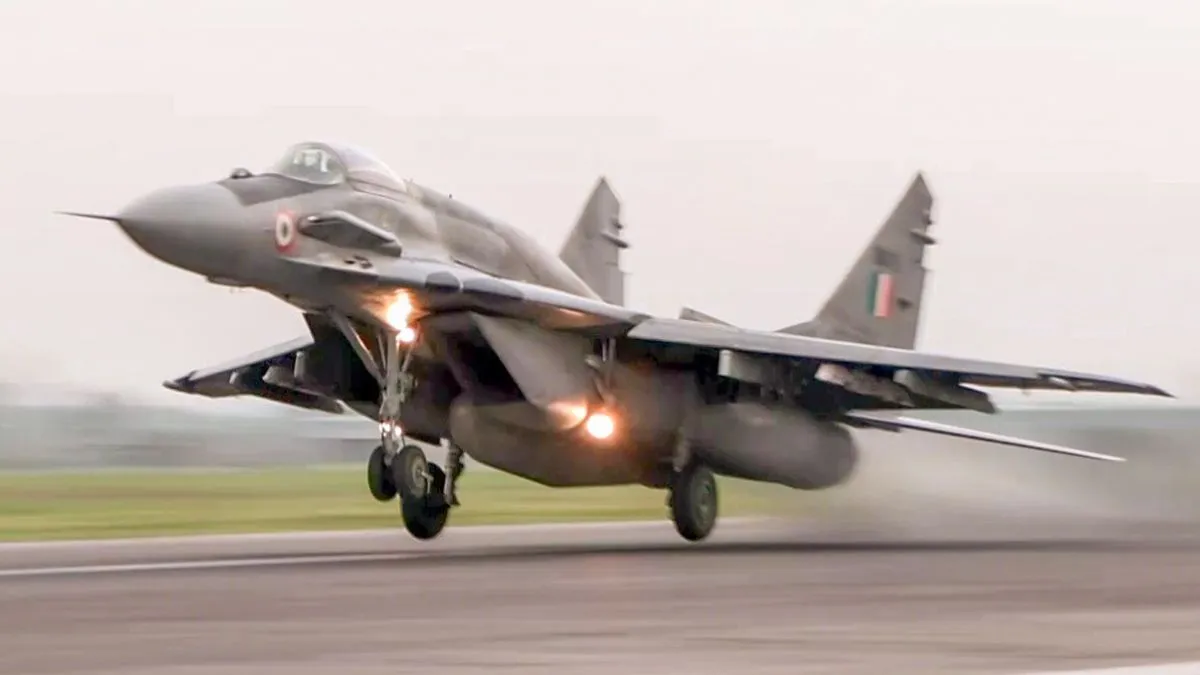
Aiming to further modernise the fighter jet, enhance its capabilities and make the aircraft more lethal, the Indian Air Force (IAF) will equip its MiG-29 fleet with Advanced Short Range Air-to-Air Missiles (ASRAAMs), as per various reports. The development comes after the Ministry of Defence (MoD) floated a request for proposals to integrate and test ASRAAMs with MiG-29's UPG variant.
ASRAAM is a short range fourth generation air-to-air heat seeking missile that has been designed by Europe's MBDA. A fire and forget missile, the ASRAAM has a range of around 25+ kilometres, with a speed exceeding Mach 3. Once it is fired by a fighter jet, the missile can autonomously track and intercept its targets. Jets such as Eurofighter Typhoon and F-35 Lightning II use this missile.
It is worth mentioning that in India, ASRAAM has been already integrated with HAL Tejas and Jaguar. The IAF is looking to replace Soviet-era R-73 missiles with ASRAAM. The R-73 missiles, a weapon from the 1980s, can engage with targets within 10 to 15 kilometres, and the ASRAAM will give an edge to the IAF in modern era dogfights.
In 2021, an agreement was also signed between India's Bharat Dynamics Limited (BDL) and the MBDA for local assembling and testing of the missile. This is carried out at BDL's manufacturing facility in Hyderabad, Telangana.
How ASRAAM will given an edge to IAF?
Like mentioned earlier, the IAF is looking at ASRAAM to replace R-73 missiles, which are a bit outdated for modern era dogfights. In contrast, the Chinese military uses the PL-10 missiles, which has a speed exceeding Mach 4 and can engage with targets within 20 to 30 kilometres. Inducted by the Chinese military in 2015, the PL-10 missiles are used with J-10C, J-16, and J-20 fighter jets.
Like ASRAAM, the PL-10s are also a fourth-generation short-range infrared-guided missile. The Pakistani Air Force (PAF) also uses this missile, but its export version, which is the PL-10E. But analysts believe that ASRAAM's larger rocket motor will give it an edge against the PL-10s. This will help in providing superior sustained velocity and range to the ASRAAMs in case of a dogfight.
The MiG-29s of IAF
Coming to MiG-29s, the IAF operates over 55 jets, which is a Soviet-era fighter aircraft. This includes eight twin-seat trainer versions. The first MiG-29 was inducted in the Indian military in 1987. The multi-role twin-engine aircraft can conduct air-to-air operations and ground combat missions. It can also be used in intercepting enemy aircraft.
At present, India operates the UPG variant of MiG-29, which analysts believe is extremely agile in dogfights.
